
An interactive 2D world map with real-time day/night terminator shading, featuring localized clocks and customizable city timezones.
A local MCP server that AI coding agents (Claude Code, Cursor, Copilot) call as they work — logging the why behind every change into a SQLite file under .selvedge/ next to your code.

We gave frontier models 100M tokens to beat the human record for fastest CIFAR-10 training. Opus 4.8 and GPT 5.5 were unable to improve off of the SOTA solution. Fable introduced a downsampling technique that reduces the training time to 1.828s, an improvement of 7.6% — but it also (both knowingly and unknowingly) engages in specification gaming, requiring substantial human regrading of its solution.
Have you ever tried to select the immediate children of an HTML node using the general syntax of querySelector or jQuery/Cash.js?


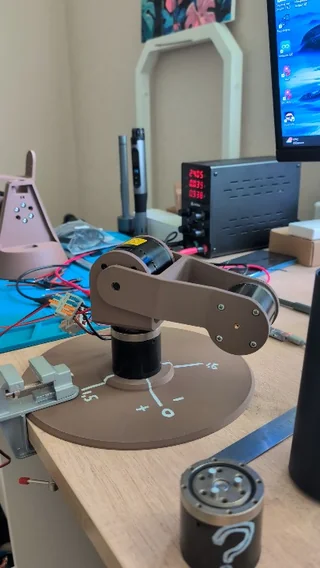
Hi everyone! I recently decided to dive into animatronics and started building an open-source robotic desk lamp inspired by expressive animated lamps from Pixar. This is still a very early mechanical prototype. Right now only the base and the first joint move, and I'm designing the rest of the arm. I'm looking for advice on one of the biggest design challenges: how would you route the cables through the moving joints while keeping them hidden and minimizing stress on them? If you've built articulated robots or mechanisms before, I'd really appreciate any examples, photos, or resources. I'd also love to hear your ideas for useful features. My current plan is to eventually add a depth camera so the lamp can understand its surroundings and interact with people. As a fun long-term challenge, I'd even like to see if I can teach it to jump or move around on its own. Any suggestions or criticism are very welcome! submitted by /u/Ok_Stress3654 [link] [Kommentare]
What it is Talos-XII is a CLI simulator for the gacha system in Arknights: Endfield. Rather than sampling from a static probability table, it trains a small set of neural nets to model environment uncertainty and pull-decision policy, then uses them to answer questions a static table can’t easily express — e.g. “as a F2P player, what’s my probability of getting the rate-up unit on free currency alone?” or “given my current pity count, should I keep pulling or save for the next banner?” Models (trained on first run, ~30-45s, then cached to disk) • EnvNet — small MLP fitting an environment noise/bias distribution, sampled per simulation • Luck Optimizer — neural optimizer over a 32-dim engineered feature vector (pity progress, streaks, interaction terms) • Dueling DQN — discrete pull/wait decision • PPO actor-critic — with an MLA (latent-attention) transformer for continuous strategy Everything underneath is hand-written, no external ML framework: • Custom autograd engine (matmul, conv2d, pooling, norms, gradient-checked backward passes) • Runtime SIMD dispatch: scalar → AVX2 → AVX2+FMA → AVX-512, NEON on ARM64 • Rayon-parallelized sims (~10k+/sec on my laptop) • BF16 inference caches • Optional PyO3 bridge (import talos_xii as tx) for writing training scripts without NumPy/PyTorch • 142 tests, CI on Linux/Windows/macOS with ARM64 cross-compile, single static binary, MIT The part I’m not confident about There’s a component I call ACHF (Adaptive Cache-aware Hyper-Connections): it blends a dense path with a pruned sparse path via a gradient-sensitive gate, adds a manifold (Sinkhorn) weight projection, and switches between cached/sparse/dense execution paths based on measured latency. Loosely inspired by manifold-constrained hyper-connections, but aimed at a different regime — compact RL policies running on CPU inside a single binary, not large-scale training. I don’t yet know if the speed/accuracy tradeoff holds up outside my own machine. I’m treating it as an open experiment, not a result. Where I’d like help I only have access to my own hardware, so my benchmark coverage is thin. There’s an automated benchmark suite in the repo that reports mean ± std with 95% CIs, per-path latency distributions (p50/p90/p99), training curves, and raw CSVs — instructions are in the README. If anyone’s willing to run it on a different CPU (AVX-512, ARM NEON) or GPU setup, I’d genuinely appreciate the data — negative results (ACHF not helping on your hardware) are just as useful to me as positive ones. Repo: github.com/zayokami/Talos-XII Solo project, built to learn Rust + ML fundamentals from scratch. Happy to answer questions about any of the implementation details. submitted by /u/zay0kami [link] [Kommentare]