I'm an 18-year-old independent student from Tunisia. I built and I'm leading an open, from-scratch machine-translation pipeline and parallel corpus for Tunisian Darija. Sharing it for feedback. Why: Tunisian Darija, written in Arabizi (Latin letters + numerals like 3/7/9/5 for Arabic phonemes), has almost no open NLP resources. Existing Arabic tools route it through MSA and mishandle the orthography. To the best of my knowledge there was no open parallel corpus or from-scratch baseline for it. What I built (all open): - Arabizi-aware SentencePiece BPE tokenizer (3/7/9/5 as protected symbols), shared 16k vocab. - ~15.6M-param encoder–decoder Transformer, from scratch (no pretrained LM): transfer-learned from cleaned Moroccan Darija, then fine-tuned on hand-crafted Tunisian pairs. - Full cleaning / training / eval pipeline. Honest results & limitations: v1 BLEU is 3.89 on a small locked test set low, and I'll be upfront about it. The corpus is ~553 hand-crafted pairs, so data is the bottleneck, not architecture. I treat 3.89 as a first honest baseline to beat as the corpus grows. Where I'm taking it: I'm expanding this into a larger, ethically-collected Darija corpus that I curate and validate consent-documented field collection, every pair provenance-tagged. I'm looking for contributors to help grow it, with every contribution reviewed to keep quality and consent standards. Looking for: technical feedback/critique, and anyone interested in contributing data or collaborating on low-resource / dialectal Arabic MT. Links: github repo: https://github.com/Dhiadev-tn/darija-translator Hugging faces dataset: https://huggingface.co/datasets/Dhiadev-tn/tunisian-darija-english hugging faces model: https://huggingface.co/Dhiadev-tn/darija-translator submitted by /u/Dhiadev-tn [link] [Kommentare]

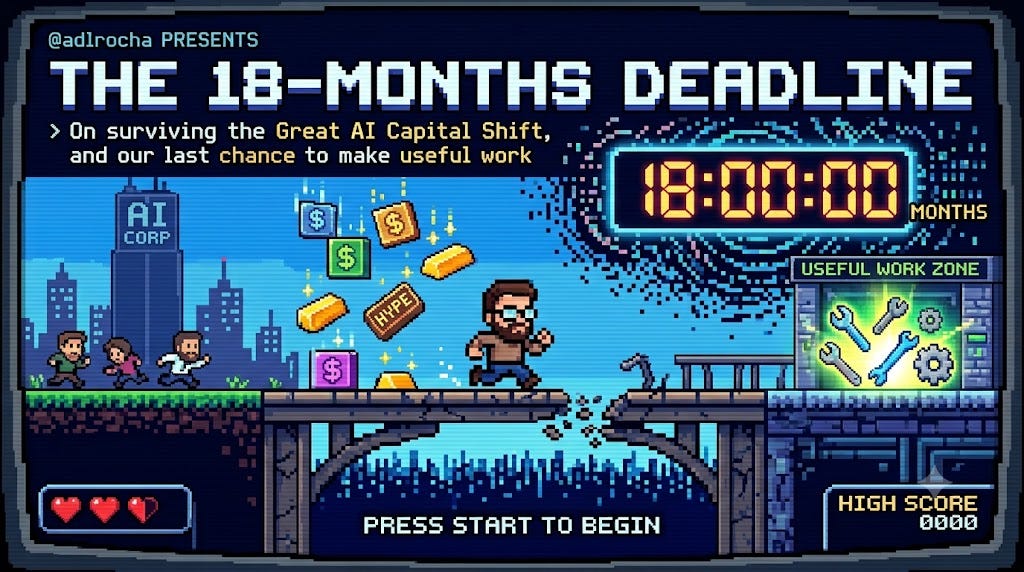
On surviving the Great AI Capital Shift, and our last chance to make useful work


Solar and storage ‘most effective way of addressing energy sustainability, affordability and security’, recent report says
XTZ made a fresh all time low about a week ago, around $0.20, and we're barely above it now. Down 97% from the top, below the floor that held since 2018. Market cap is around a quarter billion, which is basically what the ICO raised in 2017. Nine years, round trip. Crypto is rough everywhere right now, but Tezos has been hit harder than most. For context, I'm a generative artist. I've released work on Tezos and so have a lot of artists I know, some of their best stuff, in small digital editions. So I'm biased, obviously. But I've watched this ecosystem the whole way down, and the gap between what it is and what it's priced at is kind of absurd at this point. The art is the part outsiders don't get. Minting costs pennies here, so artists actually experiment. That's why hic et nunc blew up in 2021 and why fxhash became the home of generative art. Thousands of artists, millions of works. Zancan's Garden, Monoliths gets talked about next to Fidenza. William Mapan dropped Dragons here before Art Blocks made him famous. All that work lives on this chain and nowhere else, and to me the coin is sort of backed by it. Not like gold in a vault, more like real people who stayed through the whole crash because they're here for the work. Meanwhile the chain never stopped. 21 upgrades since 2018, no forks, no downtime, and the 21st just went live on June 30. Blocks are 6 seconds, and a transfer costs a fraction of a cent whether it's $10 or $10k. And there's genuinely interesting stuff ahead. Etherlink (the EVM L2) went from about $1.5M to $82M TVL last year. And Tezos X, the biggest architecture change in the chain's history, has its testnet live and is aiming for mainnet this summer. Bear case is real: maybe none of this flows to XTZ, competitors have more money and attention, NFT volume is a shadow of 2021, and cheap can always get cheaper. If Tezos X slips, nobody will care. I hold a little XTZ, so not financial advice. But for me it comes down to one thing: artists kept releasing their best work here through the entire crash. Chains with actual culture don't just disappear. Or at least I hope not. submitted by /u/Slackluster [link] [Kommentare]





Hello everyone! I recently used Switcher.finance, as I noticed many people recommended it. Unfortunately, after using it to swap some crypto, they received my crypto but refused to send the crypto that I am supposed to get. After contacting them, they keep saying that they sent it to me but stuck at transit. I also did some digging afterwards, and realised that they operate a massive bot farm, using multiple account to promote their services across social media. This is a massive fraud and scam. Until this is resolved, please avoid it at all costs. Based on my experience, I believe this is a massive scam. submitted by /u/JestonT [link] [Kommentare]
I've been trying to come up with a solution for keeping extremely long ai sessions coherent. Sometimes there is too much substance to risk compaction. With so much buzz around diffusion going on it got me thinking, what if we treat the context like a progressive render, blurry>sharp. The practical way to make text "blurry" is compression. This is a "diffusion inspired" system which borrows the coarse-to-fine process, not the formal math. It uses semantic compression so the overall structure of the session stays intact. Read the compressed version first to build an outline. Then read progressively less compressed slices until you're reading small verbatim chunks that give full detail. So you're basically using compression as noise on the input side, then progressively building an output. Each slice is compressed to fit within the context window, so the model only ever needs to read the current slice+input+current output. Tell the model what pass it's on, so it knows whether to write an outline or add detail. The thing I'm actually trying to preserve is what you'd call "non-local information". Think of it as stuff that surfaces when looking at the whole session & doesn't survive fragmented retrieval. Retrieval misses it, compaction deletes it. Both miss what only exists in a holistic view. Here is a visual demonstration to get a general idea of the workflow. https://dev-boz.github.io/diffusive-semantic-compression/demo/architecture-demo.html There is substantial overlap with lots of prior art, Recursive Language Models is one of the closest (source and output on disk, process recursively). I wrote most of this before I found RLM and nearly gave up before realising there was still a small part that was novel. As far as I can tell there's no exact match for this particular implementation. Please let me know if I've missed one. The difference to regular masked diffusion is in changing the length of the input rather than just masking. What seems to be new ground is using compression as noise and a position-aware process. I've done some basic testing. Mainly to see if it was at all viable. Just some basic tests using small models like Qwen2.5 7B. The untrained models show that they can do each part (outline, refine, add detail) but they struggle with the full end-to-end process. There 's occasional end-to-end success, but it's nowhere near reliable. On untrained models it also hasn't yet beaten a cheap dense read of the same document. The main bet is whether position-aware training changes that, I haven't been able to test that yet. I've published all the pre-registered failures, parser bugs I found etc. Another note: the goal is preserving structure and nuance, but the tests so far measure planted facts and split-up numeric composition. Mainly because the experiments needed answers you can actually score. The nuance evaluation is being designed but isn't ready yet. The next step is a small model fine tune to test if position aware training can help. If you have the time to look at the idea, it really needs a prior art check from anyone who knows the diffusion-LM/long-context space. And if anyone wanted to help expand the idea or contribute with compute or collaboration for the fine-tune please do. Here is the repo for the proposal. Links to testing repo and prior art inside. https://github.com/dev-boz/diffusive-semantic-compression submitted by /u/Bravo_Oscar_Zulu [link] [Kommentare]