 R
↗
R
↗
Hello, its been a while! I want to share a bit about the journey behind my challenge of building an Open Source commercial grade humanoid robot totally alone at home. You might remember me from https://www.reddit.com/r/robotics/s/zzx9Yi4tXI. Which was my first iteration! My first iteration was honestly pretty bad. It was a beginner-level design, and many of you probably noticed it looked like something that would never actually work. Looking back, I completely agree. It lacked proper physics, kinematics, finite element analysis, and nowhere near enough structural rigidity to survive a walking gait. Everything looked fine inside a simulator, but reality was different. The robot literally broke during its very first movement. First Iteration on fusion360 looked like, yes you can make fun of it all you want but this baby tought me that you should not give up: https://preview.redd.it/7qbpdbss26dh1.png?width=972&format=png&auto=webp&s=c31061037ed50ece8dbabbd9312db2dbdee4c620 I threw it away. After that, I gave up for a few months. Life got in the way, and I stopped working on the project entirely. Eventually I came back, more motivated than ever. For months I dove deep into control theory, kinematics, mechanics, physics, electronics, energy systems, transmission systems, Actuators, FOC, Torque and robot design. That led to the second iteration of my humanoid. second iteration render on FUSION 360: https://preview.redd.it/obi18ie756dh1.jpg?width=795&format=pjpg&auto=webp&s=df46134a3e419df72d61641d5d695cc04ac9b359 ...which also failed. 😂 Why it failed? The whole design was just bad, i wasn't using the motors case for anything just covering everything up instead of using the motors to hold stuff together and better like real humanoids do. And many other things that i will make a video on. gen2 fluid teleoperation The second version was a huge improvement. Teleoperation was smooth, I had the software stack working well, and I was even able to experiment with reinforcement learning policies and software in depth. But mechanically, I knew it was still far from where it needed to be. Also Hardware. I had to add Robstride 04 and 03 to my actuators for required torque. For economic reasons i made the biggest mistake in my life that was selling the NVIDIA JETSON AGX ORIN. Anyways i got a JETSON ORIN NX 16GB as a replacement. So I scrapped that one too. (burning money yay) Now I'm building what I consider my latest iteration, and I'm continuously improving it before machining the final parts. My goal is for this robot to run, jump, and eventually do whatever I can teach it to do. I am heavily focusing on manipulation btw. This time the design process is completely different. I've incorporated finite element analysis (FEA) for every part, proper mechanical engineering principles, design for manufacturing (DFM), and many of the concepts used in modern commercial humanoid robots. Thanks ARXIV for many papers. https://preview.redd.it/34e3quus56dh1.jpg?width=851&format=pjpg&auto=webp&s=c2fc7eeae553f11ffae6176221c969f8e506de2f https://preview.redd.it/or3qjrno56dh1.jpg?width=881&format=pjpg&auto=webp&s=169be6140f54de577e7fb93c9adccef497d6e4f2 https://preview.redd.it/6ccn0qap56dh1.jpg?width=642&format=pjpg&auto=webp&s=1459308f1b2bf675cf6e4ee9df311b09175fd12f This was before i understood that a screen on a head of a robot that will be falling is not a really smart idea. Latest Iteration (WIP): https://preview.redd.it/znp4kfki56dh1.jpg?width=784&format=pjpg&auto=webp&s=ab0352498c8ef68ec840508d03b49831e0ffe669 https://preview.redd.it/lo12fc8k56dh1.jpg?width=1018&format=pjpg&auto=webp&s=90c0bc6451bdfca5c3cb8570700e03cf0bae0d0d STILL IMPROVING. and Yes this is not just a CAD Humanoid. I have burned around 20kg- 25kg of PETG,PA-CF and some aluminum parts trying to make it happen :) i will be posting new iteration teleoperation and manipulation videos soon. BTW One challenge I didn't expect was the battery. Lithium batteries are heavily restricted for import in my country Honduras, so I had to design and build my own DIY Li-ion (please do not use LIPO on humanoids that walk) battery pack from scratch. Which i have a full video on how to do it for a humanoid robot specific needs, i am sure this might help atleast someone. I've failed more times than I can count. But every failure taught me something. I'm going to keep building until this robot walks and eventually reaches the level of commercial humanoid robots. I AM HEAVILY FOCUSING ON MANIPULATION. And yes... It will be OPEN SOURCE. I'll continue posting updates here and on X, and I'm also working on a website where I'll publish in-depth tutorials explaining how humanoid robots work (FROM MY LEARNING) and how you can build one from scratch. Thanks to everyone who's been following the project. And also thanks to everyone that has made fun of me too! I have been building this totally alone. for 110 working days exactly. I have 110 days of videos of the process. With Honor, Carlos Abrahan Lopez :D https://x.com/carloslopeezr submitted by /u/Medical_Skill_1020 [link] [Kommentare]
R
↗
I’ve been looking at cheaper ways to test robotics projects properly before putting anything onto real hardware. The clean version in my head is something like. develop locally > run in Isaac Sim, Gazebo or MuJoCo > do the heavier training/eval somewhere with more GPU > test on the real robot But after looking through some forums, the real flow seems a lot messier, Isaac Lab install and version conflicts, Docker setups breaking, headless rendering hanging, cloud GPUs running out of memory, or the sim using the wrong GPU entirely. What does your actual setup look like, including the slightly cursed scripts, pinned environments, machine images, or other workarounds that have somehow become part of the normal process? submitted by /u/michaelmanleyhypley [link] [Kommentare]
 R
↗
R
↗
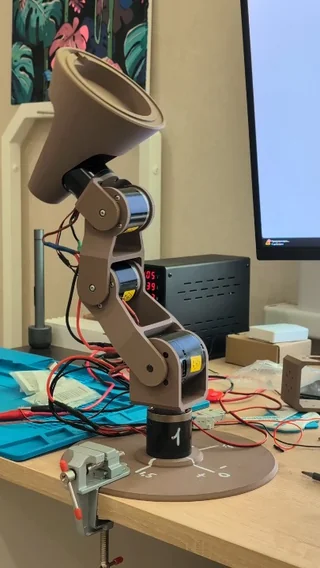
This is the first movement test with the assembled prototype. The motion is still rough and the wiring is currently a complete mess, but all the connected joints are finally moving — so naturally, I made it dance. Next: smoother trajectories, control tuning, and proper cable management. submitted by /u/Ok_Stress3654 [link] [Kommentare]
R
↗
Does anybody here have the files or can create an 3d printable 3dof stewart platform powered by 3 sg90 micro servo motors and run by an arduino? While I am currently studying to be a robotics engineer, I have only completed one year and do not have the knowledge to design, built, nor program a platform. I've looked online but all of the ones I found are too complex and/or require a lot of components. I did find one however, the design had the arms and the top platform be one large print, which made it difficult to print on my 3d printer. It also had extra designs on it just for decoration, which would be a waste of filament. I just want a small simple one that the arms, top platform, and bottom platform can all be printed separately. It just needs to be big enough to fit a lego speed champions car, while also just being powered by the micro servos and run by an arduino uno. submitted by /u/Ok_Bus_3393 [link] [Kommentare]
 R
↗
R
↗
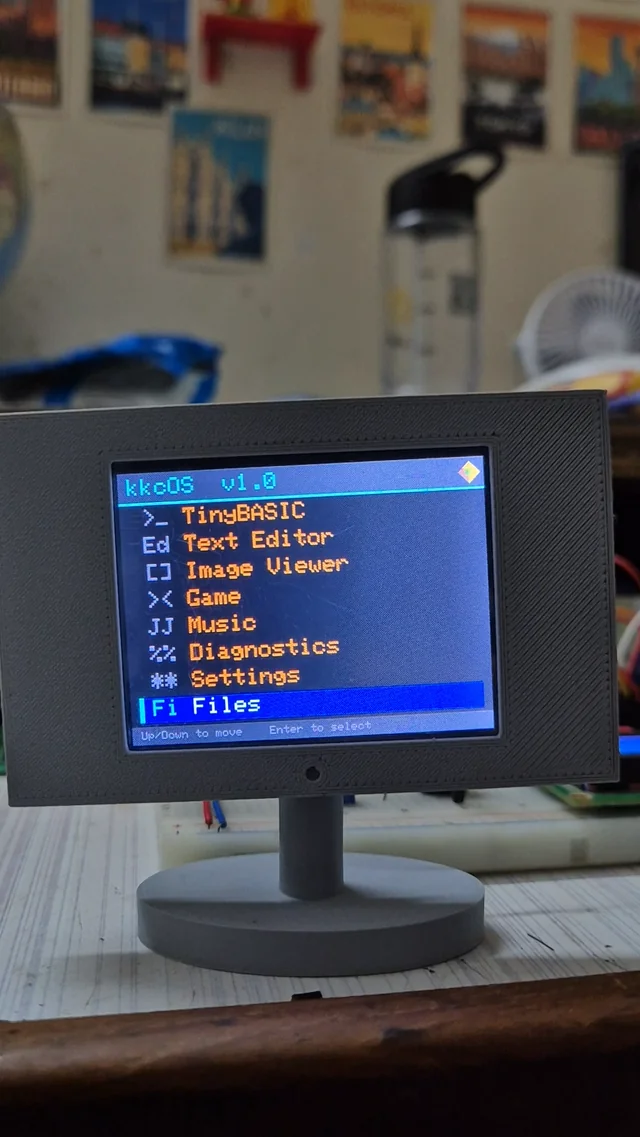
I made this homebrew computer with 1284p and VGA interface (currently on a TFT). Here I showcase the software part where I made a file storage system on its EEPROM. submitted by /u/Grand-Station-6886 [link] [Kommentare]
R
↗
Bit of a long shot, but is there anyone here who actually worked on data collection for humanoid robots? I have a high level understanding of the process and required data, but don’t understand the details. I’m trying to figure out the real workflow, not just what’s described in papers. Looking for someone who’s done it in practice and wouldn’t mind answering a few questions. submitted by /u/Farseer_W [link] [Kommentare]
 R
↗
R
↗
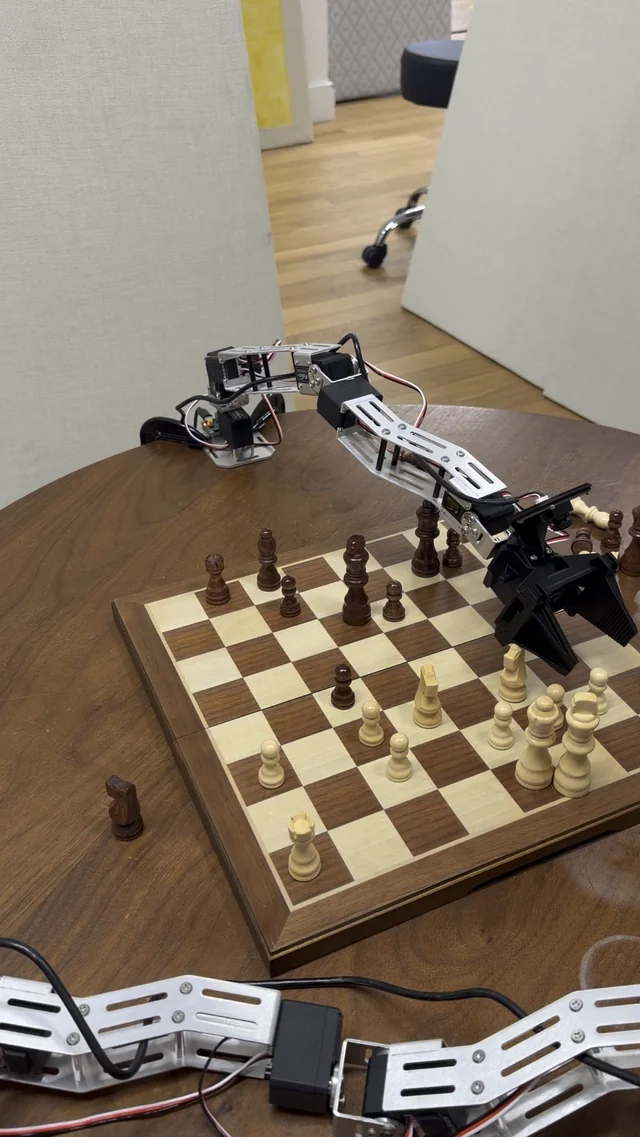
From a live stream yesterday where I let people remote control a pair of robot arms to play chess! There’s always one troll… submitted by /u/earthtojek [link] [Kommentare]
 R
↗
R
↗
In need of a micro-electronics/precision soldering specialist We need help repairing our "Loona" companion robot, which is a vital therapy bot for my husband, a Vietnam Veteran. The Issue: After a recent manufacturer repair, she is rolling backward constantly. A wire on the circuit board likely needs to be switched/resoldered. Skill Needed: High-level skill in mini/micro-soldering and delicate electronics. Why We Are Repairing: We strictly believe in repairing our items rather than throwing them away, which is what the company wants us do. That mensd our lifetime of memories go into the trash too, Please message me if you have the tools and experience to tackle a precise electronic repair. Thank you! https://www.youtube.com/shorts/froFLicMXo4 submitted by /u/wendisigo [link] [Kommentare]
 R
↗
R
↗
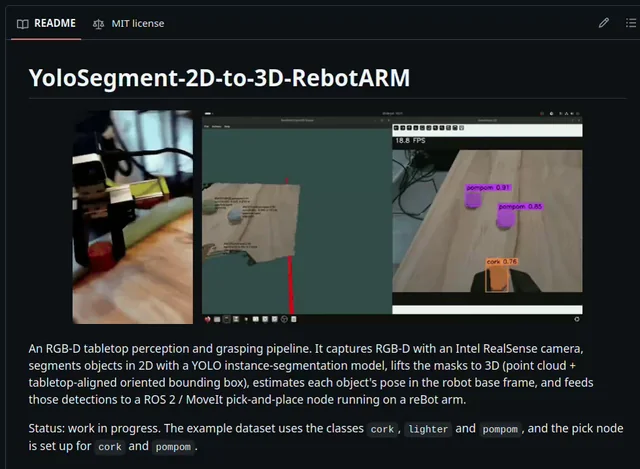
Some of you asked for the full pipeline code, so here it is. https://github.com/danieldoradotalaveron-rb/YoloSegment-2D-to-3D-RebotARM_Pick_and_Place submitted by /u/nettrotten [link] [Kommentare]
 R
↗
R
↗
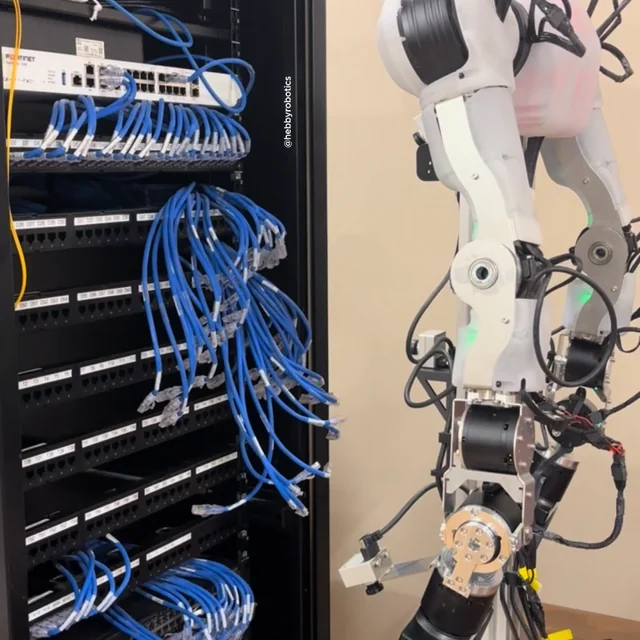
The scarce thing in a data center is not manpower, but instinct that only comes from years on the floor. Most robotics companies are focused on robots as a productivity amplifiers: 24/7 uptime, five days of work done in two. Few are focused on the potential of robots to change how people work altogether. We wanted to show what it looks like to rethink human-robot collaboration, using AI so a shrinking pool of experts can meet the increasing demands of future infrastructure. The obvious thing to automate is the rote physical work that consumes an expert's attention without needing critical judgment. Cabling tasks are the most common example of this. They're necessary when setting up any rack, but usually one-off, and labor is readily available to address this need. We think this is a good place to start, but the least interesting place to change how people work. Standard operating procedures (SOPs) are how critical infrastructure stays stable, and they're the work that scales worst. The video shows one common procedure: clearing the cables a technician leaves behind after testing, and reconciling the rack to a stable state for the next test. A robot that runs SOPs the same way every time, never skipping a step, keeps the system in a known, predictable state. This reduces the cognitive overhead on experts so they can solve harder problems. What most excites us is robots guiding where an expert's attention should go. In the video, the robot checks the switches with a thermal camera, then makes a judgment on whether the increase in temperature is a real problem or a spurious reading. This instinct requires an expert to synthesize all available background context and accumulated lessons from past failures. This is where we want to double down, and show how human-robot collaboration places scarce expert attention exactly where it matters. More to come. submitted by /u/kuaythrone [link] [Kommentare]
R
↗
I have some 35-48v 500w bldc motors (e-skateboard motors) that I want to use for my robotics projects. They are much higher power than the small gimbal motors I typically use with Simple FOC drivers, so I'm wondering what's the typical setup for these high power motors. Power supply: better to use a big lipo battery or a wall power supply? From what I've seen, batteries can provide more current but are kind of dangerous? Controller: I want to use an FOC drive to precisely control position. the motor has an encoder built-in. I was looking into the ST G431 driver, but I'm not sure if it can handle so much power. I'm quite new in BLDC control and high power electronics, any advice or info would be really helpful! submitted by /u/the_relentless_epee [link] [Kommentare]