 S
↗
S
↗
Ask, vote, share. Polls, slider opinions, and clickable image votes from real people around the world.
 X
↗
X
↗
and how i accidentally got into hardware development
 T
↗
T
↗
From the highly eclectic blog of Mark Dominus
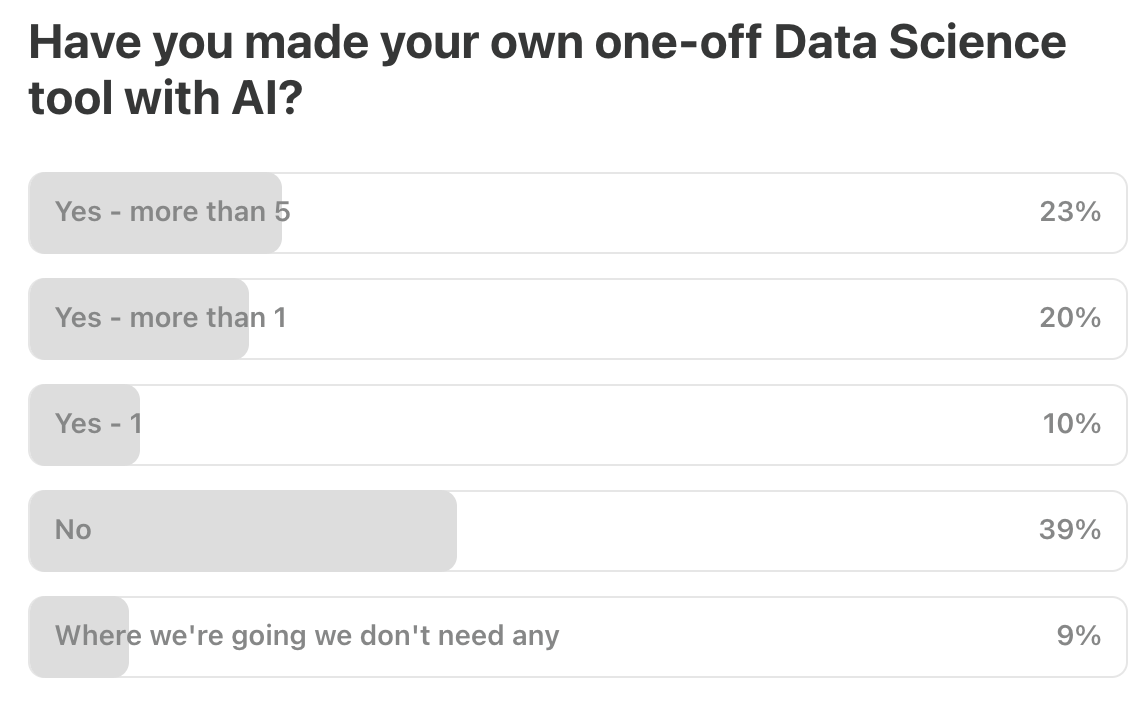 D
↗
D
↗
Curated news, articles and jobs related to Data Science, AI, & Machine Learning
 S
↗
S
↗
Yesterday I posted this on Mastodon (post link) I'm building a new habit here on Mastodon: instead of liking, I try to reply to at least 3 posts, especially...
R
↗
So we're using an ESP32S with a TJA1050 transceiver and basically we're using this setup to operate a rover using ROS2 Humble and MAVLink commands, so it has a lot of modules like actuators, PDB, mini-arm, and etc connected through a CAN bus network. Now the issue is that we will be using multiple BLDCs for our rover's arm and these motors continuously send out updates (or heartbeats or sth) so using these BLDCs in the same network seems like the MCU will lag or slow down and just be downright ineffective. So is there any way to isolate the motors to a different network or CAN line? I was thinking of adding another MCU on top of the ESP32 to only handle the motors but is there an alternative to this approach, preferably one without adding more hardware? submitted by /u/Sadhya [link] [Kommentare]
 X
↗
X
↗
I’ve been working on speeding up AVX-512 vertex decoding in meshoptimizer recently; in the process I stumbled upon two optimizations that I did not end up using but I thought they might be fun to write about! The optimizations that actually made it in require some higher level background / explanations that will have to wait until another day :)
U
↗
An open educational evercookie lab showing how websites can persistently re-identify a browser across storage vectors.
S
↗
Community-driven AI-powered research directory of global startup ventures.
 T
↗
T
↗
In the coming weeks, Apple will move anonymously generated emails addresses to a different domain.
 T
↗
T
↗
no, it did not cause the flooding in Dubai
 O
↗
O
↗
Otty is a blazing-fast, GPU-accelerated terminal emulator.
 X
↗
X
↗
Audited OpenAI financials viewed by Ed Zitron and verified by the Financial Times show $13.07B in 2025 revenue, $34B in costs, and a $38.5B loss attributable to OpenAI.