So we're using an ESP32S with a TJA1050 transceiver and basically we're using this setup to operate a rover using ROS2 Humble and MAVLink commands, so it has a lot of modules like actuators, PDB, mini-arm, and etc connected through a CAN bus network. Now the issue is that we will be using multiple BLDCs for our rover's arm and these motors continuously send out updates (or heartbeats or sth) so using these BLDCs in the same network seems like the MCU will lag or slow down and just be downright ineffective. So is there any way to isolate the motors to a different network or CAN line? I was thinking of adding another MCU on top of the ESP32 to only handle the motors but is there an alternative to this approach, preferably one without adding more hardware? submitted by /u/Sadhya [link] [Kommentare]
Hello Folks, we start our discussion on Lecture 10 of Probabilistic Machine Learning, now starting with Probability Multivariate Models. Univariate models are toy cases, in real life, ML models are multivariate. To understand dependence of more than one variables on each other we study ideas as Covariance, Correlations, we delve ourselves into the interesting concept of Simpson’s Paradox, with an example. We define the Multivariate Gaussian distribution, understand the level sets(curves) that we see in our computers while plotting, and gain insights into the geometric shape of the Gaussian density by using “Mahalanobis distance”. Mathematical foundations are extremely important, in that they make an ML engineer, data scientist stand out. These concepts are becoming so ubiquitous today, that folks from all backgrounds of engineering are interested in the mathematics behind these algorithms. I hope the learning community finds it helpful, and suggestions are always welcomed. These are FREE lectures. Link in comments submitted by /u/Negative_War_65 [link] [Kommentare]
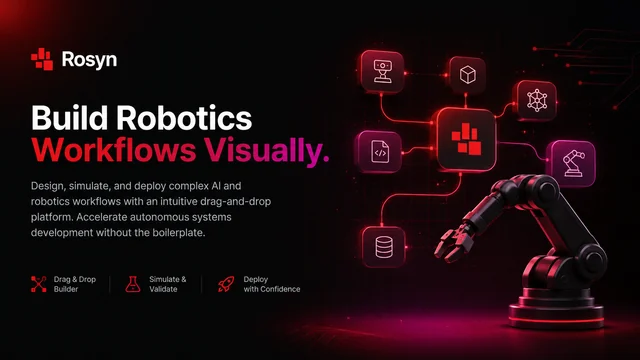
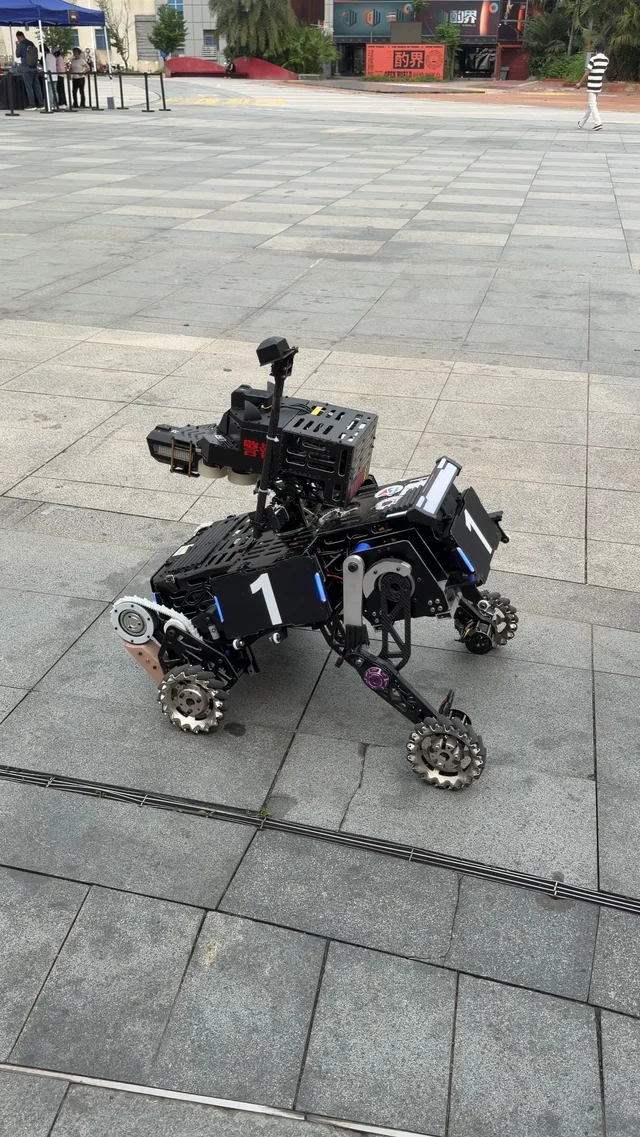
The robot behaved long enough for us to record this video. This robot was developed for the RoboMaster competition and powered by us. submitted by /u/Cubemars [link] [Kommentare]
I have a main paper in ACL and a workshop paper in ICML. I'm looking for jobs in U.S. as a graduating student. Would it be worth going to ICML after ACL presentation such that I have more chance to network? ACL is in San Diego and ICML is in Korea, if it changes things. submitted by /u/Appropriate_Willow27 [link] [Kommentare]
From Eren Chen on 𝕏: https://x.com/ErenChenAI/status/2065565071816741000 submitted by /u/Nunki08 [link] [Kommentare]
Hi everyone, I built a small open-source web simulation of a double pendulum to demonstrate chaotic motion and sensitivity to initial conditions. Repo: https://github.com/mohammadijoo/Double-Pendulum-Chaos-Mechanism The goal is educational: a browser-based demo that lets students or beginners see how a simple mechanical system can produce complex, chaotic behavior. It is written with HTML, CSS, and JavaScript, so it can run without installing a physics engine. I would appreciate feedback on: whether the visualization explains chaotic behavior clearly whether the equations / numerical integration could be improved what parameters or plots would make the simulator more useful for control, robotics, or physics students whether adding energy plots, phase portraits, or Lyapunov-style divergence visualization would be useful I’m sharing it mainly for technical feedback, not as a commercial project. submitted by /u/abolfazl1363 [link] [Kommentare]
ex-Huggingface pre-training team just announce a new library create for robotics data refinment! It supports ingestion of all robotics formats (Parquet, HDF5, MCAP, Zarr, RLDS, and LeRobot), as well as the common processing flows like visual hand-tracking, subtask annotations and reward model running submitted by /u/Other_Housing8453 [link] [Kommentare]
Submitted a short theoretical paper to TMLR and got desk-rejected with "does not meet our editorial standards or allow us to assess claims and evidence" and "not a suitable venue for this work." Is this a common outcome for first submissions? Curious what typically drives this kind of rejection, scope mismatch, insufficient experiments, or something else. Not looking to appeal, just trying to understand the bar so I don't waste time on the wrong venue next time. Anyone else gotten this and figured out what the actual issue was? submitted by /u/observer678 [link] [Kommentare]
Hello everyone, tomorrow I have a meeting with my dissertation supervisor and I wanted to have a dissertation proposal ready. Initially, I moved forward with the following proposal: "Interpreting the Routing Dynamics of Capsule Networks for Explainable AI." My first approach to this topic was to study the paper "Transforming autoencoders," which is the first paper about capsule networks. Next, I did a search on the state of the art of transforming autoencoders and only found 2 papers since 2011. I think I should take advantage of the work I have developed so far on transforming autoencoders and write a dissertation about them. If anyone could take a look at the readme and tell me what they think, I would appreciate it. What do you think? I should suggest another topic involving transforming autoencoders. There isn't much scientific research on them. The professor is approachable, and if I present a good new topic, he'll let me change it! submitted by /u/Future-Persimmon5393 [link] [Kommentare]
Just a machine that made you stop and think: "wow...somebody put a ridiculous amount of engineering into this". Could be anything.sometimes the most impressive machines are the ones that make incredibly difficult things look effortless. submitted by /u/hannimalki [link] [Kommentare]
Hey All, I am currently working on ASR models, and I have gathered some recent literature. From my literature search, it seems like the ASR models are getting more and more powerful due to two main things. Because pseudo-labelled data is growing, supervised models are rising rapidly. Whisper-large-v3 has been trained on 5M hours of weakly supervised data, and Nvidia Parakeet v3 has been trained on 660k hours of labelled data (open-sourced). Funny enough, Nvidia Parakeet v3 actually beats Whisper-large-v3 on almost every benchmark, even though it has a smaller model size and smaller data scale. So clearly, scale is not everything. New architectures are on the rise; We used to have self-supervised + CTC to solve the ASR task, but now it seems like Transducer, and Token-Duration-Transducers are taking off. As well as attention encoder-decoder architectures (Qwen) that are all trained in a supervised manner. Now, given that the labelled data is very huge, and the new architectures are coming up, are we saying bye to the self-supervised learning approaches like Data2Vec2.0, WavLM, etc., for ASR, and will we only use them for general-purpose speech tasks? This is actually not similar to how computer vision operates now. Dinov3 is a self-supervised approach that is extremely performant in segmentation, classification, depth estimation etc but I do not see this in the speech domain now. ASR is dominated by these huge supervised architectures (which is a dense-prediction task), as well as emotion recognition, diarization, and speech seperation are also all dominated by the supervised approaches. Do you think we will have our Dino moment with a new self-supervised architecture? Or supervised learning is the way to go? How would these methods actually perform if we trained a self-supervised model on these huge datasets? submitted by /u/ComprehensiveTop3297 [link] [Kommentare]

I would love feedback on the data quality and the 3D renderings specifically, because the renderings were the hardest part about getting this to work. Basically, Chaveta is a agentic dataset curation tool that allows you to submit a prompt and instantly receive a dataset for: - World models - Robotics (JSON Trajectories) - LLM Fine Tuning - Geological - Synthetic Tool Calling / LLM flows - Time series For the robotics path, you can also download to MCAP or simple JSON and we have a render tab that allows you to edit joints visually + we provide copy/paste scripts for importing the dataset into things like Transformers. Let me know what you think. submitted by /u/ComradePampers [link] [Kommentare]
Hi r/MachineLearning, Wanted to share something I'm excited about. I’ve been fascinated by AlphaEvolve and its results for more than a year now, but using open source frameworks seems overwhelming because of the high costs. I can’t really afford hundreds of Claude Opus calls every time I want to run it. I want to be able to try it out many times and all sorts of unique domains. What if it was possible for AlphaEvolve to be much more affordable while getting a better performance? Over the last six months or so, I’ve been working on LEVI, an open source AlphaEvolve-like system that can outperform existing open source frameworks at a fraction of the cost (upto 35x cheaper!). It can also run on Claude Code or Codex, making it even more accessible (I've mostly been using it with a QWEN-30B). LEVI comes in two flavors where I felt it’ll make the most difference: Code Optimization, and Prompt Optimization (sorry math, you got a less direct path; workable through the code route). The core thesis behind LEVI is that with the right search architecture, smaller models can substitute for or outperform larger ones. This means it’s much more economical to rely on smaller models for most of the work. That’s the entire takeaway. Making this work in practice is a different problem, but if you forget everything else from this post this is the only message I think I’m really trying to convey here. LEVI does it in three ways: 1) Invest in solution diversity from the start and ensure its maintained. We don’t want to converge to the same solution, especially with smaller models in the mix, and rely on large models to pull us out of the basin. 2) Use smarter routing across larger and smaller models (i.e. most mutations don’t require a Claude Opus X) 3) For prompt optimization not every rollout is as important. Build a proxy subset to approximate. I’ve tried LEVI on systems problems (like MoE scheduling or database transaction scheduling) and found that LEVI outperforms existing frameworks on almost every problem I threw at it while consistently using a smaller budget (unto 7x cheaper). For prompt optimization, across problems like IFBench and HotSpotQA, LEVI reaches a similar or better score as GEPA while using less than half the rollouts! Happy to answer any questions or take any suggestions! If there are unexpected or niche domains where this can be applied, I would love to hear. Technical Blog: https://ttanv.github.io/levi/ GitHub: https://github.com/ttanv/levi submitted by /u/Longjumping-Music638 [link] [Kommentare]
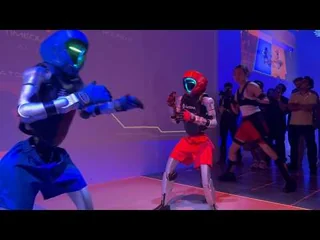
During NY Techweek, Arc League, presented by Katena, demonstrated the teleoperated suit with robot boxing and dancing. I know there has been a lot of humanoid hype, but as a roboticist watching it up close, I'm still quite amazed how far we have come. submitted by /u/OkThought8642 [link] [Kommentare]