
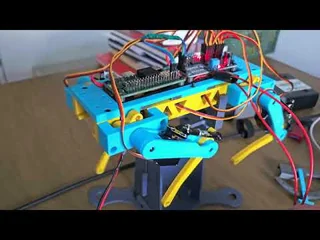
It seems that everyone around is building robots these days. Overcoming my laziness, I decided to also build my own small robodog, and I'm sharing the result of this project, which took me quite a bit of trials and errors during long evenings. All parts were designed from scratch. Everything that is plastic was 3D printed. Everything that isn't plastic was sourced from generic stores - there are no custom CNC orders here. The main SBC is a Radxa Zero 3W running Ubuntu 24.04 with ROS 2 Jazzy. The servos are powered by a Sunflower PCA9685 driver board. There are two separate power rails: 5V for the Radxa and 6-7V for the servos. The trotting gait is shown in the video. I'm currently using an inverse kinematics algorithm, but my long-term plans include Tensor Lite and trained neural networks for skills. The project is still ongoing - I have so many things to try and learn. But it is solid enough as a good foundation for future iterations. submitted by /u/Consistent_Chance_97 [link] [Kommentare]

Digital immortality is a myth, what can we do about it?

...also don't tell lies. But I'm getting ahead of myself already. I keep running into people online who openly say that they use AI to do their writing for t


VaultSort is the all-in-one solution for Mac users who want to take control of their digital files with military-grade security and intelligent organization.

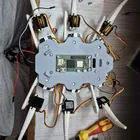
Everything works fine, just for these maze of cables, I have run out of ideas, how do I actually get rid of the mess? I am using 2 16 channel servo drivers. all 18 (plus 2 for camera) are connected to those 2. I am using a buck converter on top and a 4200 MAH battery. The raspberry pi relays all info to my laptop and it control the motion additionally i also need space to put an imu sensor over it. Help !! submitted by /u/Grand-Station-6886 [link] [Kommentare]
I've been working through the internals of LLM inference and writing up what I learn as an open, in-progress handbook. Just wrapped another chapter on GPU execution and memory internals: why a GPU sits mostly idle during inference, how the memory hierarchy gates throughput, and where the real bottlenecks live. Added mermaid diagrams for the architecture pieces so the flow is easier to follow than a wall of text. It's a personal learning project, still growing chapter by chapter. I'd value feedback or corrections from anyone who's run inference in production, where my mental model breaks down is exactly what I want to find. Issues and PRs welcome. github.com/harshuljain13/llm-inference-at-scale submitted by /u/YouFirst295 [link] [Kommentare]




Clear — An intent-first agentic development language. Write readable specifications. AI agents turn them into real software.