 R
↗
R
↗
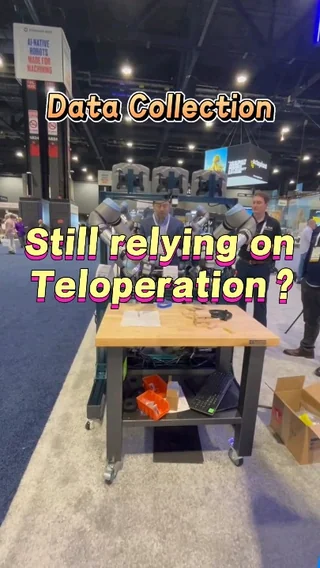
I’m attending the Automate Show in Chicago and tested the teleoperation solution on display at the Universal Robots booth. When it comes to physical intelligence, data collection is a critical component. Today the industry uses a variety of acquisition methods including VR systems and optical motion capture. Teleoperation remains a highly practical approach for data collection thanks to its reliability and intuitiveness. What do you think? submitted by /u/No_Challenge_3410 [link] [Kommentare]
R
↗
R
↗
Do you guys get a miccai grants result? I do not receive any mail. Don’t I accept? submitted by /u/CrazyIndependent7436 [link] [Kommentare]
R
↗
not sure if this is the right flair 😕 I had put this post up on r/gradadmissions but i feel like I'd get a better demographic that knows the field better here submitted by /u/Proud_Imagination_94 [link] [Kommentare]
 R
↗
R
↗
I designed and built this 16-DOF humanoid robot using low-cost servos and fully 3D-printed parts. I’m currently working on the bipedal walking system and developing the locomotion algorithms based on the robot’s forward and inverse kinematics. I’ll be sharing more updates soon! Here’s a short video showing the development process so far: https://vt.tiktok.com/ZSCJJAqr6/ submitted by /u/RoboDIYer [link] [Kommentare]
R
↗
With the release of meta-reviews, ECCV sent out a google form for dissatisfied authors to submit an appeal for the following reasons: Policy errors, e.g., reviewers or Area Chairs applied a policy that does not exist, or reviewers or Area Chairs applied policies that are not applicable for the contribution type of the paper; Clerical errors, e.g., it is clear from the meta-review that an Area Chair intended to accept a paper but the paper was rejected; and Obvious and major misunderstandings on the side of the reviewers or Area Chairs (historically, these are extremely rare). Is anyone considering submitting an appeal? I was rejected with 6/4/3 final scores on criteria that policy and AC/Reviewer guidelines explicitly state my contribution type should not be penalized for. Also, according to their policies, if they were to use the criteria in their decision, they have to explicitly disagree with the declared contribution type and state so in the meta review (all three reviewers agreed with the declared contribution type and the AC does not mention changing the paper's type.) submitted by /u/Muted-Ad4511 [link] [Kommentare]
 R
↗
R
↗
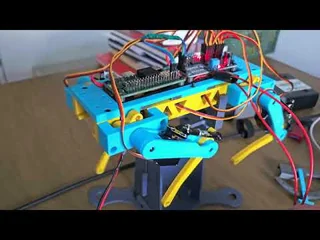
It seems that everyone around is building robots these days. Overcoming my laziness, I decided to also build my own small robodog, and I'm sharing the result of this project, which took me quite a bit of trials and errors during long evenings. All parts were designed from scratch. Everything that is plastic was 3D printed. Everything that isn't plastic was sourced from generic stores - there are no custom CNC orders here. The main SBC is a Radxa Zero 3W running Ubuntu 24.04 with ROS 2 Jazzy. The servos are powered by a Sunflower PCA9685 driver board. There are two separate power rails: 5V for the Radxa and 6-7V for the servos. The trotting gait is shown in the video. I'm currently using an inverse kinematics algorithm, but my long-term plans include Tensor Lite and trained neural networks for skills. The project is still ongoing - I have so many things to try and learn. But it is solid enough as a good foundation for future iterations. submitted by /u/Consistent_Chance_97 [link] [Kommentare]
 R
↗
R
↗
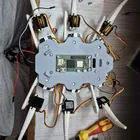
Everything works fine, just for these maze of cables, I have run out of ideas, how do I actually get rid of the mess? I am using 2 16 channel servo drivers. all 18 (plus 2 for camera) are connected to those 2. I am using a buck converter on top and a 4200 MAH battery. The raspberry pi relays all info to my laptop and it control the motion additionally i also need space to put an imu sensor over it. Help !! submitted by /u/Grand-Station-6886 [link] [Kommentare]
R
↗
I've been working through the internals of LLM inference and writing up what I learn as an open, in-progress handbook. Just wrapped another chapter on GPU execution and memory internals: why a GPU sits mostly idle during inference, how the memory hierarchy gates throughput, and where the real bottlenecks live. Added mermaid diagrams for the architecture pieces so the flow is easier to follow than a wall of text. It's a personal learning project, still growing chapter by chapter. I'd value feedback or corrections from anyone who's run inference in production, where my mental model breaks down is exactly what I want to find. Issues and PRs welcome. github.com/harshuljain13/llm-inference-at-scale submitted by /u/YouFirst295 [link] [Kommentare]
 R
↗
R
↗
R
↗
R
↗
So we're using an ESP32S with a TJA1050 transceiver and basically we're using this setup to operate a rover using ROS2 Humble and MAVLink commands, so it has a lot of modules like actuators, PDB, mini-arm, and etc connected through a CAN bus network. Now the issue is that we will be using multiple BLDCs for our rover's arm and these motors continuously send out updates (or heartbeats or sth) so using these BLDCs in the same network seems like the MCU will lag or slow down and just be downright ineffective. So is there any way to isolate the motors to a different network or CAN line? I was thinking of adding another MCU on top of the ESP32 to only handle the motors but is there an alternative to this approach, preferably one without adding more hardware? submitted by /u/Sadhya [link] [Kommentare]
 R
↗
R
↗
Hello Folks, we start our discussion on Lecture 10 of Probabilistic Machine Learning, now starting with Probability Multivariate Models. Univariate models are toy cases, in real life, ML models are multivariate. To understand dependence of more than one variables on each other we study ideas as Covariance, Correlations, we delve ourselves into the interesting concept of Simpson’s Paradox, with an example. We define the Multivariate Gaussian distribution, understand the level sets(curves) that we see in our computers while plotting, and gain insights into the geometric shape of the Gaussian density by using “Mahalanobis distance”. Mathematical foundations are extremely important, in that they make an ML engineer, data scientist stand out. These concepts are becoming so ubiquitous today, that folks from all backgrounds of engineering are interested in the mathematics behind these algorithms. I hope the learning community finds it helpful, and suggestions are always welcomed. These are FREE lectures. Link in comments submitted by /u/Negative_War_65 [link] [Kommentare]
 R
↗
R
↗
 R
↗
R
↗
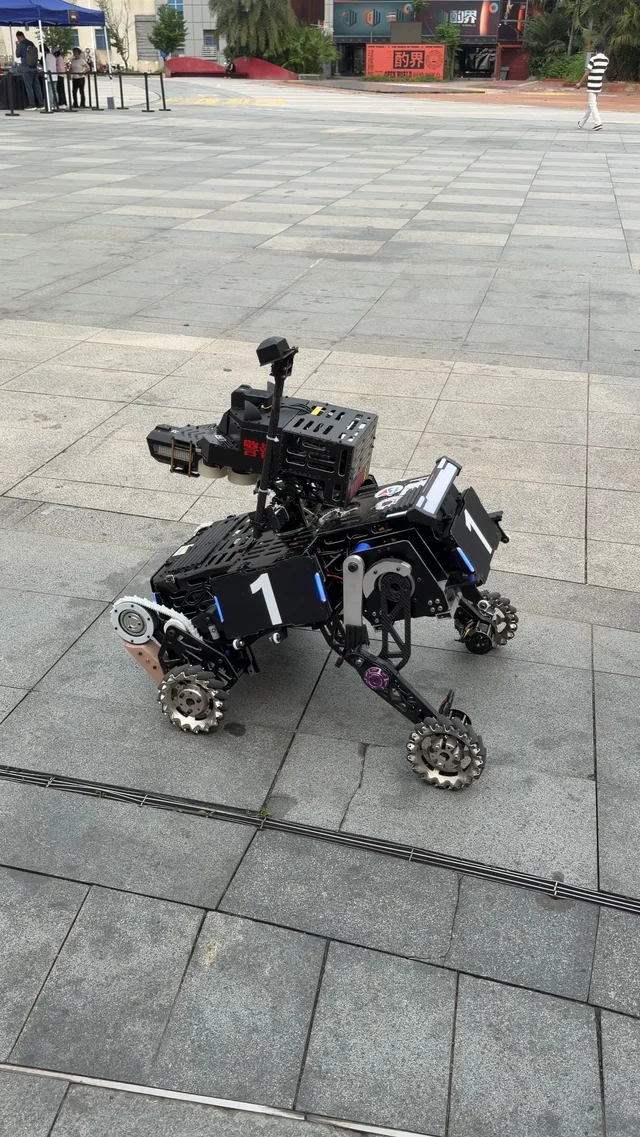
The robot behaved long enough for us to record this video. This robot was developed for the RoboMaster competition and powered by us. submitted by /u/Cubemars [link] [Kommentare]
R
↗
I have a main paper in ACL and a workshop paper in ICML. I'm looking for jobs in U.S. as a graduating student. Would it be worth going to ICML after ACL presentation such that I have more chance to network? ACL is in San Diego and ICML is in Korea, if it changes things. submitted by /u/Appropriate_Willow27 [link] [Kommentare]