 R
↗
R
↗
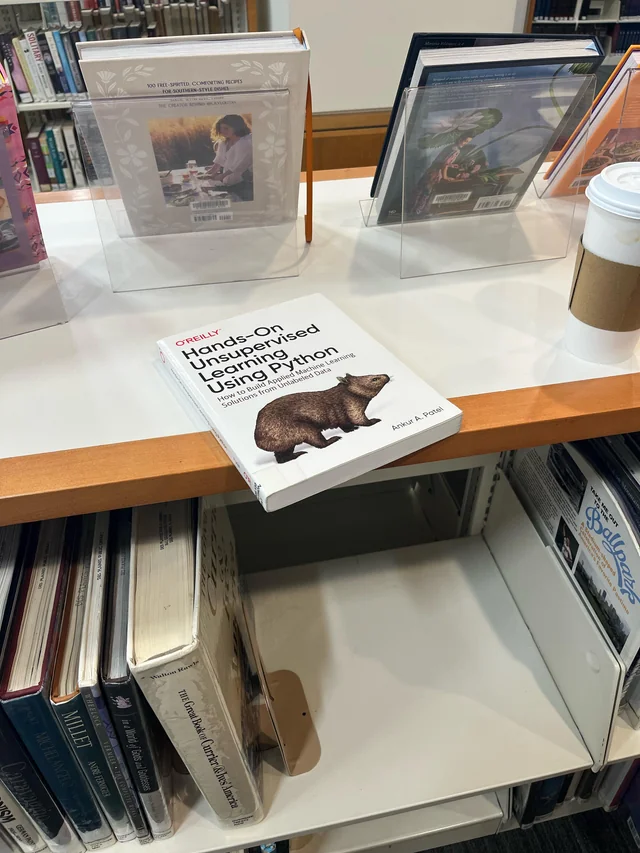
Pleasantly surprised to find O’Reilly books on ML at a public library submitted by /u/ai_hedge_fund [link] [Kommentare]
R
↗
Hey guys, I received mediocre scores for my EMNLP paper during the May ACL ARR cycle: 2.5/3, 3/4, 2.5/4. The paper is in the Interpretability track. The reviewers had no larger issue with the methodology or the paper in general, but it seemed like they didn't fully get the so what of my paper. I've tried to clarify everything in my rebuttal, but I don't assume that the reviewers will engage in the discussion. With the current scores, I won't make it to the conference and likely not even into findings. Hence, I was thinking of withdrawing the paper, if scores don't improve, improve the presentation of my paper, and submit it to the BlackboxNLP workshop by the end of next week. As I'm a first year PhD student, I'm not so familiar with ACL ARR, and how best to approach this. Hence, I wanted to ask you guys. Should I keep the paper in the cycle and hope for the best (or switch to the conference at a later stage) or should I withdraw it directly, adjust it slightly, and head directly to the workshop? submitted by /u/H4RZ3RK4S3 [link] [Kommentare]
R
↗
Zhang et al. paper's introducing the SA-MDP framework (2020) (state adversarial MDP) argues that an attack using the critic network (V(s)) is expected and supposed to produce a weaker attack than an attack using the actor network (pi(s)) itself to generate perturbation on agent observations. A claim supported by their empirical results using different single-agent simulation environment. However, I'm consistently finding the opposite when comparing both attacks on multi-agent PPO policies trained on some scenarios from the VMAS library. Policies are IPPO (Independent PPO, to not confuse with MAPPO) and GPPO (Graph Independent PPO, see Bettini et al. 2023 arxiv) with their heterogeneous versions. The PGD attack is adapted to continuous policies using the KL divergence closed form. Am I doing something wrong or this is actually something that doesn't contradicts Zhang et al's findings given the difference of the context? submitted by /u/ham_bam0 [link] [Kommentare]
 R
↗
R
↗
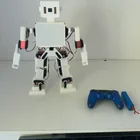
Hello, my name is Noah , I’m 14 years old and I’ve been building this humanoid robot from scratch. I designed the parts in CAD, 3D printed them, assembled the servos, and now I’m working on the software and walking algorithms/ gaits . It’s powered by a Raspberry Pi and uses multiple servo motors for its joints. There’s still plenty to improve, but seeing it come together has been really rewarding. I have posted it on TikTok and Instagram under the name of NoahisRobotix , but have not been that successful so far.. I’d love to hear what you think or answer any questions! submitted by /u/Equivalent_Ask_1156 [link] [Kommentare]
R
↗
R
↗
We submitted our first paper to ARR, intending to commit to IJCNLP-AACL. Area: Multilingualism and Cross-Lingual NLP Scores: (3,4) (2.5,3) (3,3) - average 2.83 for reviews, 3.33 for confidence 3 for soundness on all, 4 for reproducibility, and 2,3,3 for excitement. The reviewer who gave us 2.5 has a very short review. They only list one weakness in two sentences and give the paper 2.5. They also give 1,2 for the datasets and software while the other reviewers both give 3 or 4 for these. The (3,4) review gave us 3 weaknesses, with two being writing issues. The (3,3) review has a very nice and very thourough review with many weaknesses and strengths. Questions Is the score good for IJCNLP-AACL findings in the Multilingualism and Cross-Lingual NLP area? How will each review be weighted in the meta-review? Will the shorter outlier review be weighted less in this? How much will rebuttals help? Should we expect the reviewers to respond or change their scores because of the rebuttals? Is there a specific format for rebuttals or any tips you have for rebuttals in ARR? submitted by /u/hepiga [link] [Kommentare]
 R
↗
R
↗
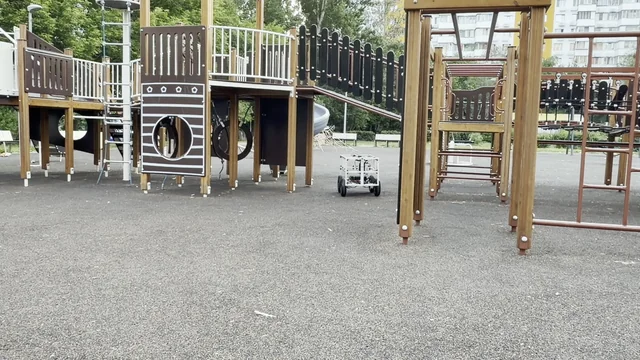
First real drive outside. Before this it only ran on the bench. Build: four 10.5" hoverboard hub motors, 2x ODrive (ODESC 3.6), Raspberry Pi 5, aluminium profile frame. Control is fully manual right now, from a laptop over 4G: live camera, per-motor telemetry, ARM / E-STOP. Main thing I learned: skid-steer turning depends heavily on surface grip, so that has to go into the control logic rather than being tuned by feel. Next step is autonomous A-to-B: 3D lidar, ODrive on CAN with closed-loop wheel control, ROS2/Nav2 for planning. Still early. Happy to answer anything about the build. submitted by /u/NiamorroMilky [link] [Kommentare]
 R
↗
R
↗
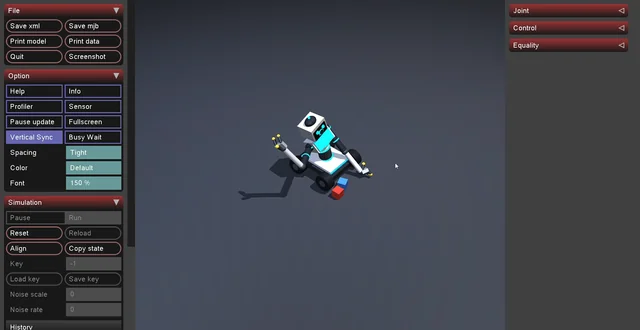
Hey everyone, I've been building CARL, an embodied virtual primate scout in MuJoCo. He has a 28-DOF body, 3-fingered hands, and is controlled by a multi-tiered biologically-inspired cognitive architecture. The codebase is fully open-source, but it is far from perfect. We are looking for help, critiques, and design upgrades on absolutely everything: 🛠️ 1. Physical Design & Body Upgrades (Morphology/Hardware) - Suggestions for better hand/gripper layouts (should we go to 5-fingers or use compliant pads?). - Better limb length proportions to maximize reach and avoid joint locking. - Optimal positioning of LiDAR, camera sensors, and tactile grids. - Bipedal chassis balancing and layout suggestions. 🎮 2. Control Loops & Trajectories (Robotics/Controls) - Smother arm trajectory models to fix our sudden joint-angle jumps and snapping. - Calibrating physics contact constraints in MuJoCo to stop fingertip clipping. - Alternatives to our current Damped Least Squares IK solver. 🧠 3. Cognitive Architecture & AI Models (Deep Learning/RL) - Optimizing our PPO actor-critic network and Liquid Time-Constant (LTC) arm policy. - Better reward shaping to speed up learning convergence (currently too slow!). - Improving how our high-level emotional drives (dopamine, cortisol) link down to motor execution. We are completely open to any feedback, design overhauls, or code contributions. Take a look at the repo and tell us what you would change! * GitHub Link: https://github.com/Manassadashiv/carl-simulation * Honest breakdown of our struggles: https://github.com/Manassadashiv/carl-simulation/blob/main/CONTRIBUTING.md submitted by /u/Manas_Sadashiv [link] [Kommentare]
R
↗
Hi, I was reading the openRLHF paper: https://arxiv.org/pdf/2501.03262v4 , but when I click the abstract page: https://arxiv.org/abs/2501.03262v4 , it shows "REINFORCE++". Note that https://arxiv.org/html/2501.03262v4 still shows the correct openRLHF paper. I believe Arxiv is having some incorrect symlinks? Is there anyone working at arxiv here who would like to look into this? submitted by /u/Ok-Painter573 [link] [Kommentare]
R
↗
I've been working on tlabel, an open-source Python toolkit that loads tactile sensor data (GelSight, DIGIT, PaXini, etc.) into a unified format. One thing we struggled with: how to define and label manipulation primitives consistently. The T-Rex paper (Tactile-Reactive Dexterous Manipulation) defined 22 motor primitives for dexterous manipulation — grasp, press, wipe, twist, poke, and so on. That's probably the most comprehensive taxonomy out there right now. But not every task needs all 22, and not every lab uses the same definitions. So we built a configurable taxonomy system on top of tlabel, with T-Rex's set as the default starting point. How it works We picked 7 primitives from T-Rex that have clear force signatures (reach, grasp, press, squeeze, wrap, wipe, lift), plus Cutkosky grasp subtypes. The engine can auto-predict these from visual-tactile images — even without a force sensor, it estimates force distributions from GelSight/DIGIT images and maps patterns to primitives. python import tlabel data = tlabel.demo('gelsight') data.predict_primitives() Every prediction carries a source tag (ai_predicted vs ai_predicted_estimated vs manual) and a confidence score. Low-confidence segments are left blank for you to annotate. Defining your own primitives If your task has primitives not in the default set, you can register custom ones with physical rules: python tlabel.register_custom_primitive('poke', force_range=(0.1, 0.8), deformation_max=0.15, contact_required=True, confidence=0.5 ) data.predict_primitives(min_confidence=0.4) Or scope it to a local taxonomy without polluting the global registry: python taxonomy = tlabel.get_default_taxonomy() from tlabel import PrimitiveRule taxonomy.register(PrimitiveRule( name='poke', min_force=0.1, max_deformation=0.15, contact_required=True, min_confidence=0.5 )) data.predict_primitives(taxonomy=taxonomy, min_confidence=0.4) Manual annotation still works python data.add_primitive('reach', start_frame=0, end_frame=10) data.add_primitive('grasp', start_frame=10, end_frame=25) data.add_primitive('lift', start_frame=25, end_frame=40) data.get_primitive_timeline() # [('reach', 0, 10), ('grasp', 10, 25), ('lift', 25, 40)] Export python data.export("output.csv") # Columns: primitive_label, primitive_source, primitive_confidence The design principle is "assist, not autoritate" — AI predictions are suggestions with metadata, not ground truth. You stay in control. Pure Python, MIT license, no dependencies beyond numpy. Code: https://github.com/liesliy/tlabel Curious what primitive sets other people are using for their manipulation tasks. submitted by /u/ImmediateArm7942 [link] [Kommentare]
 R
↗
R
↗
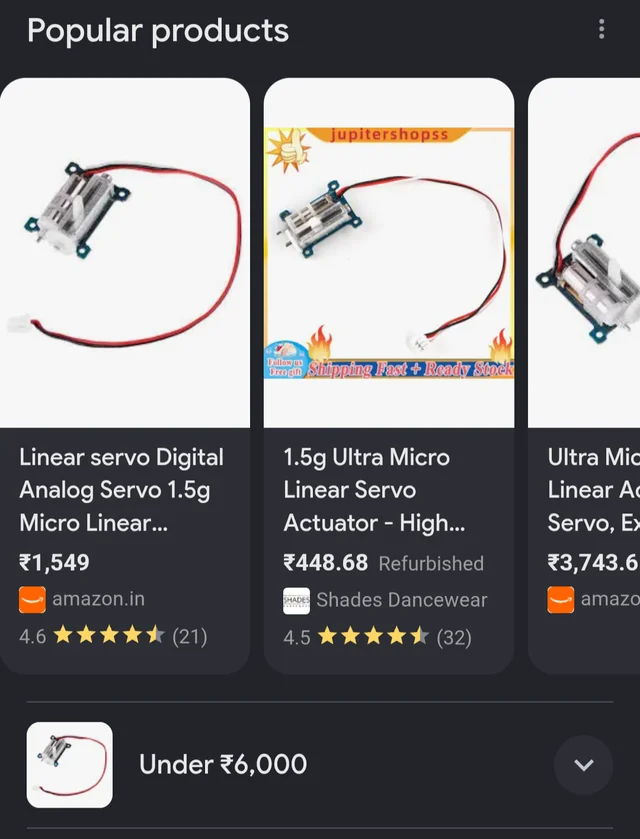
I see a lot of smaller parts are costlier than the usual sizes. Even for screws , it sometimes costs 2k rs. Why is this? Don't tell that it's because of the import duty. submitted by /u/MotorPsychology1712 [link] [Kommentare]
R
↗
Built a memory system called TRACE that organizes agent conversation history into a topic tree (branches + summaries) instead of flat RAG chunks, and benchmarked it on MemoryAgentBench (ICLR 2026), specifically the EventQA accurate-retrieval task. Its a pypi package: pip install trace-memory Results (F1): • TRACE (gpt-oss-20B): 82.5% • TRACE (gpt-oss-120B): 83.8% • Mem0 (GPT-4o-mini, paper’s official number): 37.5% • MemGPT/Letta (GPT-4o-mini, paper’s official number): 26.2% Ran gpt-oss locally, so this is an open-weights model against MemGPT/Mem0 on GPT-4o-mini, not an apples-to-apples same-backbone test (I don’t have the money for open ai tokens). I tried to get Mem0 running on gpt-oss-20B directly for fairness, but its fact-extraction step needs strict JSON output and gpt-oss’s responses didn’t parse cleanly (known issue, not gpt-oss specific. Same bug shows up with Gemini/Mistral too). Letta needs a full server setup so I skipped it. Full JSON logs from both runs are in the repo if you want to dig into the methodology yourselves. GitHub: https://github.com/husain34/TRACE submitted by /u/PsychologicalDot7749 [link] [Kommentare]
R
↗
We recently open-sourced our implementation of obstacle overtaking using GPMP2 (Gaussian Process Motion Planning). The project demonstrates trajectory optimization for autonomous overtaking by representing robot trajectories as continuous-time Gaussian Processes and optimizing them as a factor graph. Instead of sampling-based planning, the approach jointly minimizes smoothness and obstacle costs while satisfying vehicle dynamics constraints, producing collision-free and dynamically feasible trajectories. Some highlights: GPMP2-based trajectory optimization using factor graphs Integration with robotics simulation for reproducible experiments Clear codebase that can serve as a starting point for researchers and students working on motion planning If you're working on motion planning, trajectory optimization, autonomous driving, or robotics, I'd love to hear your thoughts, suggestions, or ideas for extending it. Repository: https://github.com/AutonomousVehicleLaboratory/obstacle-overtaking-gpmp2 submitted by /u/Turbulent_Leek8446 [link] [Kommentare]
R
↗
As someone who is not affiliated with any of the big tech companies, I find it particularly difficult to have the confidence or enthusiasm to approach any ML problem with an attitude that my professors probably had at my stage in life. I'm sure I am not the only one having the following thoughts: "My research is currently being done better at companies." "ML problem I set out to solve is already solved and in fact turned into products and sold for millions at companies X, Y, Z. There is no need for further research." "Industry is not interested in theoretical ideas and there is plenty of evidence for that, starting with their hiring practice." "Companies wouldn't have millions of dollars in funding or revenues if their models weren't working." "Research is like Darwinian evolution. Evolution aims to produce the fittest model. After decades of evolution, the fittest model is already in industry, why should I explore other evolutionary dead-ends?" "There may not be a next big thing after LLM. If there were, it would be simply incorporated as a function or a subroutine that LLM simply calls when needed, and the average person would be none the wiser. My contribution would be invisible." Seems like research outside of big tech companies is pointless (unless you are a prof who is making big $$ while doing it). Because whatever they are working on might be lightyears ahead of whatever you are doing, but you wouldn't know because their model is simultaneously closed-source and omnipotent. There are tons of people sharing their resumes on other ML/CS subreddits and occasionally you see that their projects are along the lines of "linear regression for Titanic dataset" or "YOLO for pedestrian detection" and they are wondering out loud why nobody is hiring them. Everyone with more ML experience can see because there is zero need for people with this skillset. But what if my very research also looks the same to people in industry? What if my "deep geometric autoencoding variational neural-former" also looks like some silly Kaggle project because industry can already do that much more efficiently? How do you silence these thoughts? submitted by /u/NeighborhoodFatCat [link] [Kommentare]
 R
↗
R
↗
Stack-chan’s birthday is July 2. It all started with this first post on July 2, 2021: https://x.com/meganetaaan/status/1410631124045291521?s=20 Since then, we have celebrated Stack-chan’s birthday every year with the community. This year, we held “Stack-chan Birthday Party 2026” in Tokyo, Japan. https://preview.redd.it/bhaewzjw6bbh1.jpg?width=4096&format=pjpg&auto=webp&s=1b9d50e2071ffcf838ac8770ac51e6c1735f0664 More than 80 people joined us on-site, making it one of the liveliest Stack-chan gatherings yet. Many community members shared their projects, updates, and ideas, and we were also very happy to welcome the M5Stack team from Shenzhen, which made this year’s event even more special. Stack-chan is an open-source palm-sized communication robot, but more than that, it has grown through the creativity and continuous participation of its community. Over the past five years, people have built new mods, applications, faces, voices, hardware variations, and many other experiments around Stack-chan. Thank you to everyone who joined, presented, supported the event, or has contributed to Stack-chan in any way. Event page: https://stack-chan.connpass.com/event/394846/ YouTube archive: https://www.youtube.com/live/7sIlyWFUqsw?si=Qg_RtoDIF2dEoZFe Happy birthday, Stack-chan! submitted by /u/Few_Competition6685 [link] [Kommentare]