So, I just read LeCun's interview with Nebius Science. I feel he had some cool points about LLMs being able to answer things, but not literally understand the physics of the physical world. (Like, being able to explain a task and actually performing it are two completely different things.) But I wanted to get opinions on what others thought of his solution to the problem. He thinks JEPA could be the solution. But it made me think about whether JEPA is genuinely the architectural solution to this, or if we’re just looking for a "magic bullet" that doesn't exist yet in our toolbox I have the link here: https://nebius.science/stories/meet-yann-lecuns-lab-and-the-ai-world-of-2030 submitted by /u/ConsciousGreenPepper [link] [Kommentare]

Hello, I recently finished reading this survey paper: Deep learning tackles single-cell analysis – A survey of deep learning for scRNA-seq analysis, which comprehensively covers 25 different methods across 6 subcategories for applying deep learning to scRNA-seq analysis. To summarize the methods from this paper, I prepared a table containing the Category, Method, Purpose, Architecture, Metrics, Explanation, and the specific Novelty of each method. I hope you find this summary useful. https://preview.redd.it/n3okgq66t1eh1.png?width=1662&format=png&auto=webp&s=fb71b306d3ffc346f243b04ccc9fe7a14076fbd7 https://preview.redd.it/njs5lq66t1eh1.png?width=1662&format=png&auto=webp&s=1dcdebbef3f2746b1e94f7182c9e4a11f10a7f12 https://preview.redd.it/zsv2yq66t1eh1.png?width=1662&format=png&auto=webp&s=05ecb58355b6a32a25d32cc25a2a9e500f9cd489 submitted by /u/teraRockstar [link] [Kommentare]
Does anyone have accepted short-paper at ACL/EMNLP/EACL 2025/26? Could you share your track and overall assessment? I'm just trying to get a sense of things, as it seems short papers have a lower acceptance rate than long ones. submitted by /u/No_Cardiologist7609 [link] [Kommentare]
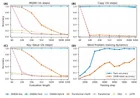
Hi everyone, I've been working independently on a recurrent architecture called **DABSN (Dynamic Adaptive Bias State Network)** for the past several months, and I finally reached the point where I feel comfortable sharing the first preprint. The paper is mainly about the architecture itself and its behavior on reasoning, memory, and long-sequence benchmarks (MQAR, Copy, Key-Value retrieval, A5/60, etc.). The code is also public with PyTorch, C++, and Triton implementations so everything can be reproduced. While finishing the paper, I also trained my first language model with the same cell: - 24M parameters - 1B pretraining tokens - GPT-2 tokenizer Those results ended up being much more interesting than I expected, so I'm now writing a second paper focused entirely on language modeling, long-context behavior, and scaling. This is where I'd love some help. I'm looking for people who might be interested in collaborating on the next paper, whether that's: - independent reproduction of the results, - helping design stronger baselines and evaluations, - or having access to larger GPU clusters so we can scale the architecture much further than I can on my own. Everything I'm doing is intended to be open and reproducible from day one. I'd really appreciate any feedback on the paper, and if the project sounds interesting, I'd love to chat. Preprint and Github are in the comments. submitted by /u/BleedingXiko [link] [Kommentare]
My TMLR paper was assigned to reviewers on April 23, and as of July 13 I've received 2 reviews, but the third is still pending. The discussion phase hasn't opened yet, so I can't respond to the existing reviews. Is this normal for TMLR, or is it reasonable to send the Action Editor a polite status email? asking for the 3rd review, apprecite the suggestions submitted by /u/Ok_Ant_4311 [link] [Kommentare]
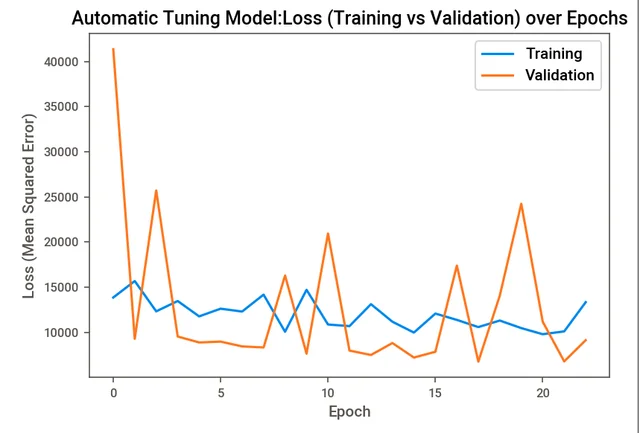
I have used Hyperband automatic tuning for an ANN model to predict price. After running HyberBand automatic tuning to get the 'best' architecture, I am obtaining a strange Val/Training loss learning curve. I cannot figure out if this is due to an error within the code or just a case of me not understanding the graph and not be able to interpret why the graph is showing as it is. I am also obtaining an R2 score of 1.00 which may suggest overfitting. I've not come across a learning curve (only shown the most basic learning curves at Uni) such as this as of yet so any advice would be greatly appreciated! Here is the code for the actual tuning, in case it is due to a coding error but I am not sure that is the case. def model_builder(hp): model = tf.keras.Sequential() model.add(tf.keras.layers.Flatten(input_dim = (train_final.shape[1]))) #creating activation choices - choosing betweeen relu and tanh hp_activation = hp.Choice('activation', values = ['relu', 'tanh']) #creating node choices - maxing unit amounts to 500 hp_layer_1 = hp.Int('layer_1', min_value=1, max_value=500, step=100) hp_layer_2 = hp.Int('layer_2', min_value=1, max_value=500, step=100) #creating learning rate choice - choice between 0.01, 0.001, 0.0001 hp_learning_rate = hp.Choice('learning_rate', values = [1e-2, 1e-3, 1e-4]) #specifies first layer after the flatten layer model.add(tf.keras.layers.Dense(units = hp_layer_1, activation = hp_activation)) #creating the second layer model.add(tf.keras.layers.Dense(units = hp_layer_2, activation = hp_activation)) model.add(tf.keras.layers.Dense(1, activation='linear')) model.compile(optimizer=tf.keras.optimizers.Adam(learning_rate = hp_learning_rate), loss tf.keras.losses.MeanSquaredError(), metrics = ['mean_absolute_error']) return model import keras_tuner as kt #creating the tuner tuner = kt.Hyperband(model_builder, objective = 'val_loss', max_epochs = 50, factor = 3, directory = 'dir', project_name = 'x', overwrite = True) # makes tuner rewrite over old tuning experiments #adding early stopping - stops each model from running too long stop_early = tf.keras.callbacks.EarlyStopping(monitor = 'val_loss', patience = 5) tuner.search(train_final, y_train, epochs = 50, validation_split = 0.2, callbacks = [stop_early]) best_hp = tuner.get_best_hyperparameters(num_trials=1)[0] best_hp.values #obtaining the best model best_model = tuner.get_best_models(num_models = 1)[0] history = best_model.fit(train_final, y_train, epochs = 50, validation_split = 0.2, callbacks=[stop_early]) tuned_df = pd.DataFrame(history.history) #running epoch loss visual def epoch_loss_visual(tuned_df, model_name = 'Automatic Tuning Model') Could it be an issue with the code itself causing the issue or is it simply the way the model is? If it's a case of it's just a bad model, I do not need to improve at the moment, but do need to understand the results, especially that of the learning curve representation. submitted by /u/Grouchy-Archer3034 [link] [Kommentare]

Pleasantly surprised to find O’Reilly books on ML at a public library submitted by /u/ai_hedge_fund [link] [Kommentare]
Hey guys, I received mediocre scores for my EMNLP paper during the May ACL ARR cycle: 2.5/3, 3/4, 2.5/4. The paper is in the Interpretability track. The reviewers had no larger issue with the methodology or the paper in general, but it seemed like they didn't fully get the so what of my paper. I've tried to clarify everything in my rebuttal, but I don't assume that the reviewers will engage in the discussion. With the current scores, I won't make it to the conference and likely not even into findings. Hence, I was thinking of withdrawing the paper, if scores don't improve, improve the presentation of my paper, and submit it to the BlackboxNLP workshop by the end of next week. As I'm a first year PhD student, I'm not so familiar with ACL ARR, and how best to approach this. Hence, I wanted to ask you guys. Should I keep the paper in the cycle and hope for the best (or switch to the conference at a later stage) or should I withdraw it directly, adjust it slightly, and head directly to the workshop? submitted by /u/H4RZ3RK4S3 [link] [Kommentare]
Zhang et al. paper's introducing the SA-MDP framework (2020) (state adversarial MDP) argues that an attack using the critic network (V(s)) is expected and supposed to produce a weaker attack than an attack using the actor network (pi(s)) itself to generate perturbation on agent observations. A claim supported by their empirical results using different single-agent simulation environment. However, I'm consistently finding the opposite when comparing both attacks on multi-agent PPO policies trained on some scenarios from the VMAS library. Policies are IPPO (Independent PPO, to not confuse with MAPPO) and GPPO (Graph Independent PPO, see Bettini et al. 2023 arxiv) with their heterogeneous versions. The PGD attack is adapted to continuous policies using the KL divergence closed form. Am I doing something wrong or this is actually something that doesn't contradicts Zhang et al's findings given the difference of the context? submitted by /u/ham_bam0 [link] [Kommentare]
We submitted our first paper to ARR, intending to commit to IJCNLP-AACL. Area: Multilingualism and Cross-Lingual NLP Scores: (3,4) (2.5,3) (3,3) - average 2.83 for reviews, 3.33 for confidence 3 for soundness on all, 4 for reproducibility, and 2,3,3 for excitement. The reviewer who gave us 2.5 has a very short review. They only list one weakness in two sentences and give the paper 2.5. They also give 1,2 for the datasets and software while the other reviewers both give 3 or 4 for these. The (3,4) review gave us 3 weaknesses, with two being writing issues. The (3,3) review has a very nice and very thourough review with many weaknesses and strengths. Questions Is the score good for IJCNLP-AACL findings in the Multilingualism and Cross-Lingual NLP area? How will each review be weighted in the meta-review? Will the shorter outlier review be weighted less in this? How much will rebuttals help? Should we expect the reviewers to respond or change their scores because of the rebuttals? Is there a specific format for rebuttals or any tips you have for rebuttals in ARR? submitted by /u/hepiga [link] [Kommentare]
Hi, I was reading the openRLHF paper: https://arxiv.org/pdf/2501.03262v4 , but when I click the abstract page: https://arxiv.org/abs/2501.03262v4 , it shows "REINFORCE++". Note that https://arxiv.org/html/2501.03262v4 still shows the correct openRLHF paper. I believe Arxiv is having some incorrect symlinks? Is there anyone working at arxiv here who would like to look into this? submitted by /u/Ok-Painter573 [link] [Kommentare]
Built a memory system called TRACE that organizes agent conversation history into a topic tree (branches + summaries) instead of flat RAG chunks, and benchmarked it on MemoryAgentBench (ICLR 2026), specifically the EventQA accurate-retrieval task. Its a pypi package: pip install trace-memory Results (F1): • TRACE (gpt-oss-20B): 82.5% • TRACE (gpt-oss-120B): 83.8% • Mem0 (GPT-4o-mini, paper’s official number): 37.5% • MemGPT/Letta (GPT-4o-mini, paper’s official number): 26.2% Ran gpt-oss locally, so this is an open-weights model against MemGPT/Mem0 on GPT-4o-mini, not an apples-to-apples same-backbone test (I don’t have the money for open ai tokens). I tried to get Mem0 running on gpt-oss-20B directly for fairness, but its fact-extraction step needs strict JSON output and gpt-oss’s responses didn’t parse cleanly (known issue, not gpt-oss specific. Same bug shows up with Gemini/Mistral too). Letta needs a full server setup so I skipped it. Full JSON logs from both runs are in the repo if you want to dig into the methodology yourselves. GitHub: https://github.com/husain34/TRACE submitted by /u/PsychologicalDot7749 [link] [Kommentare]
As someone who is not affiliated with any of the big tech companies, I find it particularly difficult to have the confidence or enthusiasm to approach any ML problem with an attitude that my professors probably had at my stage in life. I'm sure I am not the only one having the following thoughts: "My research is currently being done better at companies." "ML problem I set out to solve is already solved and in fact turned into products and sold for millions at companies X, Y, Z. There is no need for further research." "Industry is not interested in theoretical ideas and there is plenty of evidence for that, starting with their hiring practice." "Companies wouldn't have millions of dollars in funding or revenues if their models weren't working." "Research is like Darwinian evolution. Evolution aims to produce the fittest model. After decades of evolution, the fittest model is already in industry, why should I explore other evolutionary dead-ends?" "There may not be a next big thing after LLM. If there were, it would be simply incorporated as a function or a subroutine that LLM simply calls when needed, and the average person would be none the wiser. My contribution would be invisible." Seems like research outside of big tech companies is pointless (unless you are a prof who is making big $$ while doing it). Because whatever they are working on might be lightyears ahead of whatever you are doing, but you wouldn't know because their model is simultaneously closed-source and omnipotent. There are tons of people sharing their resumes on other ML/CS subreddits and occasionally you see that their projects are along the lines of "linear regression for Titanic dataset" or "YOLO for pedestrian detection" and they are wondering out loud why nobody is hiring them. Everyone with more ML experience can see because there is zero need for people with this skillset. But what if my very research also looks the same to people in industry? What if my "deep geometric autoencoding variational neural-former" also looks like some silly Kaggle project because industry can already do that much more efficiently? How do you silence these thoughts? submitted by /u/NeighborhoodFatCat [link] [Kommentare]
Hi everyone. Do the ACL arr may 2026 reviews come out of July 2nd or do they come out on July 7 th?? How much does one need to get into Main or Findings? I am a bit new to this. Thanks a lot folks. submitted by /u/Anshuman3480 [link] [Kommentare]
EACL 2027 just published their CFP which contains an important change to the common ARR process: For this cycle, author response and author-reviewer discussion are two separate stages Looking at the deadlines, they not only split the process but also allow more time: Author response period Sept 14-19, 2026 Reviewer engagement and Author-reviewer discussion Sept 20-24, 2026 Previously, ARR cycles only gave five days in total for the discussion period. ARR May 2026, for example, only gives July 7 to July 13 for the total authors-reviewer discussion (no separate author response period). In summary, that means not only that the process is being split in two stages but you now also have more time. --- In my opinion this is really good as in the past having just 5 days to post a reply (potentially involving new experiments - even though that is not the original idea of the discussion period) and getting into a discussion with the reviewers felt very tight - for authors and reviewers. I am, therefore, really looking forward to this change. Any thoughts? submitted by /u/S4M22 [link] [Kommentare]