


How I tricked Claude into leaking your deepest, darkest secrets

In my last post about Yocto I wrote about dealing with disappearing dependencies and how one should try to keep his layers up to date. “Next day I started by updating all the layers properly&…

Dedicated to legendary Xtree (tm) filemanager, containing version history, survey of Shareware-clones, Tips&Tricks, download section, and much more...
Created Simulation From LLM Output Background: I studied EECS and I'm now getting into robotics, mostly working through the simulation side of things. While digging into the sim pipeline I came across this repo: https://github.com/AlexKaravaev/world-creator It's a CLI that generates Gazebo and Mujoco simulation worlds from a text prompt. You type something like "warehouse with shelves and some obstacles for navigation testing" and it picks models from the Gazebo model database and places them for you. I think it's genuinely a great idea and ahead of its time. It's from ~2023, so it predates all the recent LLM progress, and the author was upfront that the model hallucinated a lot back then. With today's models this approach could work way better. Curious about a few things: Has anyone here used this or something like it in real work? Is prompt-to-world something you'd actually want, or is scene setup not painful enough to matter? From what I've seen so far, people complain way more about getting the robot itself into sim (URDF, meshes, inertia values) than the environment around it. Is that right? If someone built an upgraded version of this, what would the use cases be for you? Randomized scenes for RL training? Test scenarios in CI? Quick demos? I'm exploring building in this space, so honest "nobody needs this" takes are just as useful as feature wishlists. submitted by /u/Few_Film8907 [link] [Kommentare]



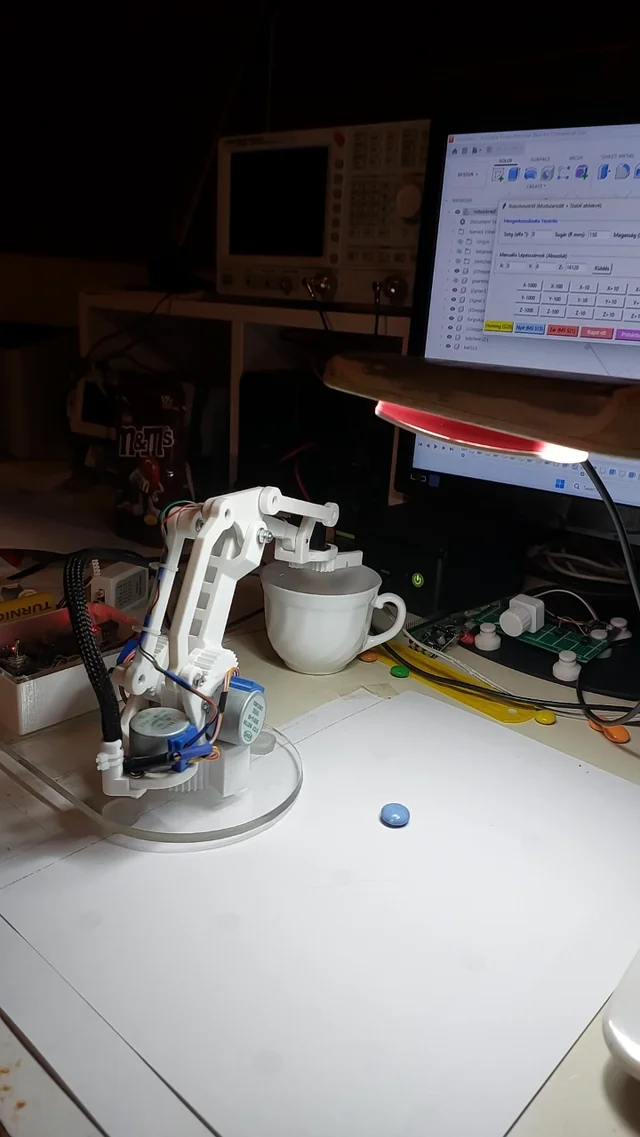
Teaching my 13-year-old grandson programming using Arduino, Python, and AI. We are currently programming this small robotic arm. I originally built the arm for him 5 years ago for Christmas. Back then he just played with it, but now he is writing new code for it. The goal is to detect candies placed in front of it and drop them into a cup. How it works: A Raspberry Pi-based USB camera monitors the workspace. A Python script running on a PC detects the candies and sends G-code commands to control the arm. Hardware & Firmware: The robotic arm is powered by an STM32F103 microcontroller running Arduino-based firmware. submitted by /u/Available-String-891 [link] [Kommentare]