Hello world I'm studying statistics and Cs, I have take cs50x, cs50p. Currently take linear algebra and calc 3 (multivariable) to start andrew ML courses, my question is do I need alot to get job in ml I was think maybe should take goggle data analytics to get quick job and let ml journey takes it's time but I don't like that I like math and want studying math but I need money can someone give me advice how get job and still be in path to ml submitted by /u/DevilNeverCryy [link] [Kommentare]
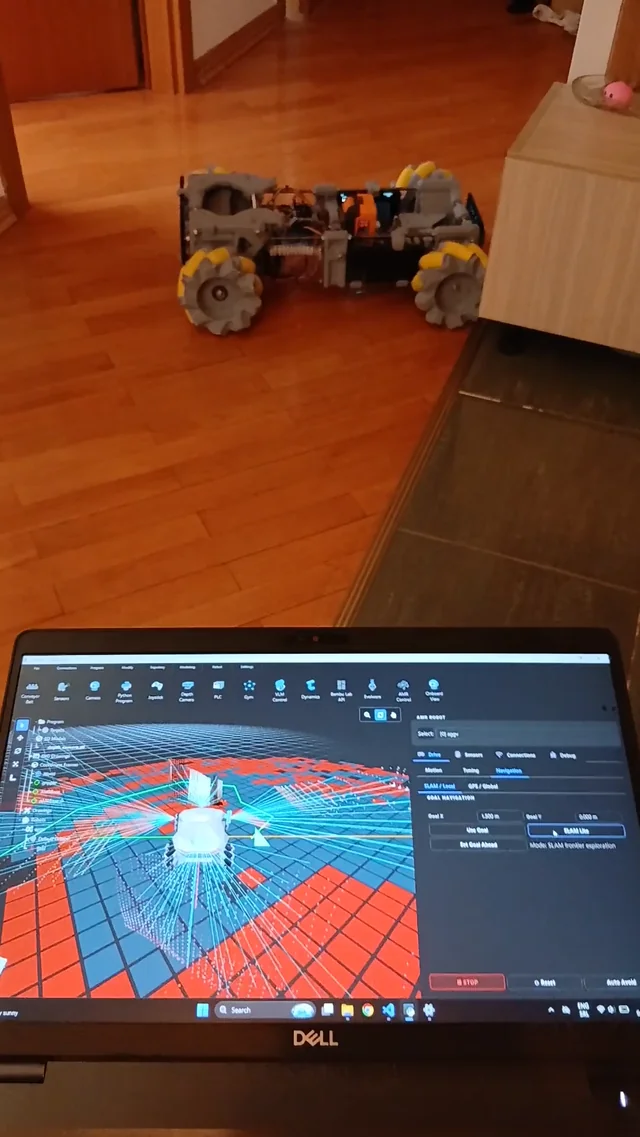
Hey r/robotics, Wanted to share my latest budget mobile robot build. The goal was to keep it under $250, so instead of buying an expensive LiDAR setup or dedicated depth cameras, I rigged up 4 cheap smartphones to stream video data. I’m running the streams through Depth Anything v3 (DA3) to estimate the depth maps, and honestly, for a "poor man's LiDAR," it’s going incredibly strong. The issue I'm running into: Since DA3 outputs relative/monocular depth maps, I’m struggling with absolute scale calibration. Right now, the robot thinks walls are further away than they actually are. It knows where the obstacles are, but the metric distance is skewed because DA3 doesn't have real-world depth data. I want to fix this by adding a hardware sensor to act as a "ground truth" anchor to correct and scale the DA3 depth data in real-time. Has anyone here tried using a ToF (Time-of-Flight) sensor or an Ultrasonic sensor to handle this kind of depth correction? Would a single-point distance reading be enough to dynamically scale the relative map, or is there a better way to do it? If anyone is curious about the hardware or wants to check out the setup, I put the specs and documentation here and the chassis CAD files here. Looking forward to hearing your thoughts on how to fix the depth scaling! submitted by /u/ganacbicnio [link] [Kommentare]
This happened a few months ago when I was working on an analysis project that dealt with time-series data. The dataset was large (10 years of data). I was using a standard profiling tool to check the pipeline. Everything looked fine because the tool reported 3% missing data rate for volume columns. I didn't think much about it because I thought it was noise, as this was my first time working with time-series data, but the downstream models weren't acting right. That's when I thought something was off, and I actually looked at the data and found the 3% missing data was not noise; in fact, it was a 6-day worth of missing data. It didn't stop here, though, as the data also had leakage, and the model hit 99% accuracy. The rolling windows and lag features were also messed up, as the chronological sequence was broken. Looking back, if I had done proper EDA, this would not have happened. But I decided to make a small validation tool called tsauditor that catches chronological breaks, leakage, and sudden sequential spikes present in global boundaries. It also adds a description along with evidence on why the data point is faulty and suggests fixes It's open source, lightweight, and on PyPI. I also added an example notebook, which has a side-by-side comparison of tsauditor with a standard profiling tool. You can also check out the comparison notebook on NBViewer. I wanted to simplify the EDA process and reduce the number of custom scripts for a dataset. Link in comments submitted by /u/severecaseofsarcarsm [link] [Kommentare]

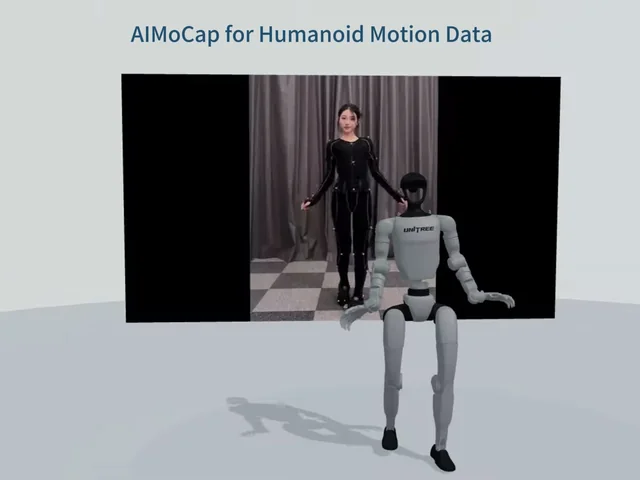
I've been experimenting with converting ordinary third-person videos into humanoid motion data. This demo includes several motion categories: • Acting • Sports • Combat • Dance The motivation is not animation alone. Recent humanoid robotics work increasingly relies on large-scale motion datasets and motion priors to improve movement quality, robustness, and generalization. Projects such as NVIDIA KIMODO also show the value of scaling high-quality motion data for downstream humanoid motion generation and control. This made me wonder whether ordinary videos could become a low-cost source of motion data for humanoid systems. There is already a massive amount of human motion available in online videos. If useful motion can be extracted reliably, it may help expand humanoid motion datasets beyond traditional mocap pipelines. For this experiment, I focused on: • Foot contact stability • Reduced foot sliding • Natural balance and movement dynamics • Consistency across different motion styles The long-term idea is: Video → Motion Data → Motion Models → Humanoid Control For anyone interested in testing their own clips, I made a public demo available here: huggingface demo I'd love to hear thoughts from people working on humanoid robotics, motion generation, imitation learning, or robot locomotion. submitted by /u/AIMoCap [link] [Kommentare]
I'm considering building the Toolbox Robotics EB15 or EB300 3D-printed robotic arm and would love to hear from people who have actually built one. I'm particularly interested in: - Overall build experience, assembly difficulty, and total filament usage. - Motion performance: Is the arm smooth or jerky? How much backlash, vibration, or missed steps do you experience? - Real-world performance: accuracy, repeatability, payload, and long-term reliability. - Software experience (ROS, MoveIt, control software, etc.) and any modifications or upgrades you would recommend. Photos, videos, build logs, or GitHub repositories would be greatly appreciated. Links:- https://toolboxrobotics.com/robotic-arm-eb15 https://toolboxrobotics.com/robotic-arm-eb300 submitted by /u/Fals3_ [link] [Kommentare]
What does provisional paper acceptance mean in ECCV? Is that the default message everyone gets? submitted by /u/NotGondor [link] [Kommentare]
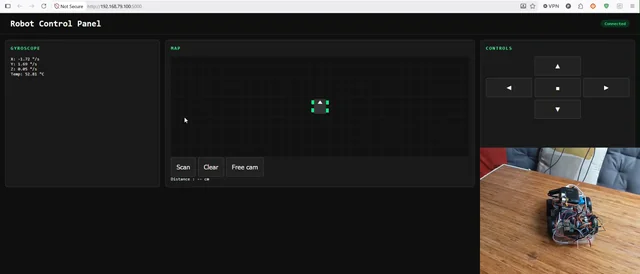
Hi r/robotics ! I’m currently working on a robotic car project for mapping, and I’d like to share my progress and get some feedback from the community. So far, the main issues I’ve encountered (and resolved) are as follows: - Synchronizing the car’s position on the map (as indicated by the gyroscope) with the position of the digitized image based on the car’s position - Managing the motors’ power supply (complex wiring) However, there are still a few issues for which I could use some advice. - It seems that over time, a discrepancy is developing between the robot’s position on the map and its actual position as measured by the gyroscope. Is this an inaccuracy in the gyroscope that could be corrected through code? - The scanner works but remains fairly inaccurate; any recommendations are welcome - The robot’s path tends to veer off course, so I’m considering adding speed encoders to implement a path correction system (I assume the problem stems from the fact that the speed of each motor isn’t always precise) My goal is to build a fully autonomous car capable of mapping its surroundings (I'll add a webcam). Feel free to share any ideas you might have. my target is build a full self driving car able to mapping his environment ( i will adding webcam). Github : https://github.com/enzocolombat/EC-Hub/ submitted by /u/Pasteque9000 [link] [Kommentare]
I'm not that well versed in ML yet. I know that "Attention is all you need" was based on work that was done with a couple of high end gaming GPUs at the time. I can afford that. Suppose for arguments sake that I have caught up on ML such that I have the competence to recreate state of the art results should I have access to the required hardware, do I still need access to huge amounts of hardware infrastructure to be able to contribute to the field at a foundational level? submitted by /u/Proof-Bed-6928 [link] [Kommentare]
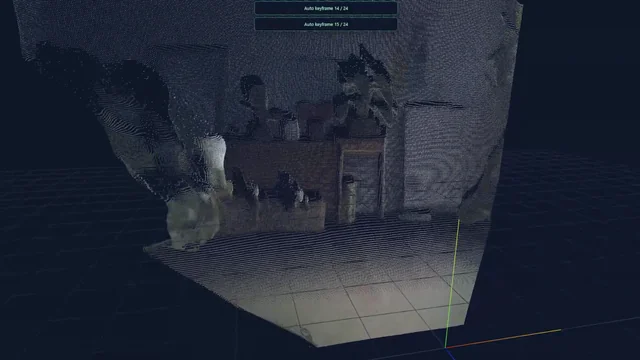
Hey everybody! Hobbyist here with an update on my cheap rover swarm project. I've been trying out Depth Anything 3 and wanted to share, because the results of such minimal hardware surprised me. The setup: each rover is just a XIAO ESP32-S3 Sense (~$15 board with a tiny onboard camera) in a 3D printed body. The ESP32 is basically a sender, it streams the camera over WiFi and reports temperature/battery/telemetry. All the heavy lifting (DA3 inference, navigation) runs on a PC that acts as the brain. No lidar, no depth sensor, one cheap RGB camera. DA3 gives me a point cloud per frame and can merge multiple frames into a larger cloud. Seeing a $15 camera produce a usable 3D-ish image of the room is still kind of wild to me. Eventually I want to use it for navigation - a kind of "poor man's lidar". It estimates what's near at three heights (eye level, above, below) to give a rough obstacle sense without a dedicated sensor. Secondly for visualization at the moment, but the goal is to stitch frames into an environment map. Positioning is currently handled by ArUco markers around the room (solvePnP). Still early and held together with hope, but it's been fun pushing this hardware further than it wamts to go. :-) submitted by /u/monkeydance26 [link] [Kommentare]
HalfwiredTV is a community for people who want to learn robotics, build projects, and collaborate with others. Our long-term goal is simple: Get everyone to a level where they can confidently learn, build and collaborate on robotics projects together in livestreams. What You'll Find Here -- People learning together teaching each other on calls in dedicated channels for topics (created as per demand) Project teammates Livestream collaborations and study sessions (uhm.. with meme songs) , also whenever anyone has something interesting to talk and show regardless of their skill level. We recently had our first livestream on a member's lazer scanning workflow for their robocar Robotics discussions ranging from complete beginners to advanced builders Your skill level doesn't matter. If you're curious, willing to learn, and willing to build, you're in the right place. Come join us : https://discord.com/channels/1514229376152113172/1514973636258172949 submitted by /u/SundeepKuPanigrahi [link] [Kommentare]
Hey everyone, I've been talking to a lot of robot engineers and kept hearing the same frustrations: - Debugging ROS2 errors takes hours - Setting up proper logging is painful - Writing boilerplate nodes wastes expert time So I built **Mechis** — a free AI co-pilot specifically for robot engineers. **What it does:** - 🐛 **Debug** — paste your error or stack trace, get the exact fix - 📋 **Logging** — describe your robot setup, get a complete ROS2 logging config - ⚙️ **Code Gen** — describe what you want in plain English, get clean ROS2 Python code **Try it free here:*\* mechis-neon.vercel.app No signup needed. Just open and use. --- **I'd genuinely love your feedback:** Did it actually help or was the answer generic? What's missing that you wish it had? What's the #1 ROS2 problem you face daily that a tool like this should solve? Would you pay for this? submitted by /u/According_Koala4857 [link] [Kommentare]
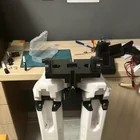
Officially i have finished the design, from now i will be working on the electrical components and control. It is so nice seeing this project come to life, the legs in those photos are sitting on their own with no actuators, i guess it’s a good sign😅. Now the big question remains, if i can make it walk🤷♂️ submitted by /u/DIYmrbuilder [link] [Kommentare]