 A
↗
A
↗
Most software ends at the action. Intelligence begins where the next action is informed by the last. A note on organizational memory.
 V
↗
V
↗
We built an AI agent and put it through four phishing simulations to reveal critical security gaps and offer solutions to protect your organization's data.
R
↗
Didnt expect this but apparently space x stock would be going live on bitpanda on 12th. For those who dont know, space x will IPOing this on june12 on Nasdaq at $135/share which is biggest ipo in history at a $1.77 trillion valuation. And since Bitpanda supports fractional shares, you dont need the full $135 to get exposure. Honestly didnt think european retail platforms would move this fast. Its kind of wild that you can just open the app and buy a piece of SpaceX. Anyone here getting in or waiting to see how day one plays out? submitted by /u/Jealous-Drawer8972 [link] [Kommentare]
 W
↗
W
↗
This website is unavailable in your location. It appears you are attempting to access this website from a country outside of the United States, therefore access cannot be granted at this time.
 R
↗
R
↗
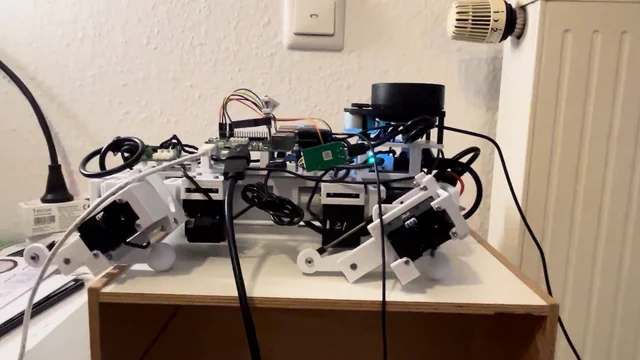
Honestly, I don't know how other people can do IMU balancing so elegantly; my PID oscillates like it's on life support. I have been tuning the PID the whole night, but then again, I don't have a lot of experience other than following some manuals, so any advice would be great! I am using BNO055 for IMU. Work in progress GitHub: https://github.com/SphericalCowww/CubicDoggo_06R Original Cubic Doggo: https://github.com/SphericalCowww/CubicDoggo submitted by /u/SphericalCowww [link] [Kommentare]
R
↗
How will AI affect our ability to think and judge for ourselves? Our new paper co-authored by 30 experts explores epistemic risks—the threats AI poses to our collective capacity to form beliefs accurately, reason well, and maintain a healthy information environment. We look at how AI can lead to harm through these mechanisms: Persuasion & Manipulation: AI systems are highly persuasive, opening the door for political/economic manipulation, incitement and radicalization, and other misuse, as well as unintentional harms like AI sycophancy and mental health risks. Cognitive Offloading: We may be delegating our thinking to AI at a deeper level than prior technologies, risking long-term degradation of individual and societal cognitive resilience. Feedback Loops: Human-AI and AI-AI interactions are narrowing the epistemic space humans and AIs draw from. This already drives homogenization, and may potentially lead to fragmentation and “lock-in” (a self-referential state that is difficult to reverse). While we believe AI could be an unprecedented lever for improving how humanity processes knowledge, we shouldn’t assume this will happen by default. We outline promising directions to change this trajectory across how AI systems are built, human-AI interaction design, institutional and individual adaptation, and information market incentives. Epistemic risks are self-perpetuating. As they can undermine the individual cognitive and social foundations needed to recognize, prioritize, and govern other threats—including the risks from AI itself—the time to act is now, before our capacity to respond is itself lost. Authors: Mick Yang, Stephen Casper, Jonathan Stray, Jasmine Li, Cameron Jones, Anna Gausen, Natasha Jaques, Brian Christian, Bálint Gyevnár, Hannah Rose Kirk, Zhonghao He, Dan Zhao, Siao Si Looi, Joshua Levy, Kobi Hackenburg, Elizabeth Seger, Matt Kowal, Michelle Malonza, Luke Hewitt, Hause Lin, Maarten Sap, Dylan Hadfield-Menell, Thomas H. Costello, Reihaneh Rabbany, Jean-François Godbout, David G. Rand, Atoosa Kasirzadeh, Gordon Pennycook, Yoshua Bengio, Kellin Pelrine Paper: https://papers.ssrn.com/sol3/papers.cfm?abstract_id=6873005 submitted by /u/KellinPelrine [link] [Kommentare]