Channels
Hi All, I've been running experiments on targeted SFT for specific capability dimensions on a 31B model. After running small training run to prime the model slightly in the direction I want, then ran a judge across 40 domains scoring six independent quality dimensions. One dimension consistently scored weakest across five runs. I am now training contrastive variants from the same checkpoint - examples with that dimension deep vs examples with it deliberately shallow, same everything else. The plan is to see if I can find the difference between the the two checkpoints to locate the circuit, then ablate those heads and measure which OTHER dimensions degrade. The idea is that if ablating dimension A's circuit causes dimension B's judge score to drop, there's a causal dependency in the network, B reads from A's residual stream output. And If I can do this for each dimension and build a causal dependency graph of how capabilities relate inside the model. Then use that graph to determine optimal training order for future rounds (train upstream nodes first, and would help me know which downstream nodes get better signal). A few specific questions: Has anyone done iterative targeted SFT guided by circuit tracing between rounds, and or by trying somewhat contrastive approaches to try to find any areas in the network? I can find papers on circuit discovery and papers on targeted SFT separately which somewhat validate this idea, but not the closed loop where mechinterp findings from a round determine training strategy for the next, and or what circuits may interact with each other in isolated scenarios, and how specific orders of training in specific directions may change how things behave. For the contrastive ablation - does anyone have any tips on what can work best in this area or could bring out more analysis? When tracing downstream dependencies via ablation, how do you distinguish direct from indirect effects? If ablating circuit A degrades dimension C, that could be A > C directly or A > B > C through an intermediate. Does anyone have a practical method for resolving this beyond ablating at multiple layers? After elemental training rounds, I plan to test whether dimensions compose naturally by running prompts that require causal chaining between two dimensions. For pairs that fail, I'm considering activation steering (injecting both dimension vectors simultaneously) as a diagnostic, if steering fixes it, possibly it's a routing problem, if not, could be a capability gap. Has anyone combined steering with fine tuning diagnostics like this? For context I don't have a ML background, I am self taught through running experiments, but from what I am learning purely from first principle understanding and experiments, it feels that if you can map these circuits and their direct second, third and so on order interactions in isolated directions (for say a group of related strengths/weaknesses you're directly trying to isolate and steer, wouldn't this be a potentially way to isolate circuits for stronger training runs? Btw if anyone has any general topics or links that are super interesting around anything related to this I'd be fascinated to see and learn about! If there's established methodology for any of this that I'm reinventing badly, I'd genuinely appreciate being pointed to it. I am so fascinated with this, it seems that if you can somehow eventually solve this problem, you could create better possible behaviour control or targeted understanding easier? submitted by /u/Substantial_Diver469 [link] [Kommentare]

If you live in Illinois, heads up on the most insane tax bill ever to be passed into law. This effectively charges every action involving digital assets (even just moving assets) with a 0.2% tax starting January 1, 2027. Move from an exchange to your cold wallet? Taxed. Move from your cold wallet to an exchange? Taxed. Sell assets at a loss (no capital gains). Taxed Illinois sucks submitted by /u/thewoz998877 [link] [Kommentare]
https://x.com/i/broadcasts/1qJVmmAokNWGB submitted by /u/rizzobitcoinhistory [link] [Kommentare]


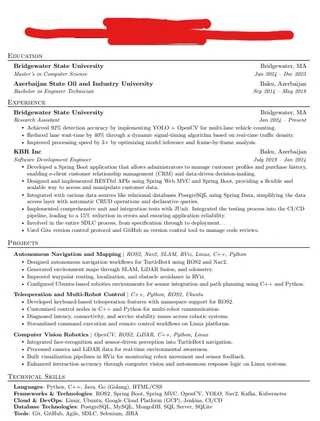
Title: Resume Review for Automate 2026 / Robotics Software Engineer (Master's Student) Hi everyone, I'm attending Automate 2026 in Chicago and would appreciate feedback on my resume. I'm a Master of Science in Computer Science at Bridgewater State University (graduating December 2025). I have 4+ years of software engineering experience and hands-on robotics experience with ROS2, TurtleBot4, SLAM, Nav2, OpenCV, computer vision, and autonomous navigation projects. I'm targeting these roles: Robotics Software Engineer Robotics Engineer Autonomous Systems Engineer Computer Vision Engineer Software Engineer (Robotics) I'd appreciate feedback on: Is my resume strong enough for robotics and automation companies? Are there any red flags? Should I emphasize my robotics projects more than my software engineering experience? Is the resume optimized for career fairs and recruiter screening? What skills or keywords are missing? Thanks in advance for any advice. submitted by /u/RaufBairamov [link] [Kommentare]
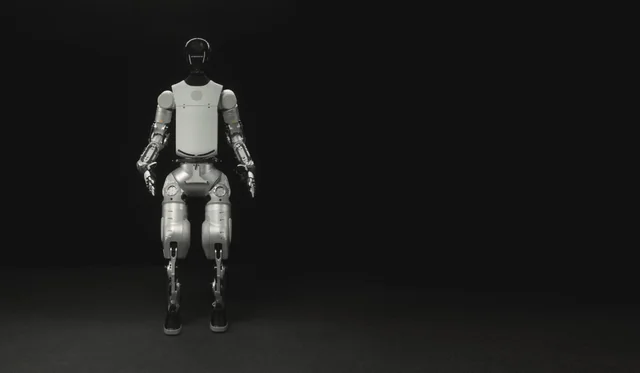
There is an ad going around about a humanoid robot to help around the house. Does anyone know about that? It feels scammy mostly because there is a video on their site showing them folding a shirt that is obviously AI. (The shirt doesn't fold correctly) I guess just curious if anyone knows anything about them. submitted by /u/Exciting_Charity_181 [link] [Kommentare]
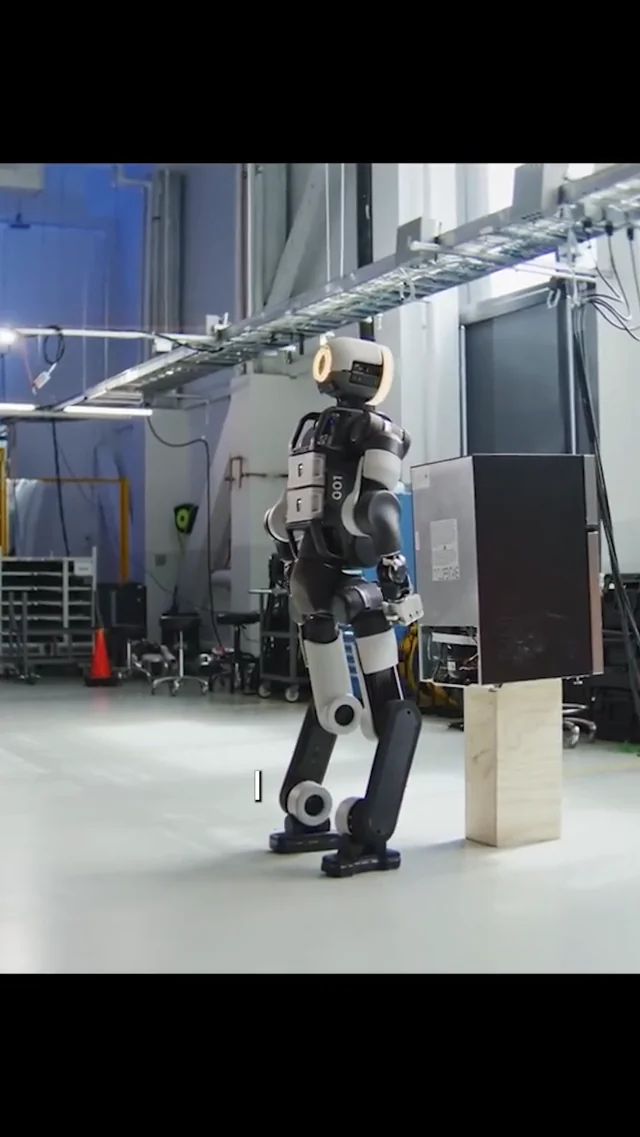
Aya Durbin says humanoid robots need to prove real customer value before they can scale. She says the goal for Atlas is not just to be impressive, but to deliver positive ROI for customers. Boston Dynamics is focusing on industrial environments first, especially work that is hard to hire for, physically demanding and difficult to automate with traditional systems. She also says customers need robots that are reliable, useful and able to become a trusted part of the workforce. submitted by /u/Responsible-Grass452 [link] [Kommentare]


Hi, after about 10 years I rediscovered a seed phrase I had written down, unfortunately without any hint to which currency or what kind of wallet. Metamask doesnt accept it, electrum doesnt accept it. After a bit of digging (and re-learning) I found out that it looks like it has some different words apart from the BIP39 words, "bagpipe" for example. Is there any way for me to find out to which kind of wallet the phrase belonged to? If not, oh well. It could not have hold much anyways. If yes, nice, very small bonus :D Thanks in advance to anyone who could help! submitted by /u/Blairsen [link] [Kommentare]
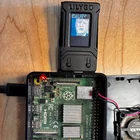
I trained a 128×128 DCGAN on my Macbook M3 and deployed it on a Raspberry Pi 4 connected to a LILYGO TTGO T-Display ESP32. The whole thing runs headlessly as a systemd service and generates hallucinated face hybrids at the press of a button. It is a 6-block generator (latent → 4×4 → 8×8 → 16×16 → 32×32 → 64×64 → 128×128) with feature maps starting at f×16=1024. Corresponding 6-block discriminator. Trained for 800 epochs on Apple Silicon MPS, 4 hours. Dataset was 2480 images across 11 subjects. One dominant anchor class (2000 images) contaminated with minority classes to produce hybrid outputs. (Can you guess who and what was included?). : ) I exported the model from PyTorch to ONNX (float32, 53MB). Inference takes 3 seconds per face on Pi 4. The Pi generates the face and sends it to the ESP32. The title is generated through a dictionary and a template sentence: "This is a NFT and I want to it." The device was built as an art piece. I took it to the streets of NYC and let strangers use it. Full video: https://youtu.be/y-S74aoud54?si=yPh5GmCJZFIIzwq6 Happy to discuss the training pipeline, ONNX conversion, or anything you're curious about. submitted by /u/Numerous-Dentist-882 [link] [Kommentare]
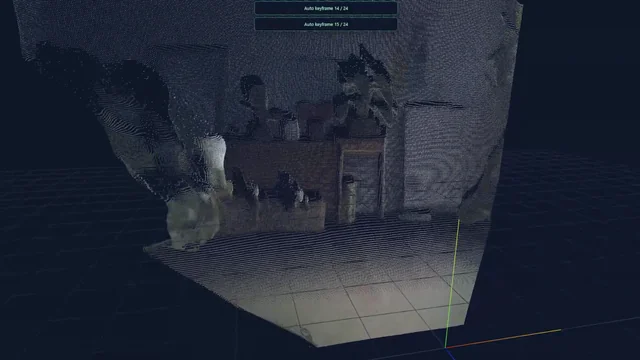
Hey everybody! Hobbyist here with an update on my cheap rover swarm project. I've been trying out Depth Anything 3 and wanted to share, because the results of such minimal hardware surprised me. The setup: each rover is just a XIAO ESP32-S3 Sense (~$15 board with a tiny onboard camera) in a 3D printed body. The ESP32 is basically a sender, it streams the camera over WiFi and reports temperature/battery/telemetry. All the heavy lifting (DA3 inference, navigation) runs on a PC that acts as the brain. No lidar, no depth sensor, one cheap RGB camera. DA3 gives me a point cloud per frame and can merge multiple frames into a larger cloud. Seeing a $15 camera produce a usable 3D-ish image of the room is still kind of wild to me. Eventually I want to use it for navigation - a kind of "poor man's lidar". It estimates what's near at three heights (eye level, above, below) to give a rough obstacle sense without a dedicated sensor. Secondly for visualization at the moment, but the goal is to stitch frames into an environment map. Positioning is currently handled by ArUco markers around the room (solvePnP). Still early and held together with hope, but it's been fun pushing this hardware further than it wamts to go. :-) submitted by /u/monkeydance26 [link] [Kommentare]