Channels








I just got random 0,03 YFIB on my Ethereum Adress. Now it is the most valuable Asset that I am holding. 0,03 YFIB costs more then 68.000 USD Is this a scam what I have to do to be safe? Am I able to remove it cause it does not show me how much I really heave. 1 YFIB shows me is 2467424,99 USD submitted by /u/Pulsary28 [link] [Kommentare]




Hey everyone, I’ve been building an end-to-end Air Quality (PM2.5) forecasting pipeline for 4 countries (US, UK, India, Australia) using 1.6M+ rows of OpenAQ and NASA weather data. The problem i hit (the variance trap): My V7 model was a standard stateless Gradient Boosting Regressor. It worked great for low-variance regions (like the US), but in highly chaotic environments (like India and the UK), the model was mathematically failing. When I calculated the MASE (Mean Absolute Scaled Error), it was > 1.0. Literally, a naive carryover guess was outperforming my ML model because the model couldn't anticipate sudden momentum shifts. the fix (Horizon aligned architecture): Instead of falling into the recursive snowball trap (where day 1 error compounds into day 30), I completely decoupled the horizons. I engineered strict autoregressive lag vectors aligned specifically to the target horizon (h=1, 7, 14, 30). Injected a 3-day rolling volatility matrix that ends precisely at the inference boundary to prevent data leakage. Result: MASE dropped strictly below 1.0 globally Even at a 30-day horizon, the model maintains a 57% predictive accuracy over the chaotic thermodynamic baseline. The stack: backend pipeline : Python, Pandas (for the memory matrix), scikit-learn, FastAPI. frontend : Next.js 16 (App Router), Tailwind v4, Recharts. Deployment: Vercel with automated GitHub CI/CD sync. (currently pushing updates manually afetr every test, so the site is actually static will automate it later) I'm currently using scikit-learn GBR, but but my immediate next step is to rip it out and rewrite the core engine using Xgboost or LightBGM to handle the sparse temporal features better. If any MLOps or Data Engineers here have advice on scaling XGBoost for multi-horizon forecasting without exploding the compute, I’d love to hear it. Roast my architecture, the repo is public. live URL : https://global-aq-intelligence.vercel.app/ github: https://github.com/divyanshailani/global-aq-intelligence-pipeline submitted by /u/Divyanshailani [link] [Kommentare]
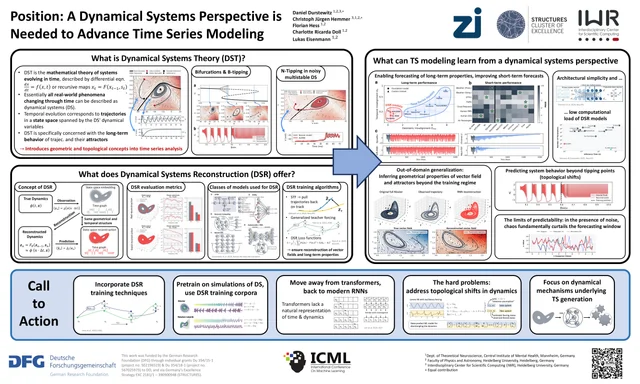
In our #ICML2026 position paper we argue a dynamical systems perspective is needed to drive time series (TS) modeling forward: https://arxiv.org/abs/2602.16864 Essentially all time series in nature and engineering come from some underlying dynamical system (DS), mostly chaotic for complex systems, and acknowledging this helps to address many open problems. Dynamical systems reconstruction (DSR) goes beyond mere forecasting and gives us an understanding of the dynamical rules that underlie observed time series. This in turn may enable true out-of-domain generalization and predicting a system’s long-term behavior, something current TS models cannot do. In the paper, we compare a variety of custom-trained and recent foundation models for TS and DSR w.r.t. short- & long-term forecasting. Specifically, we suggest: 1) Put a focus on DSR-specific training techniques and objectives in TS model training, such as generalized teacher forcing (https://proceedings.mlr.press/v202/hess23a.html). These will enable capturing long-term statistical properties and dynamical structure, and at the same time help massively reducing parameter load and complexity of TS models. Proper training is more important than model architecture! 2) Pretrain TS models on simulations from dynamical systems, rather than on artificially created time series functions. These will yield much more natural priors for real-world TS. Chaotic systems in particular contain a rich temporal structure and many timescales (often an infinite skeleton of unstable periodic orbits of any period). 3) Move away from transformers, back to modern RNNs. DS are defined by recursions in time. By ignoring this and potentially further coarse-graining signals, transformers lose essential dynamical information, making them generally incapable of capturing a system’s dynamical rules. This is evidenced by their failure to forecast a DS’ long-term statistical or geometrical structure. 4) Address the hard problems in TS modeling: Topological shifts (https://proceedings.mlr.press/v235/goring24a.html). Although in itself tricky, the really hard problem in TS forecasting is not so much mere out-of-distribution shifts, but changes that drive a system across tipping points or into different dynamical regimes, where the vector field topology changes. 5) DS properties like attractors or bifurcations are universal – acknowledging this in TS modeling will give a kind of mechanistic and transferable understanding of TS properties that is independent from specific (physical, medical, …) domain knowledge. It therefore also pays off to put a focus on mathematically tractable and interpretable models. With a great team of shared-first & co-authors, Christoph Hemmer, Charlotte Doll, Lukas Eisenmann & Florian Hess! submitted by /u/DangerousFunny1371 [link] [Kommentare]