Channels
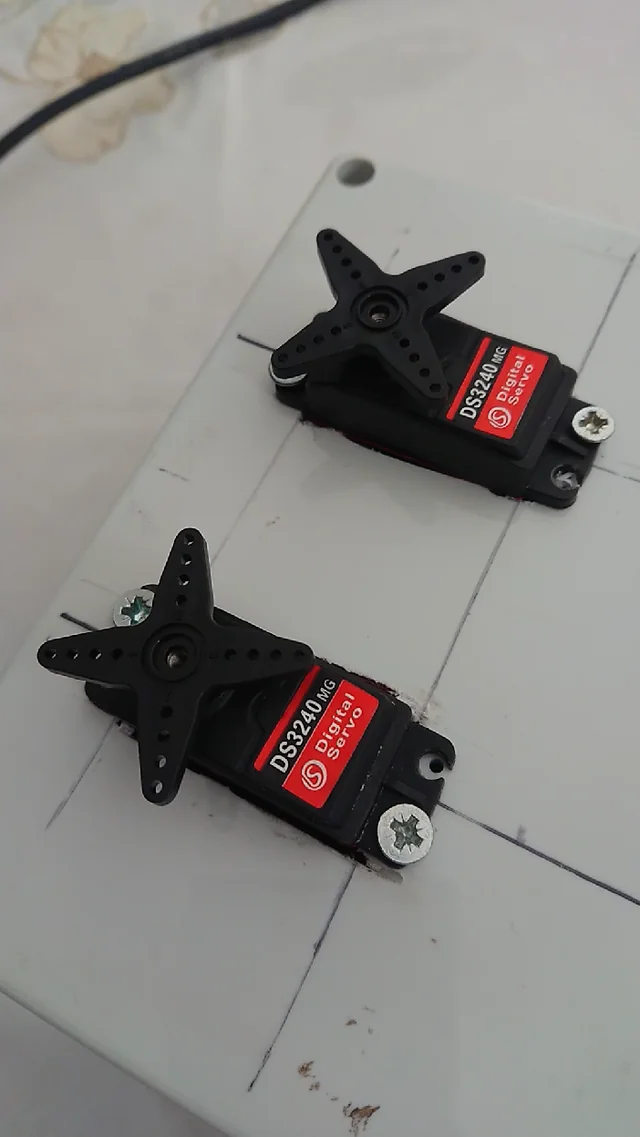
Need help with my servos. Using DS3240 MG servo motors. Getting weird jitter sometimes, sometimes not. Sounds very scratchy. Power supply is definitely strong enough. Happens with and without load. Signal wires seem far enough from noise sources. The motors have stalled once when the arms of the two collided, and I'm thinking that the gears got damaged because of that. Although I think it's unlikely because these motors are designed to be able to hold a max load of 40kg submitted by /u/YengaJaf [link] [Kommentare]




I need to tske somthing out but im not spending the minimum of 50 dollars worth of polygon just to take out money can someone send me like a little bit of it please. 0x622e3aeeFcD7Ac0ec7c0C7479e30Fc9FD9cE4122 submitted by /u/Admirable-Shift1856 [link] [Kommentare]
Hi everyone, I made an open-source Ultimaker Cura plugin that generates KUKA KRL (.src) code directly from the slicer, allowing you to send your files straight to a KRC2 controller. All your favorite Cura settings are translated directly into the robot code, completely eliminating the need for expensive software like RoboDK, Grasshopper, or SprutCAM. You just slice directly in Cura and go straight to the robot. I wanted to keep this project open-source so anyone in the community can use it for free. https://github.com/nikoladim123/CuraToKRC2 Enjoy! submitted by /u/Unlucky_Resident_237 [link] [Kommentare]


New coin “RE” just listed on Thursday has already doubled. I’m in submitted by /u/OLD-Silver-1471 [link] [Kommentare]

A paper currently trending on paperswithcode.co in the "Anomaly Detection" category is DVD-JEPA. https://i.redd.it/r6fd8n3d4f8h1.gif Here is the short summary: Most attempts to learn a world model from video try to predict the next frame pixel-by-pixel, and drown in detail that is fundamentally unpredictable. JEPA (Joint-Embedding Predictive Architecture, LeCun 2022) makes a different bet: predict the representation of the future, not the pixels, and let the encoder discard whatever it cannot predict. DVD-JEPA is the smallest honest demonstration of that idea we could build. The "world" is a DVD logo bouncing in a 16×16 box. A context encoder, an EMA target encoder, and a latent predictor are trained — with no labels and no decoder — to predict the next observation in a 32-dimensional representation space. We then show three things: It learned the world. A linear probe recovers the logo's exact (y, x) position from the frozen 32-d latent to within 0.73 px — though it was never given a coordinate. It can dream (once you add a decoder). Bolt an optional decoder onto the frozen latents and roll the predictor forward: it renders a correct future-frame video of the bounce, including wall reflections, for ~20 steps before latent drift sets in. It is useful. Run it as a 1-step predictive monitor, and the prediction error becomes an anomaly signal: inject a teleport and surprise spikes 88× over baseline, on the right frame. The whole thing runs client-side in your browser — the trained MLPs are re-implemented in ~40 lines of JavaScript. It is a joke, and it is also a correct, working instance of the architecture behind I-JEPA, V-JEPA, and V-JEPA 2. Find the paper, HF model, and project page here: https://paperswithcode.co/paper/98361 submitted by /u/NielsRogge [link] [Kommentare]