Channels


Look out for a cryptocurrency called PACT. There is one that went live around the 17th and a tone of 15 minute imposters that pump up from a penny to 8 cents over a 3 to 15 minute period. Once it reaches a certain level of holders, the whale sells off all of it and pulls the rug out from under everyone else and it drops in value by 100%. Don't fall for it. submitted by /u/brobeans1738 [link] [Kommentare]
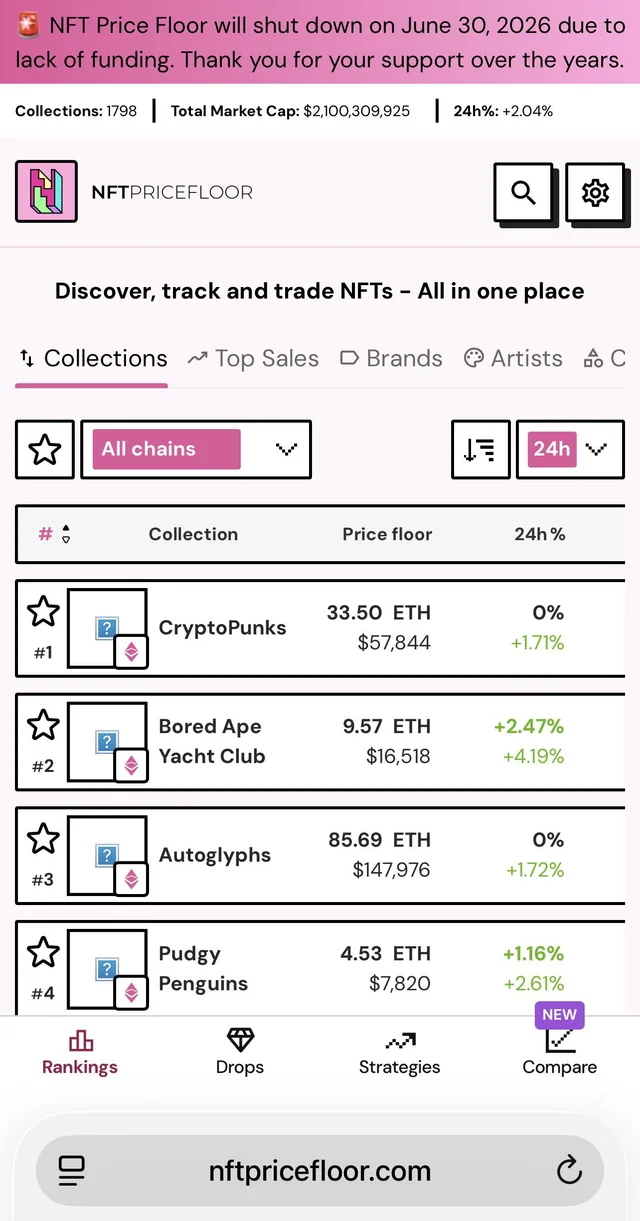
It will shut down at the end of this month. submitted by /u/birth_of_bitcoin [link] [Kommentare]
Me and claude we were discussing this and i feel it makes sense and any genuine points where we are lagging and are we improving which i don’t know i would like to know from you all. Please try to read all the screenshots which i shared. submitted by /u/Leather_Drummer3066 [link] [Kommentare]
Hello all. My friend has asked me about crypto and what is the best exchange to get started with. I think the best thing to do is start with a centralised exchange to get started with before moving onto DEXs, simply because they have more information, ramping of bank cards and also customer service. He's looking to start getting into possibly the top 30 marketcap projects, what exchange would you recommend? For me it's Kraken, but I am curious what everyone thinks, thank you for your responses in advance! submitted by /u/cryptodizzle67 [link] [Kommentare]
$109 billion. That's how much in Treasury bills stablecoin firms bought in just five months after the Genius Act passed. Not Japan. Not China. Not the Federal Reserve. Crypto companies. The "consumer protection" that wasn't The Genius Act requires stablecoin issuers to back tokens primarily with US Treasuries under 93-day maturity. It was sold as protecting users. In reality, every single minted USDC or USDT is now a forced government loan. The numbers that stop you Tether holds $141 billion in US Treasuries more than Saudi Arabia and Brazil Between Tether and Circle, the combined sector holds $160+ billion in US debt Tether is now approximately the 17th largest holder globally TBAC models project up to $2 trillion in incremental demand as stablecoins march toward $3T market cap Why Washington needs this The US must roll over ~$9 trillion in maturing debt with $2 trillion in new borrowing on top. China cut Treasury holdings to the lowest since 2008. Traditional foreign buyers are stepping back. Congress didn't just regulate crypto they conscripted it as the buyer of last resort. The global fallout The RBI explicitly warned stablecoins could erode monetary control. ECB officials called dollar stablecoin expansion a "strategic threat to the euro." 98% of all global stablecoin value is denominated in USD. This isn't replacing the dollar it's extending it through digital rails. Full breakdown: https://youtu.be/iXn1yry5mGY submitted by /u/Free-Benefit-6761 [link] [Kommentare]
This happened a few months ago when I was working on an analysis project that dealt with time-series data. The dataset was large (10 years of data). I was using a standard profiling tool to check the pipeline. Everything looked fine because the tool reported 3% missing data rate for volume columns. I didn't think much about it because I thought it was noise, as this was my first time working with time-series data, but the downstream models weren't acting right. That's when I thought something was off, and I actually looked at the data and found the 3% missing data was not noise; in fact, it was a 6-day worth of missing data. It didn't stop here, though, as the data also had leakage, and the model hit 99% accuracy. The rolling windows and lag features were also messed up, as the chronological sequence was broken. Looking back, if I had done proper EDA, this would not have happened. But I decided to make a small validation tool called tsauditor that catches chronological breaks, leakage, and sudden sequential spikes present in global boundaries. It also adds a description along with evidence on why the data point is faulty and suggests fixes It's open source, lightweight, and on PyPI. I also added an example notebook, which has a side-by-side comparison of tsauditor with a standard profiling tool. You can also check out the comparison notebook on NBViewer. I wanted to simplify the EDA process and reduce the number of custom scripts for a dataset. Link in comments submitted by /u/severecaseofsarcarsm [link] [Kommentare]
If you've tried to study modern diffusion models by digging through the official diffusers library, you know it can be overwhelming with its complexity and abstractions. I wanted to simplify FLUX diffusion models, so I built minFLUX: a PyTorch implementation focused on its core architecture and math. Here is the project: https://github.com/purohit10saurabh/minFLUX What’s inside: - Minimal FLUX.1 + FLUX.2 implementation with VAE and transformer model. - Line-by-line mappings to the source HuggingFace diffusers. - Training loop (VAE encode → flow matching → velocity MSE) - Inference loop (noise → Euler ODE → VAE decode) - Shared utilities (RoPE, timestep embeddings) The most interesting part for me was seeing that FLUX.2 is not just a scaled-up FLUX.1. It improves the transformer blocks, modulation, FFN, VAE normalization, position IDs, etc. The architecture overview of FLUX.2 is attached. Let me know if you find this interesting! 🙂 https://preview.redd.it/9evuthx2vg8h1.jpg?width=1080&format=pjpg&auto=webp&s=47e4f72f4751e1c11d3928f6dcb43c9e96cbbc0b submitted by /u/Other-Eye-8152 [link] [Kommentare]

Updated app with current public data submitted by /u/sickabouteverything [link] [Kommentare]


c0mpute: A decentralized AI built from the collective compute of its users.
Suppose you’re a PhD advisor in machine learning. Your student has been in the program for 4 years, has done solid work, and has a coherent thesis direction but they haven’t published in an A*ML venue or top journal. No NeurIPS/ICML/ICLR/CVPR/etc., and no equivalent top venue in their subfield either but 3 First author A level paper. Would you still support them graduating if the thesis itself is solid? submitted by /u/Hope999991 [link] [Kommentare]
Hi internet friends, I recorded a workshop about building your own LLM without any math / ML prerequisites. It covers everything from machine learning fundamentals, deep neural networks, transformer architecture, and pre/post-training. The only prerequisite is being comfortable with learning through code & excel examples. Sampling Large Language Models Reverse Engineering Large Language Model Perceptrons: wx+b Activation Functions: ReLU, GELU, SwiGLU GPU Coding: PyTorch, torch.compile(), fused kernels, CUDA, Triton MLPs/FFNs: Multi-input, Multi-Layer Perceptrons, Feed-Forward Networks Loss Functions: Residual errors, RMSE, Cross Entropy, Loss Landscapes Backpropagation: Training loops, Optimizers, Learning Rate, Batch Size Saving & Loading Models Initialization: Kaiming, Glorot Residuals: Addition, Scaling, Gated, Concatenation Normalization: Pre-norm vs. Post-norm, RMSNorm, BatchNorm, LayerNorm Regularization: Dropout, Gradient Clipping, Weight Decay SoftMax Tokenizers: By Character, By Word, BPE, SentencePiece Embeddings: Absolute vs. Learned, Sinusoidal vs. RoPE Attention: MHA, GQA, MQA, MLA Transformers Pre-training: Data Sources, Datasets, HTML Cleaning, Quality Filtering, Sharding Evaluation: Leaderboards, Benchmarks, Verifiers vs LLM-as-Judge Instruction Tuning: Alpaca & Other Formats, Self Instruct, Capabilities Reinforcement Learning: Policy Optimization, SimPO What We Didn't Cover: Scaling Each section has slides teaching the concepts, followed by excel-by-hand developing intuition for the math, and then coding examples. The goal is able to grok all parts of modern LLM development. We did this workshop in-person in San Francisco last month and hopefully the spaciousness of watching online works for everyone. If don't like watching videos, you can get the slides and exercises and work self-paced. submitted by /u/JustinAngel [link] [Kommentare]