Channels

MoodLens is an AI workforce platform where humans and AI work together across tasks, boards, docs, meetings, automations, and shared workspaces.
This post contains content not supported on old Reddit. Click here to view the full post submitted by /u/discordditapp [link] [Kommentare]
With the release of meta-reviews, ECCV sent out a google form for dissatisfied authors to submit an appeal for the following reasons: Policy errors, e.g., reviewers or Area Chairs applied a policy that does not exist, or reviewers or Area Chairs applied policies that are not applicable for the contribution type of the paper; Clerical errors, e.g., it is clear from the meta-review that an Area Chair intended to accept a paper but the paper was rejected; and Obvious and major misunderstandings on the side of the reviewers or Area Chairs (historically, these are extremely rare). Is anyone considering submitting an appeal? I was rejected with 6/4/3 final scores on criteria that policy and AC/Reviewer guidelines explicitly state my contribution type should not be penalized for. Also, according to their policies, if they were to use the criteria in their decision, they have to explicitly disagree with the declared contribution type and state so in the meta review (all three reviewers agreed with the declared contribution type and the AC does not mention changing the paper's type.) submitted by /u/Muted-Ad4511 [link] [Kommentare]
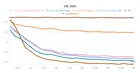
I recently revisited my matrix recurrent units algorithm (the MRU), a novel linear-time sequence architecture I created as an alternative to attention. I explain it in depth at the repo, but the gist is the MRU works by transforming the embedding into an input state matrix, cumulatively multiplying the matrices across the sequence dimension to get the output state matrix, and then transforming the matrices back into a vector. In order to make the MRU efficient on DL hardware, I created a parallel scan by utilizing the operation's associativity. About a year ago, I shared my project on Reddit (I've since renamed my account), with good results on the toy dataset shakespeare-char. A commenter asked the steps taken to bound the matrix states and another commenter found that training was inherently unstable when training on more comprehensive datasets. I addressed these by experimenting with different methods to create the input state matrix. Originally, I simply reshaped the input vector into a matrix and added the identity. Since then, I've implemented the following methods: Using the elements of the vector to fill a skew-symmetric matrix and using the matrix exponential or the Cayley Map to generate an orthogonal matrix Filling LDU factors with elements from the vector and using an activation function on D to enforce a determinant of 1. Creating QR, by using the matrix exponential or Cayley map to create orthogonal matrix Q and filling the upper-triangular matrix R. Dividing by a determinant-correcting scalar factor, found by taking the determinant. I found that these fixes prevented loss spikes with varying tradeoffs. Interestingly, the scalar factor method led to worse results. Dividing the input states should only affect the output states by scaling them, indicating that the unscaled model was "cheating" on the toy dataset by learning a simple scalar decay pattern instead of more complex relationships. Also, using the Cayley Map or matrix exponential to force the input states to be orthogonal surprisingly mostly prevented the model from learning information about the sequence, performing closer to the FFN than the Cayley QR method. The poor performance of orthogonal matrices indicates that the ability to learn shear transformations might be critical for the model. Possibly, rotations enforce dependence on the previous state, whereas shearing allows the model to adjust the state more independently of the previous state. https://preview.redd.it/9ebh98q6uo8h1.png?width=2528&format=png&auto=webp&s=03ccef7f9b90762281aba31ab88af0368e273f69 https://preview.redd.it/fkkud7q6uo8h1.png?width=2528&format=png&auto=webp&s=5e9a2ef2b0e4319990950f16aa0648adebc2c360 Above are the train loss and validation loss on the shakespeare-char dataset for a small MRU LM, transformer, and FFN, with the embedding, state, key, and value size set to 256. The MRU LM has a single MRU layer and 4 MLPs, the transformer has a single attention layer and 4 MLPs, and the FFN only has 4 MLPs. I only used a single sequence-mixing layer in order to isolate the effect of the MRU. Finally, I moved to a larger dataset, trying to replicate https://huggingface.co/roneneldan/TinyStories-33M by training a baseline GPT-2 model and a model with attention replaced with the MRU. I ended up quitting the training runs early, but the loss curves seem to already conclusively show that the MRU performs worse on this task. For the creation of the MRU's input state matrices, I used the method of creating LDU factors, since it has the best performance. https://preview.redd.it/p2uh1pyfuo8h1.png?width=2528&format=png&auto=webp&s=d6406574e0275f1aad52e89cca6462fd55116fcd Above is the validation loss for a transformer and a LM using MRU with the same hyperparameters and dimensions as the huggingface model card. The official TinyStories model was trained for 20 epochs, which corresponds to about 200k steps. In order to compare it to other linear-time models, I also briefly trained a linear transformer, using the algorithm described in Transformers are RNNs: Fast Autoregressive Transformers with Linear Attention. I think that my research shows that the MRU likely doesn't work as a direct replacement for attention for generative language modeling, but I've already laid the groundwork for this algorithm. The MRU has dramatically different strengths and weaknesses compared to other algorithms such as attention, state space models, traditional RNNs, and fast weight programmers. It performs significantly more cumulative computation along the sequence (as opposed to the computation for each token being independent), is significantly more lightweight and hence faster, but also has a much lower storage capacity. I believe that the MRU's alternative uses should still be explored. One usage of the MRU could be applying it to query and key vectors of attention. Similar to RoPE, it would rotate chunks of the vectors, but it would be able to rotate chunks in greater than two dimensions and with dynamic and non-commutative angles. This is one of many applications of the algorithm which I will continue to research, and I hope that others are interested in its applications as well. If you're interested, reach out to me at [mikayahlevi@gmail.com](mailto:mikayahlevi@gmail.com), Reddit, GitHub, or any other platform you can find me at. submitted by /u/mikayahlevi [link] [Kommentare]


Jedes Jahr dass ich älter werde wirds schlimmer. submitted by /u/Smo0thwalk [link] [Kommentare]




Hi everyone I’m exploring the idea around a benchmark around embodied Ai for households Currently the existing benchmarks focus on short tasks inside the home But they don’t take into account that a home is a place where things get worse with time Time only generates the decay Can an embodied Ai be trained to manage this slow decay of a home? The idea would be to create a benchmark where each episode is the live of a home over time The agent does not see the full real state of the house He only see partial signs like dust, small broken things and decides to act upon them without taking into account the long term needed actions If the agents continues like this there will appear at some moment a mayor renovation need which will trigger the failure of the system Something like this Do you think it could be useful for researchers working on embodied Ai? submitted by /u/Head_Concentrate_941 [link] [Kommentare]
I released MetriPlane v0.2.0 and am preparing a SoftwareX research-software paper while finishing my MSc thesis. 3-minute demo: https://www.youtube.com/watch?v=7U5nbBbGGbw Repo: https://github.com/Miko997/metriplane Zenodo DOI: https://doi.org/10.5281/zenodo.20736619 MetriPlane is an observe-only physical-observability tool for bounded workcells. The v0.2.0 demo shows a replayed missing-tool event becoming: - physical event log - Cell Truth Report - evidence bundle - local bundle verification - generated regression test The goal is not robot control or safety certification. The goal is replayable evidence: what physically happened, what proves it, and whether the incident can become a repeatable software check. I am looking for technical feedback from robotics, simulation, manufacturing, digital-twin, and research-software people. Public reproduction issue: https://github.com/Miko997/metriplane/issues/6 I am especially interested in: Does the camera-free reproduction path work on other machines? Is the evidence-bundle / regression-test loop useful? Are the limitations clear enough? What should be validated next? Scope: - observe-only - planar/tagged assets - no robot or machine control - no safety certification - no marker-free tracking claim - no production deployment claim Useful feedback format: OS: Python version: doctor: pass/fail deterministic replay: pass/fail Atlas run: pass/fail bundle verify: pass/fail generated regression test: pass/fail Technical relevance: 2–5 sentences Main limitation: 1–2 sentences Critical feedback is preferred. submitted by /u/No-Editor-8797 [link] [Kommentare]
Hello guys, I’m a 3rd year mechanical engineering student (21 yo). I’m planning to start a YouTube Channel which I’ll do online interviews with engineers working in Aerospace and Robotics Industry about their specialization and their experiences. Are there any of you would be interested in to be my guest? submitted by /u/bertgolds [link] [Kommentare]