Channels

A world model predicts environment dynamics based on current observations and actions, serving as a core cognitive mechanism for reasoning and planning. In this work, we investigate how world modeling based on language models can further push the boundaries of general agents. (i) We first focus on building foundation models for agentic environment simulation. We introduce Qwen-AgentWorld-35B-A3B and Qwen-AgentWorld-397B-A17B, the first language world models capable of simulating agentic environments covering 7 domains via long chain-of-thought reasoning. Leveraging more than 10M environment interaction trajectories of 7 domains in real-world environments, we develop Qwen-AgentWorld through a three-stage training pipeline: CPT injects general-purpose world modeling capabilities from the state transition dynamics and augmented professional corpora, SFT activates next-state-prediction reasoning, and RL sharpens simulation fidelity through a tailored framework with hybrid rubric-and-rule rewards. To evaluate language world models, we present AgentWorldBench, a comprehensive benchmark constructed from real-world interactions of 5 frontier models on 9 established benchmarks. Empirical results demonstrate that Qwen-AgentWorld significantly outperforms existing frontier models. (ii) Beyond foundation models, we further investigate two complementary paradigms through which world modeling enhances general agents. First, as a decoupled environment simulator, Qwen-AgentWorld supports scalable and controllable simulation of thousands of real-world environments for agentic RL, yielding gains that surpass real-environment training alone. Second, as a unified agent foundation model, world-model training acts as a highly effective warm-up that improves downstream performance across 7 agentic benchmarks. Code: https://github.com/QwenLM/Qwen-AgentWorld
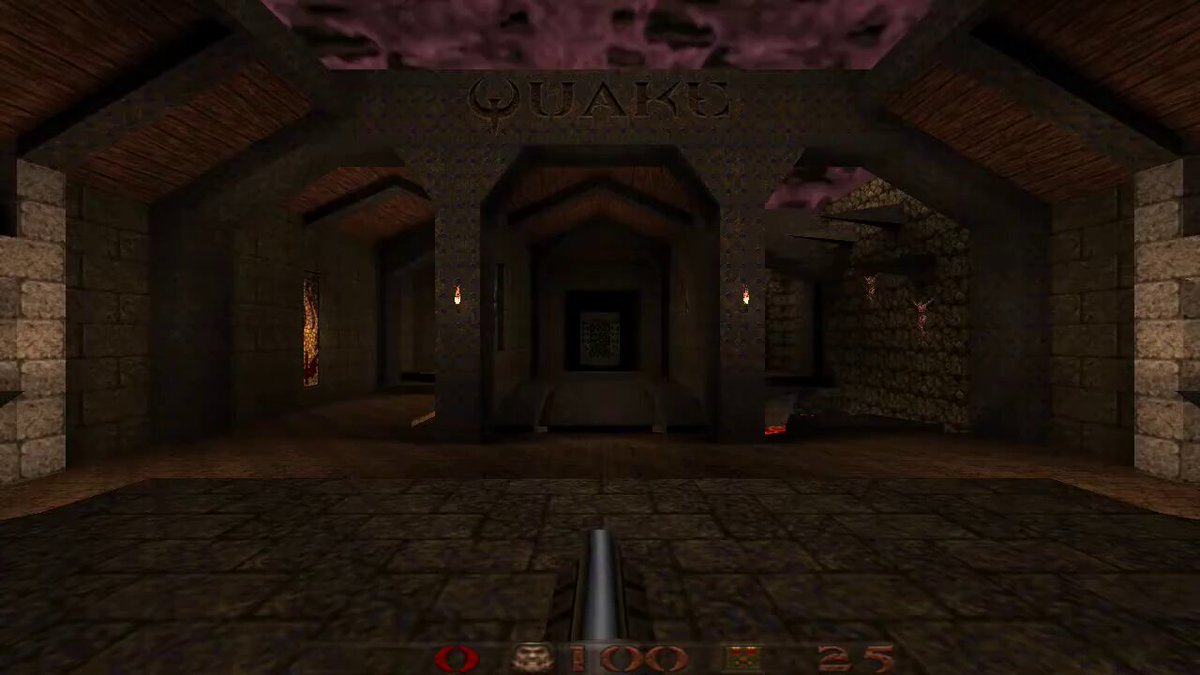
How Quake ruined id Software. There has been a lot of praise of Quake of late, with its 30th anniversary, and it's deserved. Quake is an amazing feat of art, programming, and design. I worked on it, and everything came together almost perfectly from all of us. We ended up with https://t.co/pxtjwSwmJ5
(or, "Thunderclouds Gather on the Horizon") On a couple of occasions, people have responded to my original essay with the comment that what I've created by the end isn't really an ELF executable. Rather, it is a file that the Linux kernel, in its current incarnation, happens to mistake for an ELF executable. It's a fair point. That 45-byte file clearly doesn't conform to numerous requirements of the ELF specification. But can you blame me? How could I have stopped at the point just before I tossed the ELF specification out the window, knowing what might still be possible? But to satisfy these purists, and the puritan side in all of us, I've created this sequel. So. We have an executable that we whittled down to 45 bytes. We now want to bring it into rigid conformance with published standards, while still keeping it as small as possible. The point at which we strayed from straight and narrow path was when we started fiddling with "unused" fields in the ELF header. So let's back up to before that point: This was our ninety-one-byte version. So: are we stuck with this as our best size? No, not quite. We violated no rules when we overlapped the ELF header and the program header table by eight bytes. The ELF specification explicitly permits overlap of different data structures within the file. So let's do that here: That gives us eighty-three bytes. What else can we do? Seems like there isn't much. In desperation, we might turn back to the ELF specification and read it over again, looking for something. Are there any guarantees anything about the initial register values? Only for one register: edx. And what is says is that it will contain either zero, or the address of a final shutdown procedure. So, no guarantees at all, really. Keep looking. A-ha: The p_paddr field of the program header table structure! Every other field of the headers which doesn't apply to to Intel architecture, or doesn't apply to an executable file — or, at least, not to our executable file — is required by the ELF specification to be set to zero. But for the p_paddr field, the specification says the field has unspecified contents. So we have four bytes that we can play with, after all. What can we do with them? Use it to hold part of our program, naturally. Of course, we can't put the whole program there, so we'll need to waste two of the four bytes on a jmp instruction, in order to get to the rest of it. But that still leaves two bytes that we can use, and the first instruction of our program is exactly two bytes long. The next field after the p_paddr field is the p_filesz field. If only we could overlap the jmp instruction with that, we could squeeze another instruction in there. But alas, the first byte of that field is the size of the entire file, which would be an unwise jump to make. And the remaining bytes are zeros. That approach doesn't look too promising. What about the field before p_paddr? That's the address the program is to be loaded at. Well, we already know we don't have to use the default value of 0x08048000. We do need to keep the address page-aligned, at the very least, but we should be able to fit a two-byte instruction into the top half of the address. However, our xor won't work for that. Remember that this is little-endian. The bytes of our program are currently: The xor instruction would leave C0 as the top byte, which has the high bit set, and Linux doesn't appreciate us putting our code there. (As a general rule, in a 32-bit executable, the top half of memory is reserved for dynamically assigned addresses: the heap, the stack, and shared-object libraries.) The "mov bl, 42" instruction, on the other hand, will give us a perfectly acceptable top address byte. So, we can change the load address to 0x2AB30000, and with a little rearranging we have: So we are now at seventy-nine bytes. If we can just find room for one more byte, for the "inc eax" instruction, we could replace the jump in the p_addr field with the "int 0x80", and thus have the entire program legally inside the headers! Just one more lousy byte … Perhaps we could just let the last byte of the program spill over into the next field? That would be the p_filesz field, which specifies the size of the program segment in the file. The last byte of the program is 0x80, which is certainly too big to be our file size. That is to say: Yes, we could lie about the file's size, and Linux will look the other way — but we're supposed to be on the straight and narrow here. The field after p_filesz, however, is p_memsz. If only these two fields were reversed, there wouldn't be a problem. We've looked at this field before: it specifies how much memory to allocate when loading the program into memory. Setting that field to be larger than the file size is perfectly fine. But here is a way that we can use this field: We can jump over p_filesz and into p_memsz. If we try this, we will find that we can, in fact, come out ahead: And we have arrived at seventy-six bytes! This version has the disadvantage that the program requests a fair chunk of memory. 0x0080CD40 bytes, to be precise, or eight megabytes. (And note that we now have to add the writeable flag to p_flags, to allow that memory to be zero-initialized.) Of course the memory is never actually accessed, so it hardly matters, what with virtual memory and all. All this number really indicates is at what address Linux will report a segfault instead of trying to allocate a page of RAM. So there's no real harm done. But it turns out there is a way to use a single byte to jump over four bytes. How? By using a five-byte instruction, of course! Consider a nice, innocuous instruction like "cmp eax, imm32". The only effect it has is to set the flags. Well, that and it advances the instruction pointer: The first byte of the compare instruction is at the last byte of the p_paddr field, leaving the four bytes of immediate data. Our program gets a ride across an intact p_filesz value at half the fare, and that lets us move the increment instruction out of the p_memsz field. This leaves that field holding a value of 0x000080CD, or a little over 32K — a much friendlier amount of useless memory to allocate. This is the final version of our new program. It is 76 bytes long, so we have established conformance with the ELF specification at a cost of 31 bytes. Not bad, all things considered. And now we have two programs for which we can say that every byte has been accounted for. Some of them, yes. But a few are still present, tapping an accusing index finger on our int instruction. Oh, yeah. That. Direct system calls are not actually part of the documented interface with the kernel. (Not for the likes of us, anyway.) The fact that system call no. 1 is exit isn't guaranteed to stay the same under future revisions. Who knows? It's possible that a later kernel will need to introduce new functionality to the exit function, and so, in order to maintain binary backwards-compatibility, they'll introduce a new exit function with a currently-unused system call number, and deprecate the old one. Admittedly, this is extremely unlikely to happen with such a basic necessity as exit. But it does happen. For example, there are no less than three system calls that implement the uname function, the first two having both been deprecated. In order to add more information to the utsname structure, new system calls had to be introduced, permitting the older ones to continue to adhere to the original ABI for backwards-compatibility with older binaries. (If, at some point, everyone was confident that there were no more older binaries floating around, those system calls could be removed entirely, and then perhaps new ones could reuse those numbers. Except of course there are obnoxious people like me who impede such progress by hard-coding direct system calls!) So, okay. If we're trying to be completely above-board, then we're still in the doghouse. And the only way out is to strictly adhere to the documented ABI. In this case, that means we need to exit by using _exit. Not the system call, the function. The one that's supplied by libc. Which means that (groan) we need to re-introduce all that dynamic linking overhead that we've so gratefully avoided so far. That means we need to learn exactly how ELF binaries make dynamic linking happen, so that we can do it ourselves (and in hopefully less space). That's not a trivial subject, however, so we're going to have to save it for the next essay.
The new Fed chair argued that the Fed should stop reflecting markets back at themselves. Forgotten debates show how this leads to confusing, indeterminate results.

Recently, we worked on an indoor racing track project. We had to deploy a real-time tracking system for a fleet of miniature racing cars on an indoor track at an entertainment park. The goal was to display each car's position, trajectory, and race ranking on a large screen while maintaining smooth updates and reliable tracking performance. As we know, Ultra-wideband (UWB) is a technology that enables secure, reliable ranging and precision sensing, through wireless communication, but the main problem of UWB is the signal mutual conflicts/interference, that when multiple anchors&tags exists. That is why MaUWB, which is based on STM32 controller and DW3000, solves the signal mutual conflicts with TDMA, widely used in different positioning and tracking projects. (picture 1) The Hardware Deployment Anchors (Fixed Nodes):8 fixed Anchors installed around the racing track (picture 2) Tags (Mobile Nodes): A custom UWB Tag installed on each race car (picture 3) One of the key challenges was maintaining stable operation with multiple moving Tags within the same positioning area. To reduce signal conflicts and ranging interference, the system uses a TDMA-based scheduling mechanism. This approach significantly improves stability and eliminates signal mutual conflicts when the cars move together. Result By combining software and hardware architecture, Position data is updated in real time and rendered on a large display screen. (picture 4) · Real-time vehicle positions · Driving trajectories · Dynamic race rankings The deployment of the MaUWB project not only greatly improved the gaming experience and visual effects but also reduced the difficulty of using UWB technology, which provides great convenience and a solid foundation for project software development. I'd be interested to hear how you handle multi-tag UWB deployments, especially when scaling multiple moving devices. Let's discuss in the comments! submitted by /u/Vearts [link] [Kommentare]