Channels


TL;DR for anyone who doesn’t click: BNB Chain has launched a zkTLS verification layer with Primus Labs, bringing privacy-preserving offchain data verification to the network. In normal terms: apps can now verify certain real-world or Web2 data, like identity credentials, account history, financial records, Proof of Reserves, or credit-related data, without putting the raw personal information onchain. That matters because a lot of useful blockchain use cases need private data, but public blockchains are not built for exposing sensitive user information. The article says Primus Labs’ zkTLS layer uses zero-knowledge proofs and TLS-secured web sessions to prove data is real without revealing the data itself. It also builds on Primus AlphaNet, a decentralized attestation network designed to avoid relying on one single notary. BNB Chain is adding infrastructure for privacy-preserving identity, DeFi lending, tokenization, Proof of Reserves, and real-world data verification. That could make BNB Chain more useful for apps that need trusted offchain data without forcing users to give up privacy. submitted by /u/FTXACCOUNTANT [link] [Kommentare]
I mean wait this is a genuine DOUBT and I'm not predicting anything (because I don't have that much knowledge/experience). I'm actually thinking about what even makes crypto valuable ? It was supposed to be a currency and act like digital decentralized cash.. but most countries don't treat it as a currency but as an asset. Most people just buy crypto for investing(or gambling). While other asssets like stocks, commodities, bonds have some actual value in them that is visible clearly in real world... what does crypto have ? submitted by /u/-InvictusShadow [link] [Kommentare]
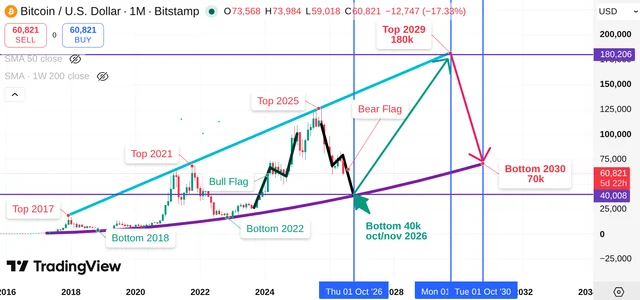
This monthly chart shows the 4 year cycle for btc and probably for most altcoins, resistance for top till now is a straight line, 2025 peak was perfect aligned with 2017/2021 peaks and surprisingly the support line is actually a curve going upward?, bottom points being 2018, 2022 and 2026 towards end of year. From chart a 30% drop may come with a solid floor of 40-45k$ (oct/nov). So a possible monthly bearflag may appear to mirror the bullflag. From resistance line the top for next cycle is 2029 with 180k$ and a possible drop to 70k$ in the upcoming year. Not sure how relevant this chart is but keep in mind this possible scenario:). Also dont know how AI bubble will affect the cycle. submitted by /u/JiZhangYue [link] [Kommentare]


What are some alts that are going to perform well next bull cycle ? Keen to hear your thoughts 👍 submitted by /u/Extreme_Exam7914 [link] [Kommentare]
A few weeks ago I made a post about how coinbase froze my account after a $100K deposit. They finally unfroze my account claiming "There were a lot of transactions that day and it was automatically triggered " Some BS if you ask me. Because you are literally an exchange meant to handle that much transactions freeze my account for no reason. I finally send all to my bank and ledger ASAP but my question is...if exchanges do that how can I send my money to fiat and spend it? How can I spend my money if they can freeze it as soon as I try to send it to my bank? For clowns saying I should wait for FBI knocking on my door. Do you think I can be smart to make almost a million and fuck it all by spilling all I have to the cops? Some people are smarter than your reach and that is why we use crypto. Mixing that shit af. submitted by /u/klandreneau [link] [Kommentare]
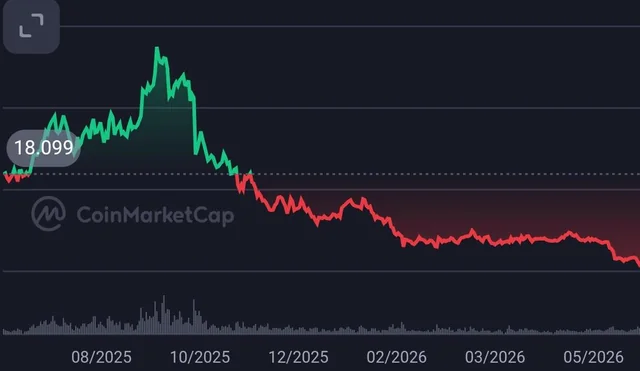
i was up, got greedy, and never took profits now i'm down over 8k can you guess the coin? submitted by /u/ninjaplays69 [link] [Kommentare]
Three things broke my faith in published benchmarks recently. One, Kimi K2.7 Code shipped with plus 21.8 percent on Kimi Code Bench v2, plus 11 percent on Program Bench, plus 31.5 percent on MLS Bench Lite. All three are Moonshot's own benchmarks. None were submitted to DeepSWE, which is the one independent coding benchmark that actually produces a meaningful spread between models. When a vendor reports gains on benchmarks they designed and control, the gains are real but the question they answer is "are we better at our own test" not "are we better at your workload." Two, GLM-5.2 hit 51 on the Artificial Analysis Intelligence Index, which is third party, but the model parameters are self reported. The index is good for relative ranking within the artificial analysis methodology. It is not a prediction of how the model performs on the specific distribution of inputs my product sends it. Three, Seed 2.1 just landed and the official information is thin. No clear public eval yet, no third party leaderboard entries I could find. So for now "Seed 2.1 is good" is just not a claim I can verify either way. What I did was build a small eval set from real production traffic, about 240 tasks sampled across our actual usage distribution, frozen so it does not drift. Every model I consider has to run all 240 and I record pass rate, latency, token cost, and a subjective quality score from the person who owns that task area. It is not as rigorous as a published benchmark and it is definitely smaller, but it has one property the published ones do not, which is that it is my distribution. The implementation detail that mattered more than I expected was removing provider variance from the run itself. I route every candidate model through GPTProto so each one gets the exact same 240 prompts in the same order, and the cost and latency come back in one log schema instead of five dashboards. A homegrown shim would do the same job, the point is not the product, it is that a fair comparison only works when everything except the model is held constant. The results have been humbling. The model that wins on our set is not always the one at the top of the public leaderboard, and the gap between first and second place on our set is much smaller than the gap the press releases imply. We also caught one model that benchmarked great but had a nasty failure mode on our long tail of edge case prompts that would have been a production incident if we had shipped it. I am not saying public benchmarks are useless. They are useful for narrowing the field. But the decision of which model to actually put in front of users should be made on your own data, and the eval set has to be frozen and versioned or it will quietly become "things the current model is good at" and stop measuring anything. submitted by /u/Additional-Engine402 [link] [Kommentare]
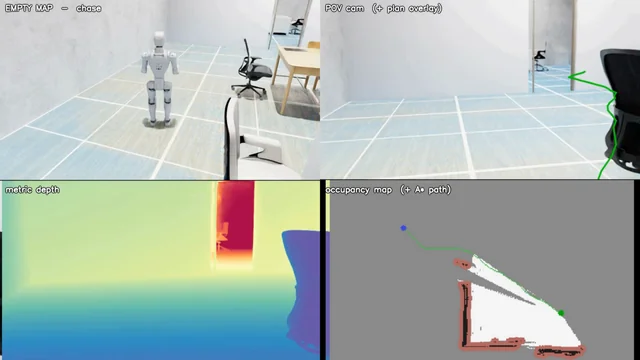
- chase: third-person view of the humanoid walking to the goal - POV cam: the robot's onboard RGB, with the planner overlay (🟢 global A* path, 🔴 immediate move) - metric depth: Depth-Anything 2's per-pixel depth - occupancy map: top-down log-odds grid being built live-> white=free, red=obstacle+inflation, green dot=robot, blue=goal, green line=A* path The robot starts with no map. It draws one as it walks, steering around furniture to reach a goal in the next room. This is a monocular-vision stack for perception, mapping, and navigation: Depth-Anything-V2 turns each RGB frame into metric depth, visual-inertial odometry (VIO) fuses that depth with the IMU for pose, the two build a live occupancy map, and an A*/DWA planner walks the robot to the goal. What would make this more close to reality? Curious to know what tends to break first when a stack like this moves onto hardware. submitted by /u/airwarmedd [link] [Kommentare]
Is this the Move-37 moment for flooring? I know, this machine is engineered for this job and probably needs close to perfect conditions to work, hence lacking the "creativity" of AlphaGo. But still, don't look where we are today, but 2 more machines down the line. Seems frightening for flooring installers at least. submitted by /u/LatentSpaceLeaper [link] [Kommentare]