Channel
c/robotics
No description.
Owner @master · 587 posts · 1 joined · Status active · Posting permission: Every logged-in user can post
Sharing a public write-up of our dual-pillar verification work: Policy stress under mass/friction tiers on Lift, Stack, PickPlaceCan, Door (robosuite / MuJoCo, n=50, paired seeds, Wilson CIs) Physics-consistency checks on generative video (CogVideoX I2V pilot documenting a freeze/hover failure mode) Positioning: fast private eval before hardware trials / institutional leaderboards — not a substitute for RoboArena or real-robot benchmarks. Article: https://haga.mushoodhanif.com/article/sim-physics-consistency-v1 Lab: https://haga.mushoodhanif.com/lab If you run sim-first policy work and want a scoped private report, the site has a submit-for-eval form (48h acknowledgment). submitted by /u/Divine-Demon7 [link] [Kommentare]

Hi! I don't know if this has been posted about before or not, but for the past week, I've been trying to control my SPIKE Prime with custom commands via BLE. However, as far as the forums stated (from what I have read), it wasn't possible without Pybricks. However, while tinkering with the robot, I found that BLE control is just an "environment variable" that could be switched. Thus, we don't need a firmware to control BLE, we just need a *one-time setup" using a USB UART communication. If you want to use this for your own projects, please check out the code, and if you like it, please drop a star on the repo! https://github.com/Somespi/prime-connect submitted by /u/Formal-Arachnid-4247 [link] [Kommentare]
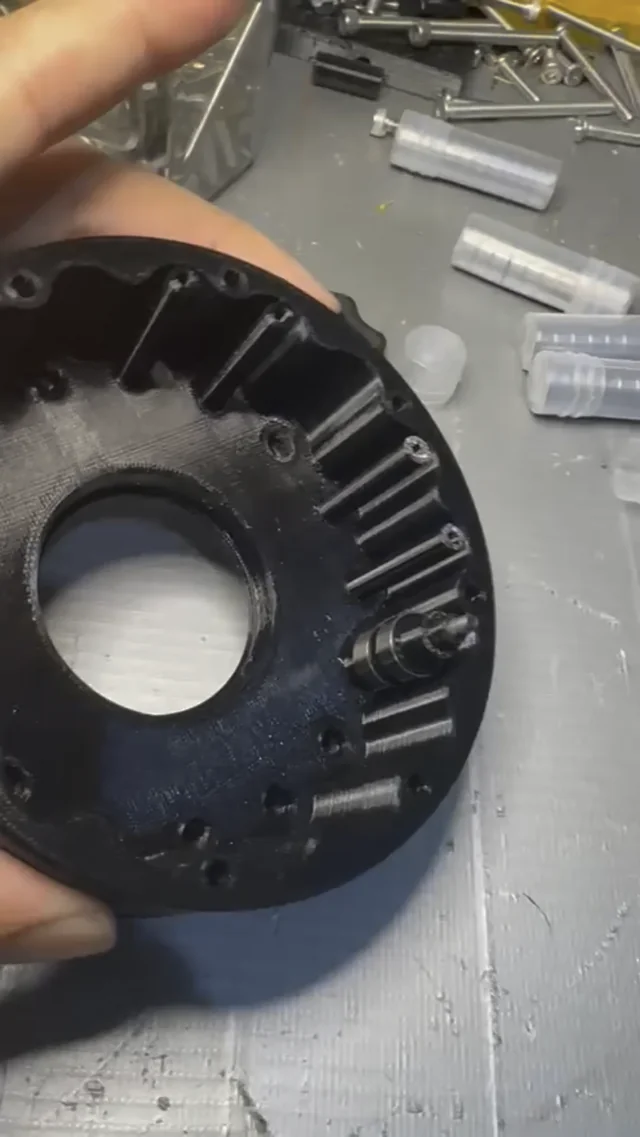
This is my DIY 3D-printed cycloidal gearbox, designed and built from scratch in my room. Every part was printed, assembled, and tested to create a compact gearbox with high torque, low backlash, and smooth motion. There are still improvements to make, but that’s part of the engineering journey. Every prototype gets me one step closer to a better design. What would you like to see next—torque testing, durability testing, or a full assembly tutorial? #DIY #CycloidalGearbox #3DPrinting #Engineering #Robotics #Robot #MechanicalEngineering #Gearbox #Maker #Prototype #Innovation #STEM #CAD #3DPrinted #RobotArm submitted by /u/Personal-Wear1442 [link] [Kommentare]
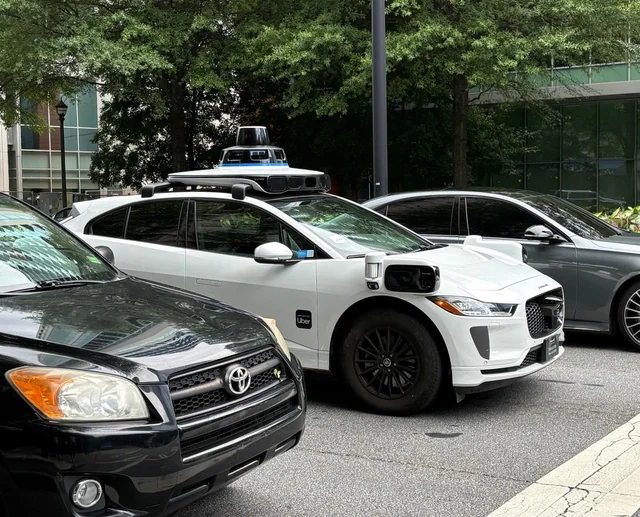
Buckhead area of Atlanta, self driving Ubers are common to see. The dome on the roof acts as the eyes and brains of the vehicle. It spins to detect radar and use the cameras for guidance. submitted by /u/swampysister [link] [Kommentare]
Background: I confounded a startup last year on Execution as a Service model. We're two confounders, and a core team of 5 guys. 4 of us used to be at xAI human data. And collectively we've worked for most of the leading genAI companies in the human data space. We started off as a managed outsourcing platform where we assign a frac COO to handle your entire outsourcing ops across functionalities which also included AI annotation and labelling. The problem: We were trying to secure contracts all over the place. Though we had 150+ registered fulfilment partners, and we secured some sizable contracts, I was genuinely confused about the growth and the direction of the company, specially with the kind of developments happening in the ops domain. I just brokered a deal valued at over 100k just for sharing internal ops data for AI training. We can't predict exactly how would the space look like. The present: The outsourcing business isn't fully justified to the kind of profiles the core team has. We were being reduced a software and marketing firm. We figured out that we need to stay relevant in the data industry. With the logistical edge that I have, and the trial run I did, I am very confident about working on physical data. We collected over 10 hours sample dataset spanning across household, industrial, construction, and electrical egocentric data. The question: Before we jump into physical data, I am genuinely looking for researchers' perspectives on ego-exocentric vs synthetic data. I understand that the upfront cost is high for synthetic, but long term cost is significantly cheaper, but how does the difference play out in the actual training workplace. TIA submitted by /u/Low_Can_4600 [link] [Kommentare]
A six-week UK trial paired Age UK volunteers with older adults through telepresence robots placed in their homes. Volunteers used the robots for regular social interaction and to guide participants through personalized exercise plans two to three times per week. Researchers reported small reductions in physical frailty, improved confidence and increased digital literacy. Some participants also became comfortable enough to begin socializing outside their homes again. The project is now being used to inform UK policy discussions around standards, procurement, regulation and implementation of assistive robots in health and social care. submitted by /u/Responsible-Grass452 [link] [Kommentare]
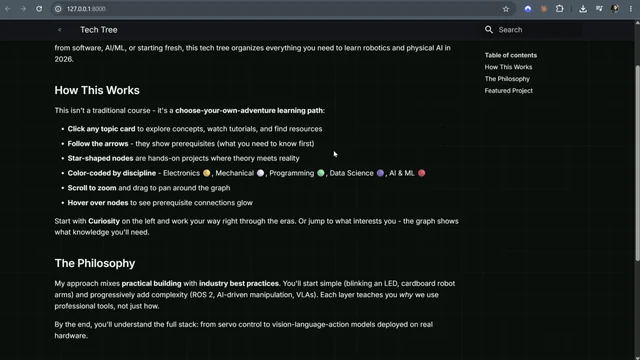
If you've tried to get into robotics, you've probably hit one of these walls: How do I get started? How do I get from blinking an LED to an autonomous robot? I come from a software (or mechanical, or data) background, what am I missing? I couldn't find a single good answer to these, so I started building one: an open source "tech tree" for robotics. It's a visual skill map. You start at the root and unlock the rest as you go (electronics, mechanics, programming, data science, AI), with hands-on builds as the milestones: blink an LED, a sensor project, a robot arm, a robot dog, and up into more serious AI. The main idea: it's not new content. There is already a ton of great tutorials, courses, and docs out there. The tech tree is just the map that sits on top of it and points you to the right resource for each skill, in an order that makes sense. It's early and nowhere near complete, which is kind of the point. It's fully open on GitHub, so if you have a favorite tutorial, a course that made something finally click, or a resource you wish you'd found sooner, you can add it. PRs and issues welcome, and "you forgot X" comments even more so. Links: Website: https://www.backtoengineering.com/ Repo: https://github.com/iuliaferoli/backtoengineering What would you add, or what's missing from the paths? submitted by /u/Growth-Sea [link] [Kommentare]

Here are the demos, a robot arm, a walker, and an RC car, more to come https://flomotion.app/motion/demos submitted by /u/dexx-32 [link] [Kommentare]

I have been thinking of building a project where a robotic arm is controlled by a local VLM model. In my understanding I feed the VLM a 2D image of the object infront of the robot and query the vlm task like "grab the hammer" and VLM provides the 2D co-ordinates and then it goes to moveit and moveit plans the mission. I'm still at the vague idea state, any kind of input or reference or guide will be appreciated! Thank you in advance!! submitted by /u/LearnfromAsking [link] [Kommentare]

I love experimenting with different boards for computer vision and robotics :D And when a board labeled "Robotics board" appeared, I decided to investigate it. Previously, I tested Qualcomm, Intel, and a few other boards. And in my opinion, this one is pretty nice on this list. No, of course, all of them are worse than Jetson (except for the price part). But it's nice that vendors are increasingly considering this task. My full overview you can find here: Article - https://medium.com/@zlodeibaal/rdk-s100-review-80-tops-robotic-board-d9ad0f464942 Video - https://youtu.be/WHAEl05g8Xk A few highlights here: The S100 is genuinely fast. Especially for classic computer vision. It's not an "INT8" board, which I hate the most:) Pipelines are nice: Python bindings, easy export, good support of operations, etc. Nice extension board. With ~$ 30, you can add GMSL support and a CAN/30-pin header LeRobot support But of course: It's not "super cheap". Just "cheaper than NX" or "cheaper than Jetson with GMSL" Export is working for general policy. But it tends to fail for accurate actions where a few millimeters of accuracy is required. I am still investigating this Only ACT is supported from LeRobot submitted by /u/Wormkeeper [link] [Kommentare]
If your design is highly anisotropic and nonlinear, does that mean you should forget about it because it is too complex to model? With current sim-to-real training approaches, the ability to model interactions becomes increasingly important. The more complex the model, the less practical simulation becomes. Part of me completely understands the value of simpler designs. But I am still wondering whether we may sometimes dismiss designs now that could provide valuable mechanical behavior simply because they are more difficult to simulate. I am not sure whether this is ultimately helpful, or whether it creates constraints on the types of mechanical designs we are willing to develop. submitted by /u/GloomyCity9841 [link] [Kommentare]