 R
↗
R
↗
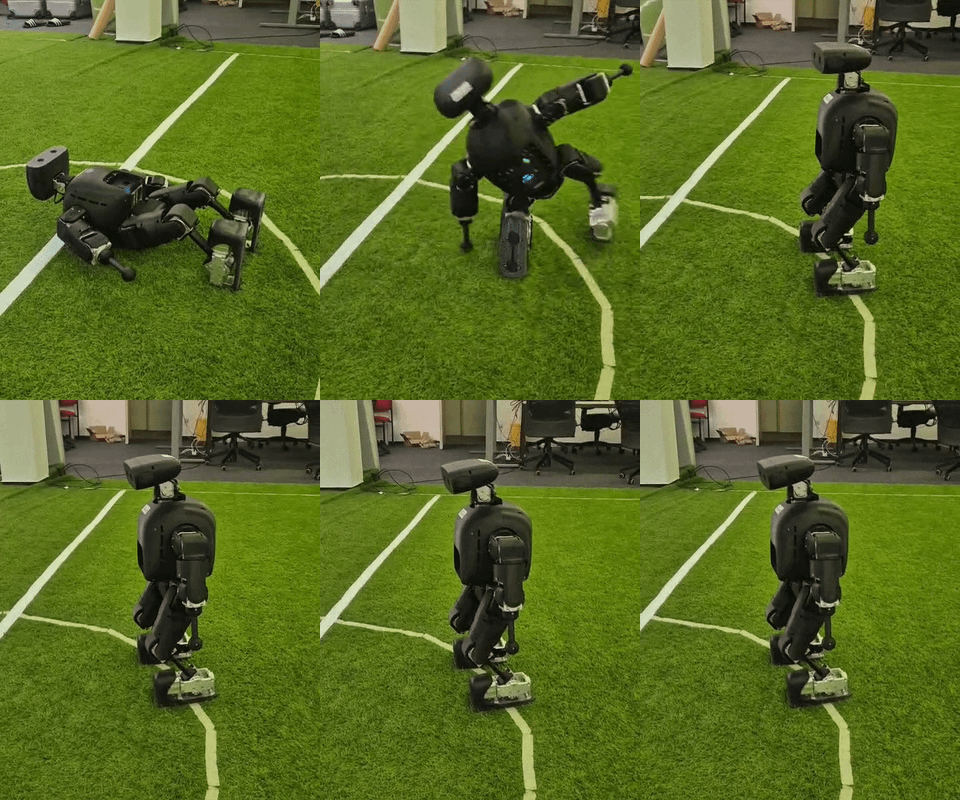
Trained in mjlab with a relatively simple reward function mainly rewarding torso height and end pose + some simple energy, self collision etc penalty. submitted by /u/floriv1999 [link] [Kommentare]
 R
↗
R
↗
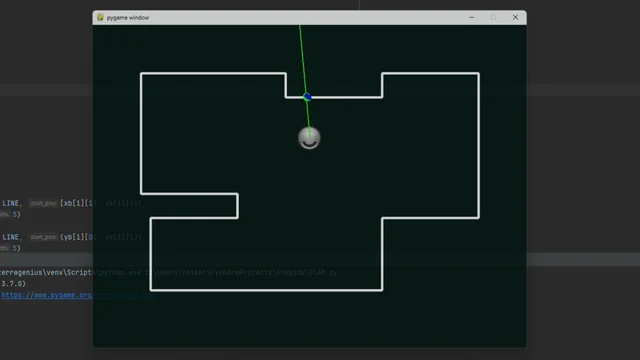
In this python simulation: a robot spins a sensor and receives the distance. I made the distance more inaccurate the farther it is from a wall. The white lines are the actual walls The green dots are the raw, inaccurate data points the blue lines are my attempt at trying to interpret the data points into walls The algorithm works like this: For every green dot, if there are two close dots, it finds the best fit line, deletes the middle dot, and moves the other two onto the best fit line. This averages out the slopes between the green dots to allow for slope comparison. For every green dot, if the angle of the lines connected the green dot in front and behind are similar, then they are clipped into just two dots (similar to the first filter). However, as you can see, it is making walls even farther off from the green points, especially for vertical sections. I suspect this is because I'm using y=mx+b, and the slope for a vertical line is undefined, so I think the algorithm has a hard time approaching that. For context, I'm an incoming freshman trying to design an algorithm for a roomba without any prior knowledge on SLAM algorithms, so I would greatly appreciate any resources for a better implementation or just general feedback. submitted by /u/ExerciseCrafty1412 [link] [Kommentare]
 R
↗
R
↗
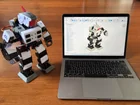
I designed and built this 16-DOF humanoid robot using low-cost servos and fully 3D-printed parts. I’m currently working on the bipedal walking system and developing the locomotion algorithms based on the robot’s forward and inverse kinematics. I’ll be sharing more updates soon! Here’s a short video showing the development process so far: https://vt.tiktok.com/ZSCJJAqr6/ submitted by /u/RoboDIYer [link] [Kommentare]
 R
↗
R
↗
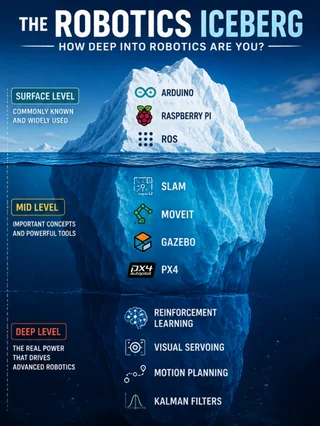
I know this isn't a perfect robotics iceberg, but I thought it'd be fun to visualize how deep the field gets. What would you move up, move down, or add? I'm curious to see what experienced roboticists think belongs at the deepest level. submitted by /u/RoboticsDaddy [link] [Kommentare]
R
↗
Unlike previous editions of IROS/ICRA, there seems to be no IEEE RAS travel grant on the IROS 2026 website this time, the only grant available is the IES-SYPA grant for upto 15 people. Is this not really less compared to any previous editions? submitted by /u/sarthaxbeatz [link] [Kommentare]
R
↗
Hi everyone I’m exploring the idea around a benchmark around embodied Ai for households Currently the existing benchmarks focus on short tasks inside the home But they don’t take into account that a home is a place where things get worse with time Time only generates the decay Can an embodied Ai be trained to manage this slow decay of a home? The idea would be to create a benchmark where each episode is the live of a home over time The agent does not see the full real state of the house He only see partial signs like dust, small broken things and decides to act upon them without taking into account the long term needed actions If the agents continues like this there will appear at some moment a mayor renovation need which will trigger the failure of the system Something like this Do you think it could be useful for researchers working on embodied Ai? submitted by /u/Head_Concentrate_941 [link] [Kommentare]
R
↗
I released MetriPlane v0.2.0 and am preparing a SoftwareX research-software paper while finishing my MSc thesis. 3-minute demo: https://www.youtube.com/watch?v=7U5nbBbGGbw Repo: https://github.com/Miko997/metriplane Zenodo DOI: https://doi.org/10.5281/zenodo.20736619 MetriPlane is an observe-only physical-observability tool for bounded workcells. The v0.2.0 demo shows a replayed missing-tool event becoming: - physical event log - Cell Truth Report - evidence bundle - local bundle verification - generated regression test The goal is not robot control or safety certification. The goal is replayable evidence: what physically happened, what proves it, and whether the incident can become a repeatable software check. I am looking for technical feedback from robotics, simulation, manufacturing, digital-twin, and research-software people. Public reproduction issue: https://github.com/Miko997/metriplane/issues/6 I am especially interested in: Does the camera-free reproduction path work on other machines? Is the evidence-bundle / regression-test loop useful? Are the limitations clear enough? What should be validated next? Scope: - observe-only - planar/tagged assets - no robot or machine control - no safety certification - no marker-free tracking claim - no production deployment claim Useful feedback format: OS: Python version: doctor: pass/fail deterministic replay: pass/fail Atlas run: pass/fail bundle verify: pass/fail generated regression test: pass/fail Technical relevance: 2–5 sentences Main limitation: 1–2 sentences Critical feedback is preferred. submitted by /u/No-Editor-8797 [link] [Kommentare]
R
↗
Hello guys, I’m a 3rd year mechanical engineering student (21 yo). I’m planning to start a YouTube Channel which I’ll do online interviews with engineers working in Aerospace and Robotics Industry about their specialization and their experiences. Are there any of you would be interested in to be my guest? submitted by /u/bertgolds [link] [Kommentare]
 R
↗
R
↗
I’m working on a concept called CENTAUR — a self-balancing single-wheel vehicle combined with an embodied AI companion. It’s not positioned as a scooter or e-bike. It’s designed as a personal mobility companion that learns you over time. Core idea A vehicle that: balances itself (single-wheel platform) carries you safely in urban + off-road environments has an AI personality that evolves with your behavior remembers places, routes, and shared experiences communicates through a physical “face” (eyes + expressions) actively supports safety in real time What it includes (MVP concept) Self-balancing single-wheel system Ride + follow modes AI voice companion (local edge model) Memory system (routes, preferences, history) Safety assistant (fatigue, risk detection, emergency response) Expressive front “face” (eyes + basic emotions) Safety-first design Real-time balance + obstacle avoidance runs locally (
R
↗
Disclosure: I work with a commercial robotics data collection team. This is not a sales post. I've been comparing different human-demonstration formats for robot manipulation, and I'm curious which configuration researchers find most useful for initial testing. The main options seem to be: • Egocentric video only • Egocentric + two wrist cameras • Task and step labels • Country and collection metadata Egocentric-only data is easier to scale, but hands often block the object. Wrist views improve grasp visibility, although synchronization and motion blur create extra problems. We're considering releasing a small free public evaluation sample from the US, UK and Australia. It would require no signup, email or contact details. Which format would be most useful for testing an existing manipulation or imitation-learning pipeline? Also, what minimum information should be included: camera calibration, FPS, task labels, timestamps, licensing documentation or failure examples? I can share the public sample in a follow-up only if the moderators confirm that it is appropriate. submitted by /u/WideAmbition1964 [link] [Kommentare]
 R
↗
R
↗
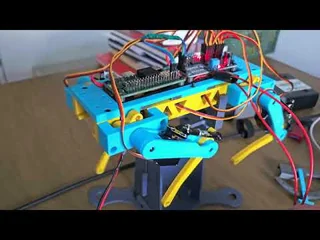
It seems that everyone around is building robots these days. Overcoming my laziness, I decided to also build my own small robodog, and I'm sharing the result of this project, which took me quite a bit of trials and errors during long evenings. All parts were designed from scratch. Everything that is plastic was 3D printed. Everything that isn't plastic was sourced from generic stores - there are no custom CNC orders here. The main SBC is a Radxa Zero 3W running Ubuntu 24.04 with ROS 2 Jazzy. The servos are powered by a Sunflower PCA9685 driver board. There are two separate power rails: 5V for the Radxa and 6-7V for the servos. The trotting gait is shown in the video. I'm currently using an inverse kinematics algorithm, but my long-term plans include Tensor Lite and trained neural networks for skills. The project is still ongoing - I have so many things to try and learn. But it is solid enough as a good foundation for future iterations. submitted by /u/Consistent_Chance_97 [link] [Kommentare]
 R
↗
R
↗
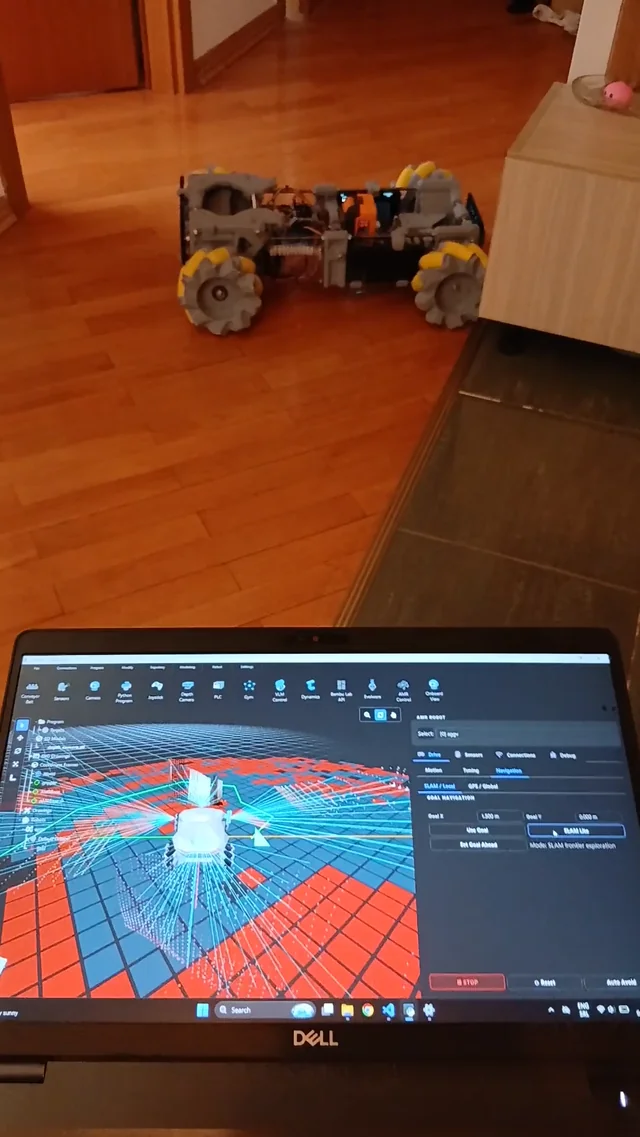
Hey r/robotics, Wanted to share my latest budget mobile robot build. The goal was to keep it under $250, so instead of buying an expensive LiDAR setup or dedicated depth cameras, I rigged up 4 cheap smartphones to stream video data. I’m running the streams through Depth Anything v3 (DA3) to estimate the depth maps, and honestly, for a "poor man's LiDAR," it’s going incredibly strong. The issue I'm running into: Since DA3 outputs relative/monocular depth maps, I’m struggling with absolute scale calibration. Right now, the robot thinks walls are further away than they actually are. It knows where the obstacles are, but the metric distance is skewed because DA3 doesn't have real-world depth data. I want to fix this by adding a hardware sensor to act as a "ground truth" anchor to correct and scale the DA3 depth data in real-time. Has anyone here tried using a ToF (Time-of-Flight) sensor or an Ultrasonic sensor to handle this kind of depth correction? Would a single-point distance reading be enough to dynamically scale the relative map, or is there a better way to do it? If anyone is curious about the hardware or wants to check out the setup, I put the specs and documentation here and the chassis CAD files here. Looking forward to hearing your thoughts on how to fix the depth scaling! submitted by /u/ganacbicnio [link] [Kommentare]
 R
↗
R
↗
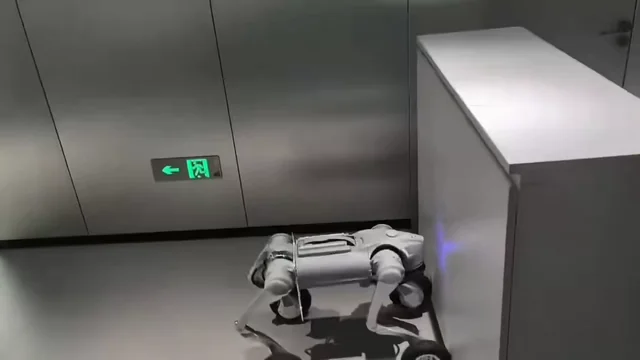
From Eren Chen on 𝕏: https://x.com/ErenChenAI/status/2067833855017353691 submitted by /u/Nunki08 [link] [Kommentare]
 R
↗
R
↗
 R
↗
R
↗
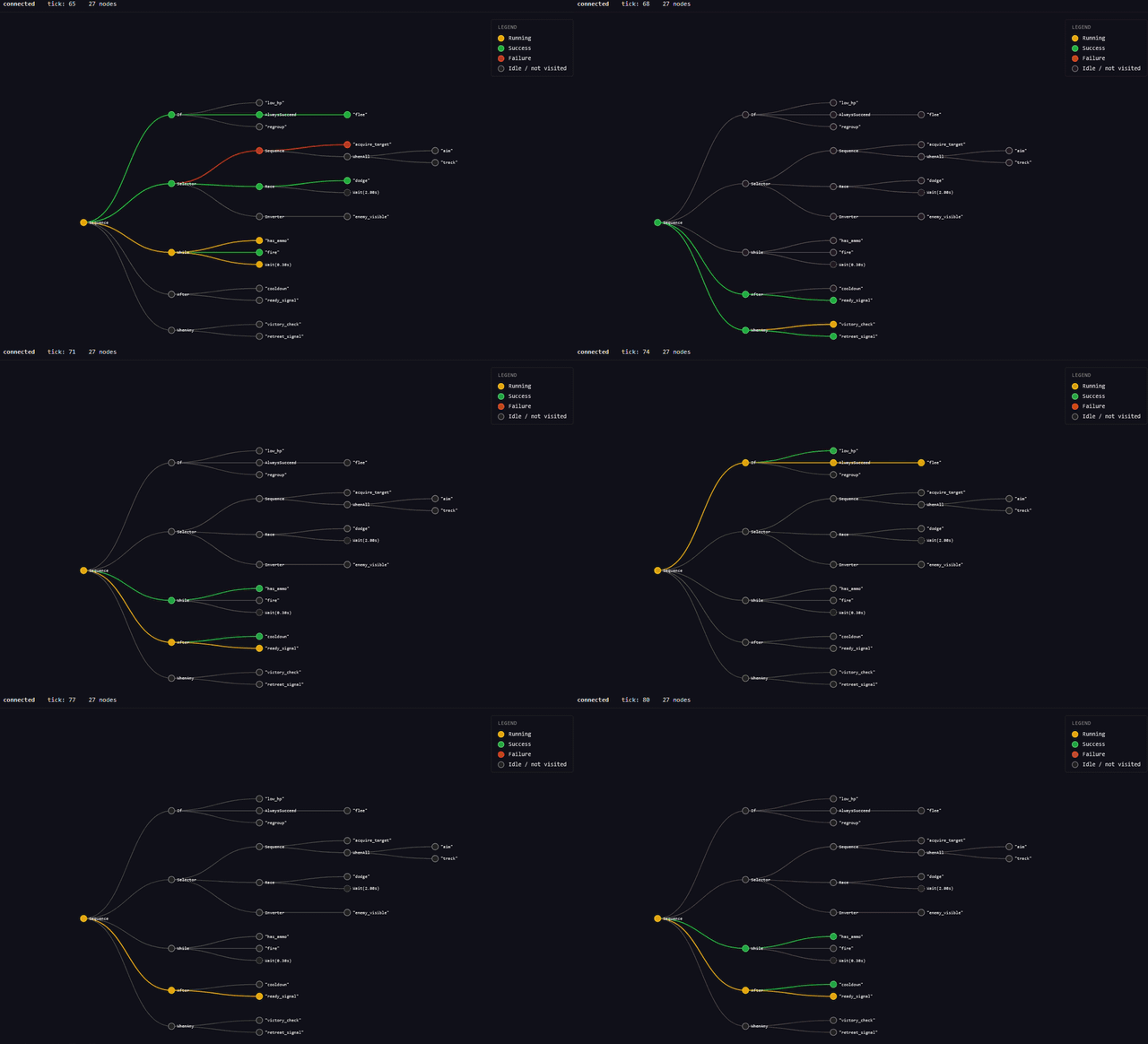
If you not familiar with the library, its basically a Rust implementation of behavior trees which are a great way to build deterministic AI — they're widely used for things like robotics, game NPCs and any agent that needs predictable, debuggable decision-making. We just introduced python bindings and a live view of the behavior tree. Also, we have added tons of new examples to get you going. For more, see: github: https://github.com/sollimann/bonsai pypi: https://pypi.org/project/bonsai-bt/ submitted by /u/Sollimann [link] [Kommentare]