 R
↗
R
↗
Not trying to advertise, but I’m sharing what we build because I genuinely believe it’s incredibly cool. Currently, we’re using it as a skin for robotics, primarily for tactile data collection. However, our long-term goal is to make it the skin layer for robots. submitted by /u/Sea-Lab-1972 [link] [Kommentare]
R
↗
I’m working with a dataset inventory of around 500K hours, including egocentric and real-world robot-training footage. I’m curious what formats robotics teams currently need most—manipulation, household tasks, teleoperation, or something else? Comment below or PM me if you’d like to see samples. submitted by /u/WideAmbition1964 [link] [Kommentare]
 R
↗
R
↗
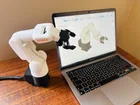
I designed this 5DOF robotic arm inspired by the KUKA KR4 Agilus. The goal was to keep all the servos hidden inside the structure, giving the arm a cleaner and more professional look. It also features a TPU-printed gripper actuated by a servo. I’m currently working on the kinematics and a custom PCB for the electronics. Still a work in progress, but I’m happy with how it’s coming along so far. More updates soon! submitted by /u/RoboDIYer [link] [Kommentare]
 R
↗
R
↗
How do you handle optical-flow dropout in GPS-denied tunnels? Been poking at navigation for tight indoor/underground spaces (tunnels, under bridges) where GPS just drops and there's nothing to fall back on. The annoying part is optical flow basically dies in there: bare concrete, repeating geometry, almost nothing to lock onto. Ends up being mostly lidar plus an illuminated camera doing the work. Testing it in sim first for obvious reasons (not keen on flying real hardware into a concrete wall to find the failure modes). Running it on UE5 with PX4/ArduPilot in the loop. For those who've flown GPS-denied in feature-poor spaces: do you just lean harder on lidar, or is there a VIO setup that actually holds up when the visual texture is that poor? Curious what's worked. submitted by /u/AlexThunderRex [link] [Kommentare]
 R
↗
R
↗
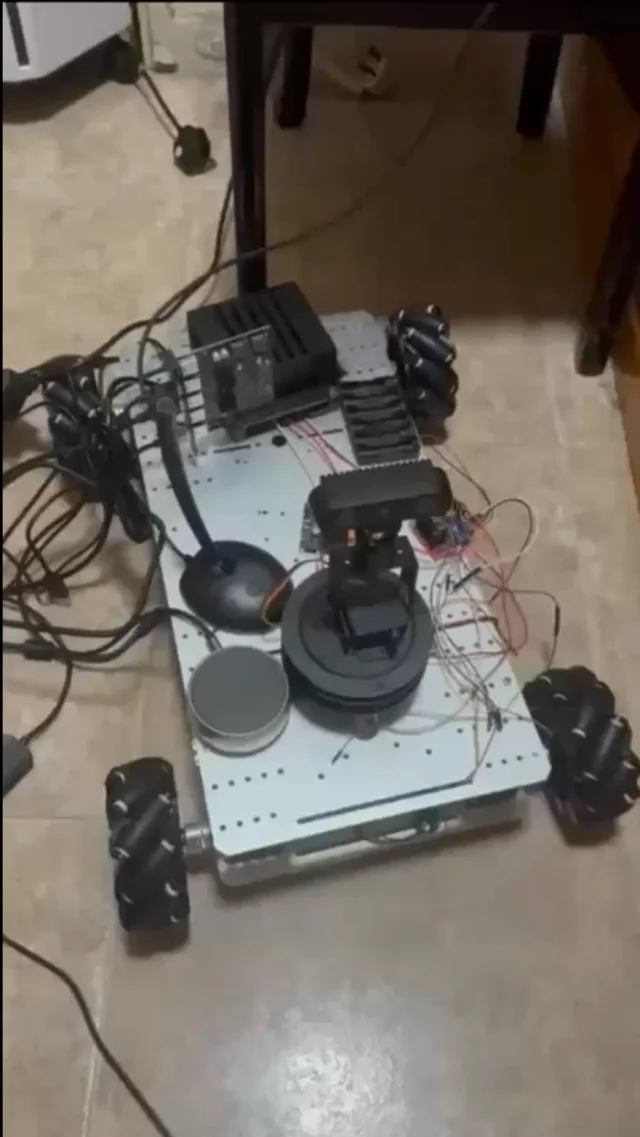
I haven't revealed her name in this video because I'd like to keep that private for now. XDXD As a first test, I successfully integrated an LLM, TTS, and ASR pipeline to enable voice conversations on the robotic car, even the response latency(LLM) is still slower. As a first test, I integrated a complete voice pipeline: → Microphone → Whisper Base (Speech-to-Text) → Ollama (LLM) → Kokoro TTS (Text-to-Speech) → Speaker The system runs locally on the Jetson AGX Xavier. Response latency is still slower... However, it is already capable of holding voice conversations while moving around autonomously. Current Stack(24 June 2025) Jetson AGX Xavier Ollama(LLM) Kokoro TTS Camera system orbbec camera Microphone and speakers(whisper base) Robotic car platform Until today, I am still improving the system. Future plans may include: Live2D avatar integration (will add later) Added VLM (Vision-Language Model) Shorter-latency LLM and VLM responses Improved voice interaction Update: The platform was later upgraded to a Jetson AGX Orin. submitted by /u/Tombother [link] [Kommentare]
R
↗
 R
↗
R
↗
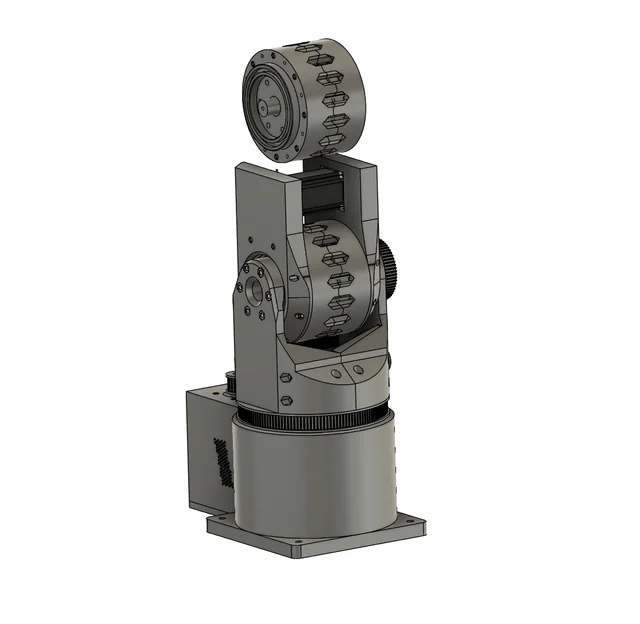
I am designing a robotic arm, and am wondering how can I determine if a certain part is strong enough and how could i determine if I have enough torque, also really any feedback would be appreciated. I took inspiration for cycloidal drives on joints 2 and 3 from arctos robotics arm. those cycloidal drives have a reduction of 25 to 1 but with pulley joint 2 will either have a reduction of 100-125. The arm is not yet finished but as i said my biggest concern is will joint two have enough torque and will the parts be strong enough when 3d printed. is uses 3Nm NEMA 23 motors and DM566TE drivers. I know it is generally recommended to start by designing from top to bottom but i really could not do it, felt weird. submitted by /u/toljaga12 [link] [Kommentare]
 R
↗
R
↗
Hi everyone, I'm building the original InMoov v1 robotic hand . The mechanical assembly and servo control are working well, but I'm currently stuck with the sensor integration. My goal is to add: Hall Effect sensors for finger position/feedback. FSR (Force Sensitive Resistor) sensors on the fingertips for touch and grip force detection. Ultimately, I want to implement closed-loop gripping, where the hand can detect contact with an object and adjust the grip force instead of simply moving the servos to fixed positions. The problem is that I can't find a proper guide explaining how to do this. I've spent a lot of time searching through YouTube, Google, GitHub, forums, and other online resources, but I still haven't found a complete tutorial that covers the entire process. I'm specifically looking for help with: Where to mount the Hall sensors and magnets. How to mount the FSR sensors on the fingertips. Wiring diagrams. Arduino code/examples. Sensor calibration. How to combine the Hall sensors, FSRs, and servo control into one working system. If anyone has: YouTube videos GitHub repositories Research papers Wiring diagrams Build logs Arduino examples Personal experience integrating these sensors into an InMoov hand (or any tendon-driven robotic hand) I would really appreciate your help. I've been stuck on this for quite some time, so any guidance or resources would mean a lot. Thank you! submitted by /u/Odd-Bell1718 [link] [Kommentare]
 R
↗
R
↗
**🎂 New Video Drop — Birthday Build Day! 🐻🤖** Yesterday I turned 28 and decided the best gift to myself was building a robot. In 33°C heat. Because apparently I hate myself.💀 Four hours of unboxing, SD card flashing, app building, and the first time this little guy moved on his own wheels. Mecanum wheels, LiDAR, Raspberry Pi 5 . the whole setup. His name is Rasp-Bär and he has a manual thicker than my thesis. This is just the beginning. He's learning to drive, I'm learning to be patient when he crashes into the wall. More videos coming the first steps, the fails, the small wins. Want to see a robot learn to exist in real time? Bring him with me on the journey. You're invited. 🐻🔧 https://vm.tiktok.com/ZGd9DH7gT/ submitted by /u/Spinning-Complex [link] [Kommentare]
 R
↗
R
↗
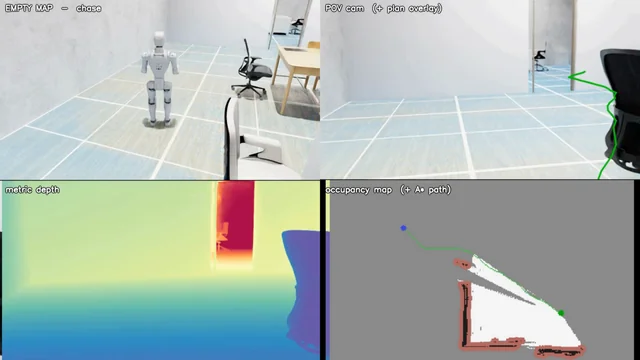
- chase: third-person view of the humanoid walking to the goal - POV cam: the robot's onboard RGB, with the planner overlay (🟢 global A* path, 🔴 immediate move) - metric depth: Depth-Anything 2's per-pixel depth - occupancy map: top-down log-odds grid being built live-> white=free, red=obstacle+inflation, green dot=robot, blue=goal, green line=A* path The robot starts with no map. It draws one as it walks, steering around furniture to reach a goal in the next room. This is a monocular-vision stack for perception, mapping, and navigation: Depth-Anything-V2 turns each RGB frame into metric depth, visual-inertial odometry (VIO) fuses that depth with the IMU for pose, the two build a live occupancy map, and an A*/DWA planner walks the robot to the goal. What would make this more close to reality? Curious to know what tends to break first when a stack like this moves onto hardware. submitted by /u/airwarmedd [link] [Kommentare]
R
↗
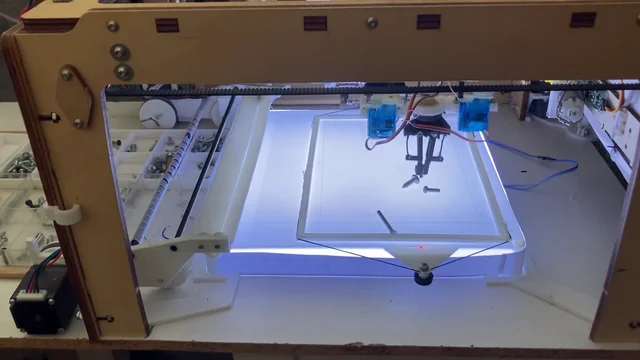
Is this the Move-37 moment for flooring? I know, this machine is engineered for this job and probably needs close to perfect conditions to work, hence lacking the "creativity" of AlphaGo. But still, don't look where we are today, but 2 more machines down the line. Seems frightening for flooring installers at least. submitted by /u/LatentSpaceLeaper [link] [Kommentare]
 R
↗
R
↗
R
↗
R
↗
I've been spending more time reading about robotics projects lately, and one thing that keeps surprising me is how much of the challenge seems to be software and infrastructure rather than the physical robot itself. When people talk about robotics, the conversation usually focuses on sensors, motors, and hardware design. But once you start looking deeper, there are things like AI models, data pipelines, edge computing, security, and system reliability that seem just as important. I recently came across thedreamers while reading about autonomous systems and noticed that many of their projects involve AI, infrastructure, and robotics-related engineering. It got me wondering how common that approach is across the industry. For those working in robotics, what percentage of your time is actually spent on hardware versus software, integration, and system maintenance? submitted by /u/No_Hold_9560 [link] [Kommentare]
 R
↗
R
↗
 R
↗
R
↗