Channels

The article is weak. But it highlights how most projects have shifted from screaming "Quantum is FUD" to "We are Quantum Resistant and there are no impacts". It puts Zcash in the quantum resistant bucket, even though that's only true if you transact privately. They haven't built anything for quantum resistance in the public sector. And Starknet which as a layer2 will require Ethereum to navigate an upgrade. What the article defines as the "Quantum resistant basket" appears mostly based on talking points. Ignoring the realities, the shift in acceptance was becoming obvious about a year ago. People considered it just a narrative, not wanting to accept the impacts and risks it poses on every live chain trying to prepare for the future. Now everyone wants to either "win" the narrative, or at least make it seem there will be no impacts while upgrading. You can spend a very long time trying to sort out what will suffer the most, and who might actually gain from the fallout. I've been doing that for 5 years, continually evaluating my investment in Qanplatform. One thing becomes clear- simply becoming quantum resistant doesn't generate new value. It is just a thorny, disruptive security upgrade that most would love to never deal with. Despite all the talking points on why the risk may be small in the next few years, the simple fact that the risk exists forces it to be dealt with. Just like any other small risk that can't be left open. Perhaps the chains that run the best with proper quantum resistance will see an edge. Or maybe some will be more convincing they are best prepared with no impacts. So rather than try to see who will win the talking points, I think more about what is the resulting opportunity--- Every time I've ever posted about the quantum threat, the response is: "If it can crack wallets, we'll have bigger problems with other systems" That's true, if they do nothing. And since they won't sit idle, the result is a gigantic emerging market needing to upgrade. Systems worldwide looking at how are they going to deal with this migration challenge. Solutions that play in that space have guaranteed demand. That's the thesis. submitted by /u/Original-Assistant-8 [link] [Kommentare]












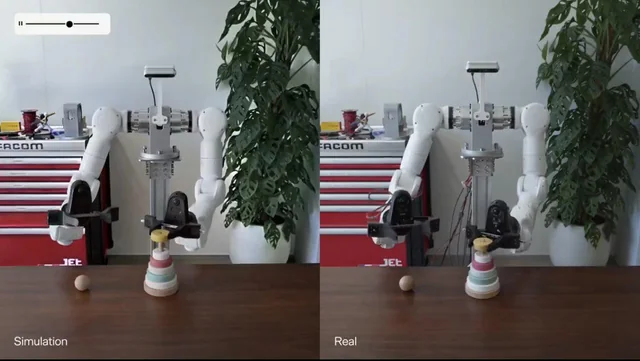
The Genesis sim video got me thinking: what does it actually take to build scenes like that (apart from gaussian splat part) with such accuracy, at scale? Asset and scene generation is one of the biggest bottlenecks in robot training. NVIDIA GR00T, Helix, HumanPlus, and ASAP all show the same pattern: more diverse scenarios lead to better sim-to-real transfer. But generating physically accurate objects and scenes takes time. Four platforms are working on this in 2026. Here's how they compare: 1. Rigyd: Agentic pipeline, best for on-demand scale and new types of objects Takes raw 3D (.glb, .fbx, .obj), images, or text and outputs calibrated OpenUSD + MJCF in ~2 minutes per asset with SimReady asset validator baked in. Generates full interactable scenes with per-object decomposition. Native Isaac Sim and MuJoCo support. Non-rigid and articulated objects are stated in the roadmap. The pipeline is agentic end-to-end, so no per-asset manual work. Good fit for teams that need to move fast with on-demand assets. 2. Lightwheel: High fidelity articulated objects, SimReady catalog Strong catalog of high-fidelity articulated assets and a SimReady library used by large enterprise customers. Per-asset visual and physical quality is high. USD and MJCF support via open-source converters. Good fit if you need a curated, validated catalog. Less flexible for new use cases or object categories outside their existing library. Catalog growth follows a curation model rather than an agentic pipeline. 3. NVIDIA Edify: Generative 3D, physics added separately Generates high-quality 3D meshes from text or image in under 2 minutes. Trained on licensed data, enterprise-safe. Tight Omniverse integration. The gap: it produces visual geometry, not SimReady assets. Physics, collision geometry, and USDPhysics schemas need to be added downstream before the asset is usable for robot training. Works well as an upstream step paired with a SimReady pipeline. 4. Moonlake: World modeling agent approach Acts directly inside Blender, automating the creation of articulated assets, physics-validated scenes, and complex environments rather than per-asset annotation. The approach is promising for research but production-grade Isaac Sim / MuJoCo integration is not there yet. If successful, world models could collapse scene generation and policy training into a single learning loop. What I think actually matters for sim-to-real transfer (ranked by impact): Per-object physics accuracy within the domain-randomization band Scene diversity (variation of scenes the policy sees during training) Visual fidelity (matters most for camera-only policies, less for contact-rich manipulation) How to choose: Need to scale across many object categories fast → Rigyd Need a validated catalog of articulated assets for known use cases → Lightwheel Need high-quality visual 3D in the NVIDIA ecosystem and will add physics downstream → Edify Researching end-to-end learned simulation → Moonlake For most teams the practical pattern is Rigyd for the long tail + hand-authored or Lightwheel assets for the few hero objects your scenario depends on. Both output standard OpenUSD/MJCF so they compose cleanly. Questions for the community: What's missing from this comparison? For those running training: where does asset prep actually bottleneck you? Image Credit: Genesis AI submitted by /u/yektabasak [link] [Kommentare]