Channels
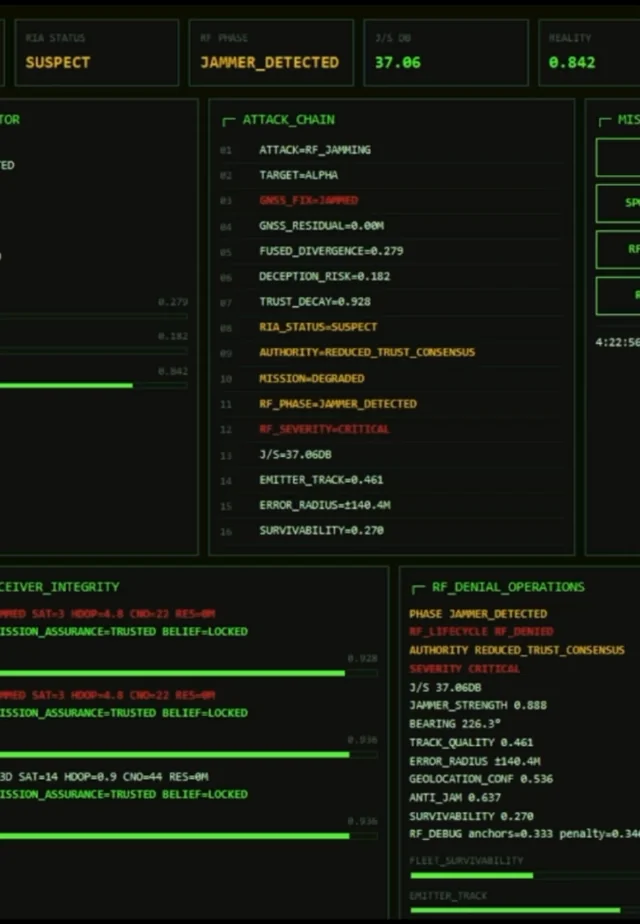
I’ve been working on a mission assurance architecture called Parallax and recently completed another validation run in a degraded operating environment. In this sim run, an autonomous USV fleet experienced GNSS/RF degradation resulting in conflicting navigation observations across multiple assets. Rather than assuming all telemetry was trustworthy, the system continuously evaluated observation integrity, measured divergence from a shared world model, isolated compromised data sources, reconstructed authority through distributed consensus, and maintained mission continuity without operator intervention. One of the problems I’m interested in is what happens after sensor fusion. Most autonomy stacks do a good job combining observations, but what happens when those observations can no longer be trusted? The entire system runs locally at the edge with no cloud dependency. All processing, validation, trust scoring, consensus generation, and decision support remain completely air-gapped and self contained. Current areas of development: • Distributed trust scoring • Reality integrity assessment • Consensus reconstruction • Autonomous recovery and reintegration • GNSS degradation and spoofing resilience • Edge-native operation with no cloud connectivity Interested in hearing how others are approaching sensor trust, degraded navigation environments, and resilient autonomy. submitted by /u/DraevenOfficial [link] [Kommentare]

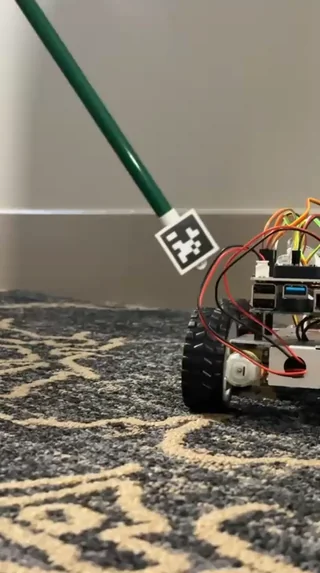
Been working on a PiCar-X build on a Raspberry Pi 4B. v1 goal: detect an AprilTag (36h11 family, ID 0), steer toward it with a PID controller, drive forward, and stop at a configured distance threshold. Toggle it on from a browser dashboard, 3-second countdown, and it goes. I built this entirely with Claude Code. It’s been a massive productivity boost while balancing a full-time job, and the process of building agentically has been a great learning experience. WebSocket concurrent send corruption The broadcast coroutine and the sensor push loop were both calling send_json() concurrently. At await boundaries they interleaved, Starlette threw, and the client was silently dropped from the send set — meaning the toggle-off confirmation never arrived and the button stayed stuck in active state even after the car stopped. Fixed by replacing the shared client set with a per-connection asyncio.Queue and a single drain task per connection. Camera color inversion that didn't respond to the obvious fixes BGR888 didn't fix it. RGB888 + cvtColor didn't fix it either. Root cause: capture_array() on this Pi hardware returns RGB regardless of the format name, and this platform's libjpeg encodes from RGB input correctly without any conversion. One-line fix once the actual data layout was confirmed via a frame diagnostic log. Had to fully remove Vilib It uses a Picamera2 internal API (allocator) removed in 0.3.36 — crashes on any camera restart after a chase session. Server now owns Picamera2 directly for the full session lifetime. What's next v2 candidates on the list: distance-proportional speed, latching stop behavior, camera tilt tracking, and operator override during chase. Stack: Raspberry Pi 4B · PiCar-X v2.0 · Picamera2 · pupil-apriltags · FastAPI · Python 3.13 submitted by /u/okineedaplan [link] [Kommentare]
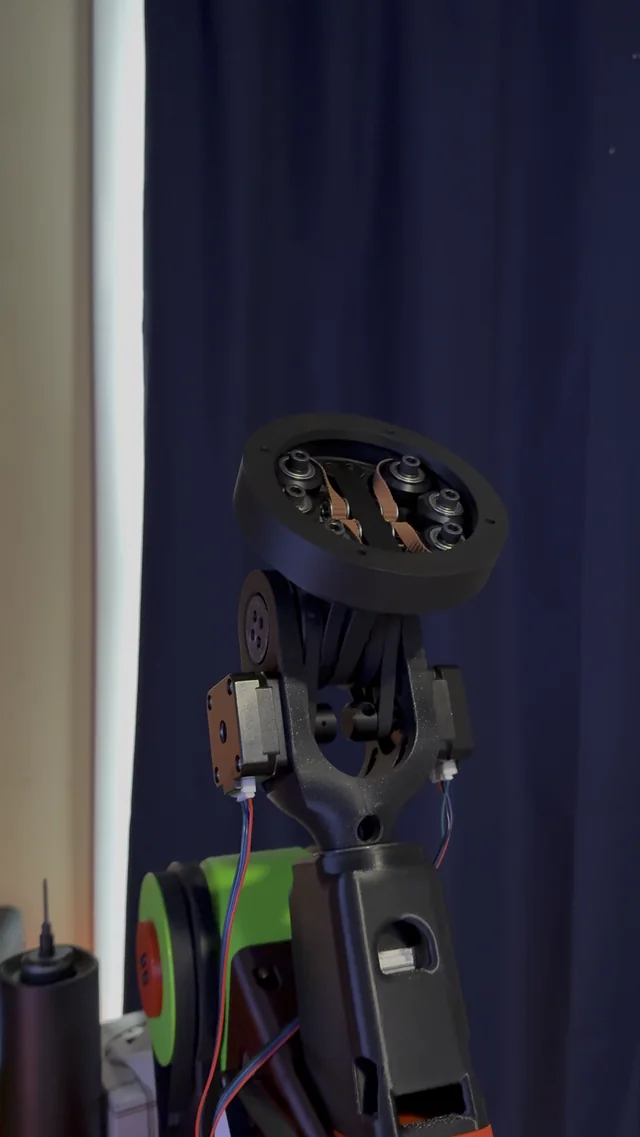
I put together a small ROS 2 subsystem that turns a 2-DOF pan/tilt platform and a cheap 2D LiDAR into a stop-and-capture 3D scanner, and figured it might be useful to someone else here. The setup: two Feetech STS3215 serial-bus servos aim an LDROBOT LD19. A node sweeps the platform and an assembler stacks the 2D scans into a `PointCloud2` using the live TF tree. There's an optional MQTT bridge so an external controller (in my case a microcontroller mission queue on a rover) can trigger scans and get a completion handshake back. It's a *complete* project — it even includes a fix to the LiDAR driver (upstream `ldlidar_stl_ros2` won't build on recent GCC/glibc; the patched fork is linked below). It talks to the rover over a well-defined set of MQTT messages, but every command also has an equivalent ROS 2 topic, so if you want a pure ROS 2 setup you just don't launch the bridge. (Personally I love the MQTT side — it lets me drive the whole thing from a tablet.) No vendor SDK — the Feetech STS/SMS half-duplex protocol is implemented directly over pyserial, including handling the URT-1 adapter's habit of echoing every TX byte back on the RX line (the kind of thing that eats an evening if you don't know it's coming). The assembler is driver-agnostic: it consumes standard `sensor_msgs/LaserScan` on `/scan`, so any conformant 2D LiDAR should work. It's running on an RK3588 today and is built to go headless on a Pi 5. This is the first piece I'm open-sourcing from a larger autonomous rover project, GPL-3.0. I'd genuinely welcome feedback — particularly from anyone who's done multi-LiDAR or TF-timing work, since the scan-to-TF synchronization was the fussiest part to get right. But it does work! Happy to answer questions about any of it. Project: https://github.com/aa2mz/pan\_tilt\_lidar Patched LiDAR driver: https://github.com/aa2mz/ldlidar\_stl\_ros2 submitted by /u/CorrectAir8833 [link] [Kommentare]

Before SpaceX IPO, Tesla and SpaceX revealed they both held considerable amount of btc, additionally Elon Musk back in the day openly embraced Dogecoin, many believes he holds a significant amount of the memecoin though undisclosed. With more than enough paper money to borrow against, I see Elon Musk/Tesla/SpaceX buying more btc and/or Dogecoin in the common weeks/months. submitted by /u/zesushv [link] [Kommentare]
Hey everyone, I got tired of paying massive monthly fees for premium alert tiers just to track multiple timeframes. To solve this, I built an Android utility called BitLogic. It is a pure market screener designed to let you visually stack your own custom technical analysis strategies and let the app scan the market for you 24/7. It currently supports live monitoring across Binance (Spot/Futures), Bybit (Spot/Futures), and CoinDCX. 🚀 Core Features Zero-Code Strategy Builder: Combine conditions using advanced AND/OR logic blocks without writing a single line of code. True Background Automation: Your strategies run continuously in the background, even when the app is closed, pushing instant notifications when your exact setups hit. Simultaneous Multi-Timeframe Checks: Scan across various intervals at the exact same time (1m, 5m, 15m, 1h, 4h, 1d) to catch micro momentum matching macro trends. Frictionless Guest Mode: Test the core strategy builder and manual scanning tools instantly without creating an account or providing an email. 📊 Supported Indicators & Data Points We are currently using a total of 124 data points, which breaks down into exactly 60 indicators/price actions and 64 candlestick patterns. Here is the exact breakdown by category: Technical Indicators (60 total): Trend & Overlap (19): SMA, EMA, MACD, Bollinger Bands, Ichimoku, Supertrend, etc. Momentum & Oscillators (23): RSI, Stochastic, MFI, ADX, CCI, MACD, etc. Volatility (6): ATR, Keltner Channels, Donchian Channels, etc. Volume (7): OBV, Chaikin Money Flow, VWMA, etc. Price Action (5): Open, High, Low, Close, Volume (The remaining 64 data points are fully dedicated to candlestick patterns). The Android version is completely free and live right now. (A native Windows desktop version is hitting the Microsoft Store soon). Check it out here: BitLogic.info I'd love to hear your thoughts on the scanning speed or the UI. Let me know what indicators you want me to add to the builder next! submitted by /u/SituationBoth7745 [link] [Kommentare]

spcx is turning into a clean case study for tokenized stocks. the basic setup is simple: spacex is expected to trade on nasdaq under spcx, and tokenized versions of the shares are also being discussed for solana through platforms like backpack securities and sunrise defi. a few things i’m tracking: spcx - the main equity ticker. big name, huge attention, and probably a useful benchmark for how much demand exists outside normal brokerage rails. sol - the chain getting the attention here. if tokenized public equities actually get real usage, settlement speed, liquidity, custody and compliance all matter more than the usual crypto narrative. backpack securities - worth watching because the claim is that the token is backed 1:1 by actual shares with redemption mechanics. that part matters more than just “stock on-chain.” sunrise defi - another piece of the infrastructure side. not as easy to evaluate from the headline, but tokenized equities need more than just a ticker and a smart contract. traditional brokers - still relevant here. if the normal share and the tokenized version both exist, the spread, fees, access rules and redemption process become the whole story. tldr: tokenized equities are moving from theory into more visible tests. spcx is just a much louder example because the underlying company has mainstream attention already. what would you care about most before trusting a tokenized stock: custody, redemption, liquidity, regulation, or fees? submitted by /u/GurneyStewart [link] [Kommentare]