 R
↗
R
↗
When working on robot models, I often wanted to: Open a shared link See the robot instantly Inspect joints and meshes Validate URDF errors Export to other formats That's why I started building RoboInfra. You can paste URDF/Xacro and instantly get: 1) 3D visualization 2) Validation 3) Auto-fix suggestions 4) URDF → MJCF conversion 5) URDF → USD conversion 6) Shareable robot links 7) And much more What other features would you expect from a tool like this? Free Forever https://roboinfra-dashboard.azurewebsites.net/playground submitted by /u/DateRealistic5066 [link] [Kommentare]
R
↗
I have developed an articulated rigid-body dynamics framework in C++23. The project is a compact, light-weight implementation of Featherstone's spatial algebra, (plus ABA/CRBA/RNEA dynamics), URDF import/export, collision detection, contact handling, and end-to-end automatic differentiation. I’m currently working on a Vulkan-based visualisation application (see demonstration videos). I would be interested in feedback from the ROS and robotics community, particularly regarding project architectural choices and possible future research directions. The repo can be found here submitted by /u/Slow_Negotiation_935 [link] [Kommentare]
 R
↗
R
↗
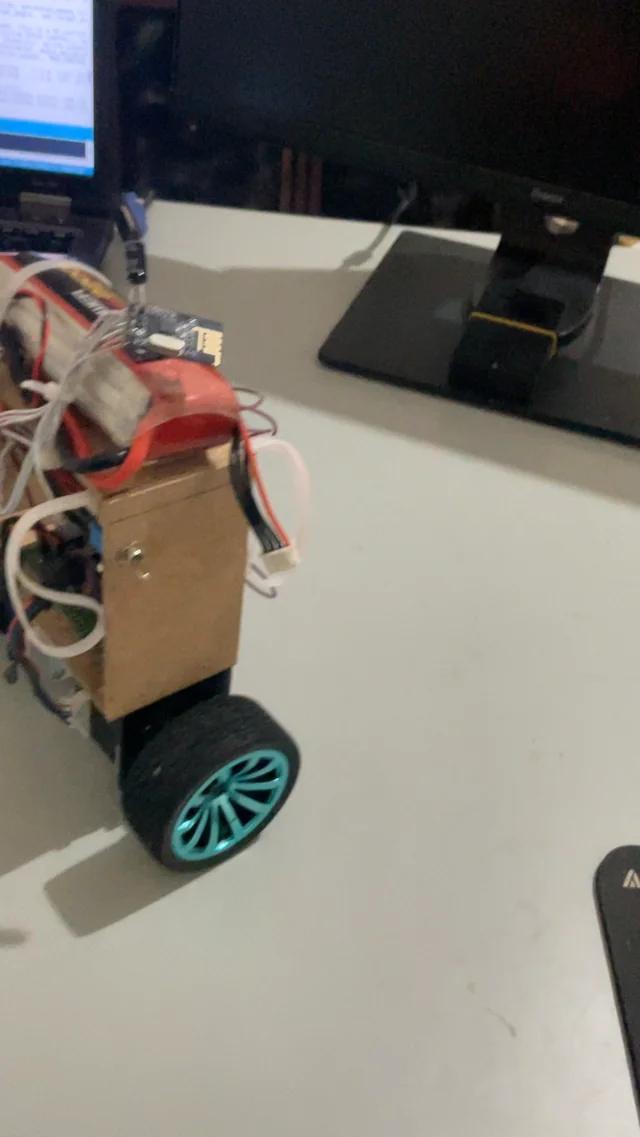
This is a self-balancing robot built around an ESP32. It uses two NEMA 17 stepper motors driven by DRV8825 drivers and an MPU6050 IMU. The biggest challenge was tuning the PID controller and filtering the IMU data for long-term stability. After a lot of tuning, it can now balance continuously—I even recorded it balancing for 45 minutes straight without falling. submitted by /u/mAbdelazim01 [link] [Kommentare]
 R
↗
R
↗
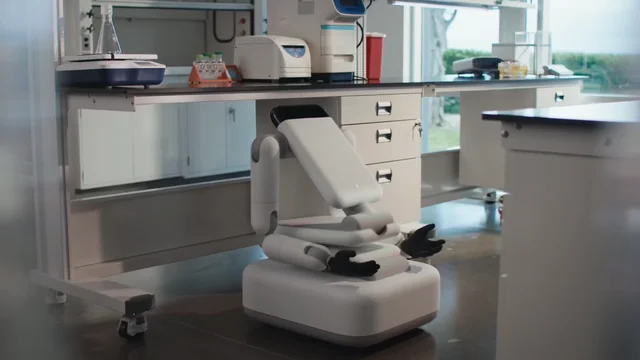
From Genesis AI on 𝕏: https://x.com/gs_ai_/status/2066869851659121128 Website: https://www.genesis.ai/ submitted by /u/Nunki08 [link] [Kommentare]
R
↗
I work in robotics, and have for almost a decade now. I keep noticing that a huge chunk of search-under-uncertainty problems, in robotics and outside it, converge on the same two-step architecture: generate variation indiscriminately first, then apply a scoring/selection pressure that keeps what works and discards what doesn't. No model of the problem is required upfront. Most the "intelligence" lives in the selection step, not the generation step. The clearest version of this in our own field is sampling-based motion planning. RRT and its relatives don't try to compute a path analytically. They expand randomly in many directions through the configuration space and then retain/extend the branches that make progress toward the goal, pruning the rest. Genetic algorithms and evolution strategies (CMA-ES, for instance) run an identical loop in parameter space instead of configuration space: generate a population of variants, score them against a fitness (cost) function, keep the survivors, repeat. Simulated annealing is a single-particle version of the same thing, generate a random perturbation, accept or reject it based on a score. Once I started paying attention to this pattern, I noticed it shows up well outside robotics too, in places that have nothing to do with computer science: Slime mold expanding in all directions through a maze of food sources, with the inefficient tendrils pruned back, and famously reconstructing something close to the Tokyo rail network when food sources are placed at the positions of major stations. Evolution itself: random mutation generates variation with zero regard for whether it's useful, and survival does the selecting after the fact. Neural development: neurons and synaptic connections proliferate in directions that aren't pre-planned, and dopamine-linked reinforcement selectively stabilizes the ones that turn out to matter. Once I started looking for more instances, I found two more that fit the same structure almost exactly: The immune system: B-cells mutate antibody variants somewhat randomly (somatic hypermutation) and the ones that bind the pathogen get clonally selected and expanded. Thought/creativity: you can't generate a genuinely novel idea by deduction from evidence that it's correct. The evidence only exists after the idea does. Novelty has to come first; judgment comes second. That last one turns out to have a surprisingly direct precedent. Henri Poincaré, describing how he worked out the theta-fuchsian functions, wrote that ideas rose in crowds and collided in his mind until pairs interlocked into stable combinations, almost like watching his own unconscious work made partially visible to consciousness, and that what got selected from that flood of combinations was governed by something close to an aesthetic sense of mathematical elegance. That's a generate-then-select loop running inside a human mind, described in 1908. The principle has been formalized more than once since then, from different directions: Richard Dawkins' Universal Darwinism: the claim that variation/selection/retention isn't a biology-specific mechanism but a substrate-independent algorithm that biology happens to be one instance of. Donald Campbell's blind variation and selective retention (BVSR), later developed extensively by Dean Keith Simonton, which applies the same two-step structure directly to creative cognition. Karl Popper's conjectures and refutations model of how knowledge grows: blind generation of new theories, followed by selective retention of the ones that survive criticism. Popper explicitly treated this as the same process as biological evolution, just running on ideas instead of organisms. Gerald Edelman's Neural Darwinism (Theory of Neuronal Group Selection), the formal version of the neuron/dopamine point above: synaptic overproduction followed by activity-dependent selective stabilization. Worth flagging here: I'm not claiming the expansion step is ever truly random. In every example above, the variation is guided. Slime mold follows chemoattractant gradients, not isotropic noise. Mutation isn't uniform across a genome, there are hotspots and repair biases. Axon growth follows chemical guidance cues, not random angles. Informed RRT* deliberately biases sampling toward the goal region instead of sampling uniformly. Even Poincaré's account isn't pure randomness, he describes an aesthetic sense that seems to steer which combinations even get generated, not just which ones survive afterward. Liane Gabora has made this exact critique of BVSR, that calling the variation "blind" overstates how random it actually is. But that's the part I find more interesting, not less. The expansion step across all of these systems is intelligently informed, biased toward promising regions by something the system already "knows," and yet it still needs the separate selection/scoring step on top of that guidance to actually converge. Neither half does the job alone: the guidance is too crude or too local to solve the problem outright (that's why expansion is still happening at all instead of direct computation), and the selection pressure has no foresight of its own, it only works because it's filtering output that the guided expansion already biased toward viable territory. Has anyone else found that this specific combination, intelligently biased expansion paired with a separate selection/scoring step, actually performs best in practice? I have personally found, that at least for my applications in autonomous vehicles and motion planning, this combination works the best. Curious whether other people doing sampling-based planning, evolutionary algorithms, or other search methods have found the same thing I have: that this architecture outperforms the alternatives, rather than just being one option among several that works comparably well. I will personally only ever use this type of algorithm after realizing this is how nature does it. Lastly, I am not proposing that analytical algorithms are better or worse than machine learning algorithms. I believe that HOW this is solved is irrespective of the fundamental search algorithm of the universe I have observed. I believe that it is the expand, then score mechanism that is important here, and does not exclude any method of expansion or scoring, as I have observed this in the above stated forms across nature. Thanks for the read if you're here, I've been thinking about this all year and needed to post it somewhere. submitted by /u/Pepperoni-Flame [link] [Kommentare]
 R
↗
R
↗
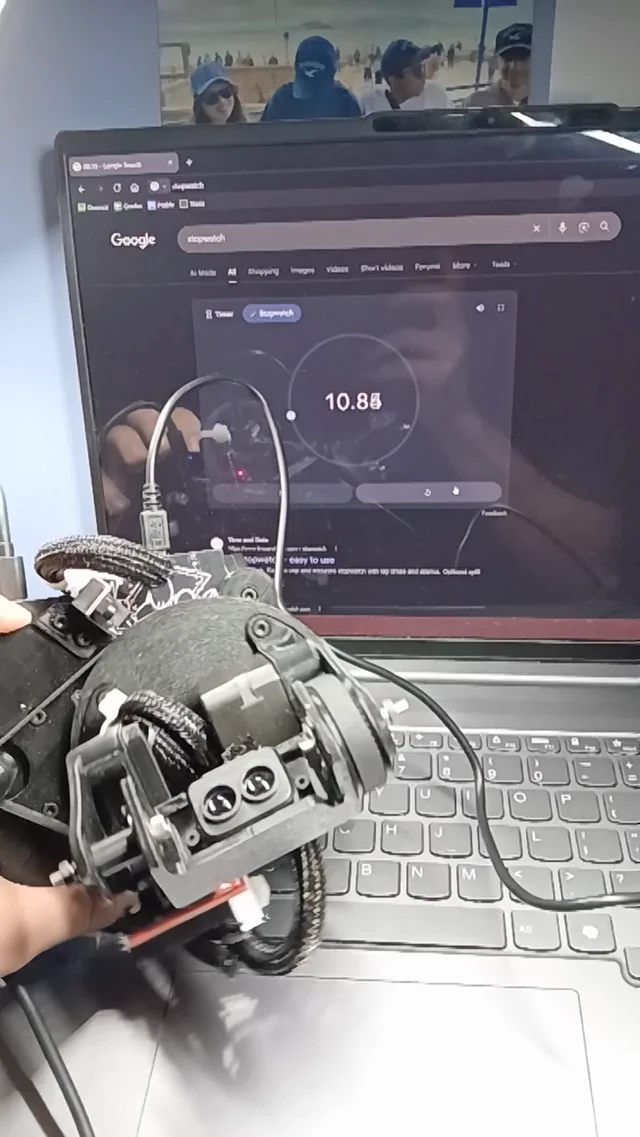
I've always been interested in point clouds and spatial data, so I created my own LiDAR scanner! It runs off of an esp32 and TMC2209s on a custom PCB, which continuously rotate and sweep the LiDAR sensor. I learned a ton creating this project, as this was my first time creating a PCB and using NEMA motors (I have used other motors before). Github repo submitted by /u/thatonebckid [link] [Kommentare]
 R
↗
R
↗
No the thumbnail is not fake and shes quite talented would not be surprised if she is in here anyways enjoy —————————————————————————————————————-——————————————————————- submitted by /u/fake_odelay [link] [Kommentare]
 R
↗
R
↗
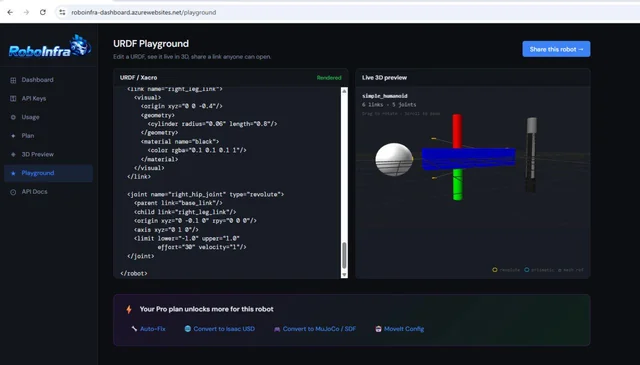
Hi everyone, I've been working on a browser-based URDF playground aimed at making robot development a bit easier. Steps: i) Paste URDF or Xacro directly into the browser ii) Instant 3D visualization iii) Shareable robot links iv) No ROS installation required Playground: https://roboinfra-dashboard.azurewebsites.net/playground Additional tooling: URDF/Xacro validation Auto-fix suggestions URDF → SDF conversion URDF → MJCF conversion URDF → USD conversion MoveIt configuration generation Mesh analysis GitHub Action integration Python SDK The goal is to make robotics workflows feel a little more like modern web development—open a browser, paste your robot description, and start iterating immediately. I'd really appreciate feedback from ROS, MoveIt, Isaac Sim, MuJoCo, and general robotics developers: What feature would make this genuinely useful in your workflow? What is currently missing from existing URDF tools? Any issues or suggestions after trying it? Thanks! submitted by /u/DateRealistic5066 [link] [Kommentare]
R
↗
I have known sence I was 7 that I have wanted to be a robotic engineer and now it is the summer going into high school and I am already taking as many electives next year but I need to know if there is anything I should do over the summer to help me submitted by /u/GameFoxx1 [link] [Kommentare]
 R
↗
R
↗
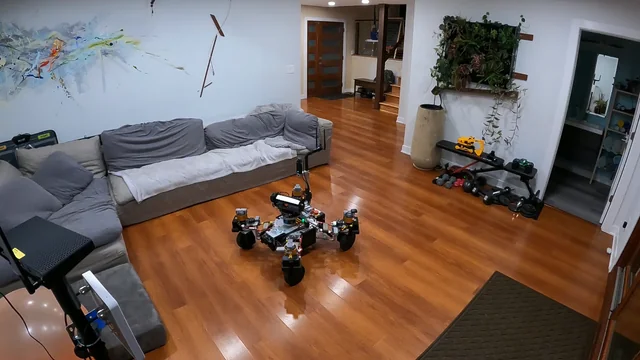
Sorry for the slow pace of the video, but I figured that seeing each visualizer perform the same path makes them more intuitive. All of these visualizers are rendered on a meta quest 3 using OpenXR. submitted by /u/RoboLord66 [link] [Kommentare]