 S
↗
S
↗
The fastest way to create, share, and fill events. AI flyers, instant tickets, every social platform — free for organizers.
 H
↗
H
↗
Find the Reddit conversations where people are ready to buy what you built, reply in your voice, and see which ones turn into customers. Reddit customer acquisition for founders.
 I
↗
I
↗
Inside "Adblock for YouTube," a trusted Chrome extension with 11M+ installs whose architecture could be weaponized by a single server-side change to steal data and hijack sessions
 M
↗
M
↗
Steve Jobs said building illegal blue boxes to allow users to make long distance and international phone calls for free with Steve Wozniak…
 G
↗
G
↗
pkgit (package it!) What is this? pkgit is an unconventional package manager designed to compile & install packages directly from their git repository. License pkgit is licenced under the GNU-GPL-2.0-or-later. if you did not get a copy, please see https://www.gnu.org/licenses/. [DISCLAIMER] Due to the nature of pkgit, you are solely responsible for vetting the repos that you add to your system. Use at your own risk. Compile pkgit Enter the project directory, and follow one of the following procedures. Using Make make Using pkgit pkgit --build Both methods will create an executable in the root directory of the project. You'll probably also want to generate a base configuration file if you don't already have one. Run this as a user to generate the config in ~/.config/pkgit: make defconfig You can also run this with root using sudo/doas to genereate the config in /etc/pkgit sudo make defconfig Install pkgit After compiling, run the following with root privilages: make install Don't have root? You can specify any install location with PREFIX=. A popular option is ~/.local: make install PREFIX="~/.local" Usage Command Syntax The structure in which you type commands into pkgit is very standard: pkgit [--flag|-f] Flags have two types; long, and short. The short type of each command uses the first letter of its long counterpart. For example: Long: pkgit --install Short: pkgit -i If you use the short version of commands, you can chain them together into one argument: pkgit -qif This example uses the --quiet, --install, and --force flags to: --quiet: minimize logs to stdout --install: install a package --force: even if already installed, will force the package to be installed Installing Packages Pre-installation Before you use any programs that you installed with pkgit, you need to specify the path of the binaries in your shell's configuration. For most users, this is the command: export PATH="$HOME/.local/bin:$PATH" or for fish users: fish_add_path $HOME/.local/bin or for csh users: setenv PATH $HOME/.local/bin:$PATH Basic install Assuming you have already added its respective repo, you can install a package by specifying its name: pkgit --install [pkg_name] Or you can use the short command: pkgit -i [pkg_name] Specific version install You can specify a version of any package based on its tags with '@' separating the name from the version: pkgit --install [pkg_name]@[version] Specific target install You can specify a target of any package based on its configuration in bldit.lua or init.lua with ',' separating the name from the target: pkgit --install [pkg_name],[target] Combined target and version install You can specify both the target and the version of any package you install in the same command (order does not matter as long as the package name is first): pkgit --install [pkg_name],[target]@[version] pkgit --install [pkg_name]@[version],[target] Repo install If you haven't added the package's repository yet, or you just want to be specific, you can install the package using its git URL: pkgit --install [url.git] This also works with the target and version syntax. Local install If you want to install a package from a local code repository, and want to take advantage of pkgit's build system autodetection, you can enter that repository's root directory and install it from there: pkgit --install . Building packages FOR DEVELOPERS You can also use pkgit as a sort of meta-build-system to automatically compile any supported project with the build command: pkgit --build [/path/to/project] This can also be done without specifying the path (pkgit --build) if you're in the project's root directory Removing Packages Removing (uninstalling) a package is as simple as it seems: pkgit --remove [pkg_name] Or the short command: pkgit -r [pkg_name] Updating Packages You can easily update your installed packages by running: pkgit --update Or the short command: pkgit -u Declaring Packages If you prefer a declarative approach, you can use the config file (read below) as a package declaration file. When you're ready, you can declare all your packages at once with: pkgit --declare Or the short command: pkgit -d Dependency Management As it is, pkgit is capable of dependency management, but you will likely have to specify the dependency URLs for each package you install in /pkgit/init.lua. There's not a universal way to check for dependencies without using an existing package manager (unless the package you're installing has a bldit.lua). Configuring pkgit Thankfully, this is a very simple process. To configure pkgit, you have one centralized configuration file: /pkgit/init.lua Thanks to liblua, pkgit pushes a package.path variable directly to your configuration file. This means that you can require any sub-file/directory, without wrestling with require(). The overall structure of the configuration file is explained in detail in config/init.lua [DEVELOPER]: bldit.lua If you want your own package's dependencies, version, compilation, and other aspects to be properly resolved in pkgit, you can create a bldit.lua file in the root directory of your project's git repo. Do not name it anything other than bldit.lua, otherwise pkgit will not find the file. A great example for bldit.lua is right here in the pkgit repository! Check it out if you want to know how it's structured. Contributing to pkgit If you want to contribute to pkgit, please refer to CONTRIBUTING.md
 F
↗
F
↗
Palestine Uprooted: Nakba Past and Present Palestine Uprooted: Nakba Past and Present Opening June 27, 2026 This exhibition has not started yet. Explore current exhibitions Tags: Exhibition Human rights violations Photo: David S. Boyer, public domain Facebook X Exhibition detailsPalestinians use the word al‐Nakba — Arabic for “the catastrophe” — to describe their forced displacement in 1948.In 1948, militias, followed by Israeli forces, expelled civilians, destroying or emptying hundreds of villages amid regional war and lasting instability. Around 750,000 Palestinians were forcibly displaced during the creation of the State of Israel.Five generations later, these people and their descendants still live with insecurity and uncertainty and are unable to return home.The exhibition Palestine Uprooted: Nakba Past and Present explores the human rights violations related to the ongoing forced displacement and dispossession of Palestinians. Featuring personal stories told through objects and video testimonies, the exhibit presents Palestinian Canadians reflecting on their ongoing struggle for justice and human rights. Together with art, photos, and text, these elements reveal enduring patterns of loss and resistance.For Palestinians, the Nakba is both their history and their present — it is an ongoing process shaping every aspect of life today.Forced DisplacementIn everyday language, people may hear “forced displacement” and think mainly of people being physically forced from their homes. From a human rights perspective, the term also includes situations where people flee or leave because conflict, violence, human rights violations, disasters or other pressures make staying impossible or unsafe.Forced displacement can be both a consequence of human rights violations and a cause of further violations.Following the UN partition plan for Palestine adopted in 1947, and until the end of the 1948–1949 Arab‐Israeli war, about 750,000 Palestinians were forcibly displaced. This represented more than half of the Palestinian Arab population of Palestine under British colonial rule, including about three quarters of the Palestinians who lived in the territory that became the State of Israel. Some were expelled by armed groups and then, after Israel’s declaration of independence in May 1948, by the Israeli army. Others fled in fear of violence or left after warnings or instructions, including from Palestinian Arab leaders who called on women, children and elderly people to leave some areas of fighting until conditions became safer. People left with the expectation that they would soon be able to return home Image of displaced Palestinians Displaced Palestinians walk along a road in Jabalia, as they leave areas near Gaza City, January 19, 2025. Photo: Omar Al-Qattaa, Getty Images The NakbaHistorically, the term Nakba refers to the forced displacement and dispossession of Palestinians in 1948. In a modern sense, many people understand the Nakba not only as a past event, but as an ongoing process. This refers to the continuing effects of displacement, refugeehood, military occupation, settlement expansion, home demolitions, land confiscation, movement restrictions, blockade and repeated wars. This understanding of the Nakba as an ongoing process of forced displacement and dispossession is reflected in the work of many scholars, experts and human rights organizations. Quote from Palestinian Canadian We have not disappeared, and we have not forgotten. And we are here. Rana Abdulla, Palestinian Canadian born in Kuwait, accountant, business owner, artist, grandmother, daughter of Nakba survivors. Facebook X SummaryPalestine Uprooted: Nakba Past and Present opens opens June 27, 2026 in the Rights Today gallery, on Level 5 of the Canadian Museum for Human Rights.This exhibition is being developed in collaboration with an advisory network of scholars, artists and community members, whose insights and lived experiences shape its content and approach. Dive Deeper Information Disorder in Times of Conflict By Saranaz Barforoush, Ph. D. and Shayna Plaut, Ph. D. The distortion of facts doesn’t just blur the truth — it shapes how the world sees a conflict, downplaying real suffering and making it easier to see others as “the enemy.” Disinformation is a direct threat to human rights. We see examples of this weapon of war taking a toll in conflicts today. Explore Story Tags: Protection of human rights Human rights violations “My future children will never get to experience the home I knew” By Damhat Zagros A first person’s reflection on being forced from home and wrestling with what that means for him and for future generations. The article provides evocative narrative as well as background on international law as it relates to refugees and internally displacement peoples and the intergenerational effects of trauma and displacement. Explore Story Tags: Human rights violations The Impact of War on Children Worldwide By Shelly Whitman Ph. D. “The world is waging war on its children, in an obscene mockery of international law,” wrote Simon Tisdall in The Guardian. In 2022, one in six of all children on the planet were living in conflict‐affected areas. As of 2024, we are witnessing unprecedented levels of attacks against children in armed conflict areas. How can we protect our youth? Explore Story Tags: Children‘s rights Facebook X
 C
↗
C
↗
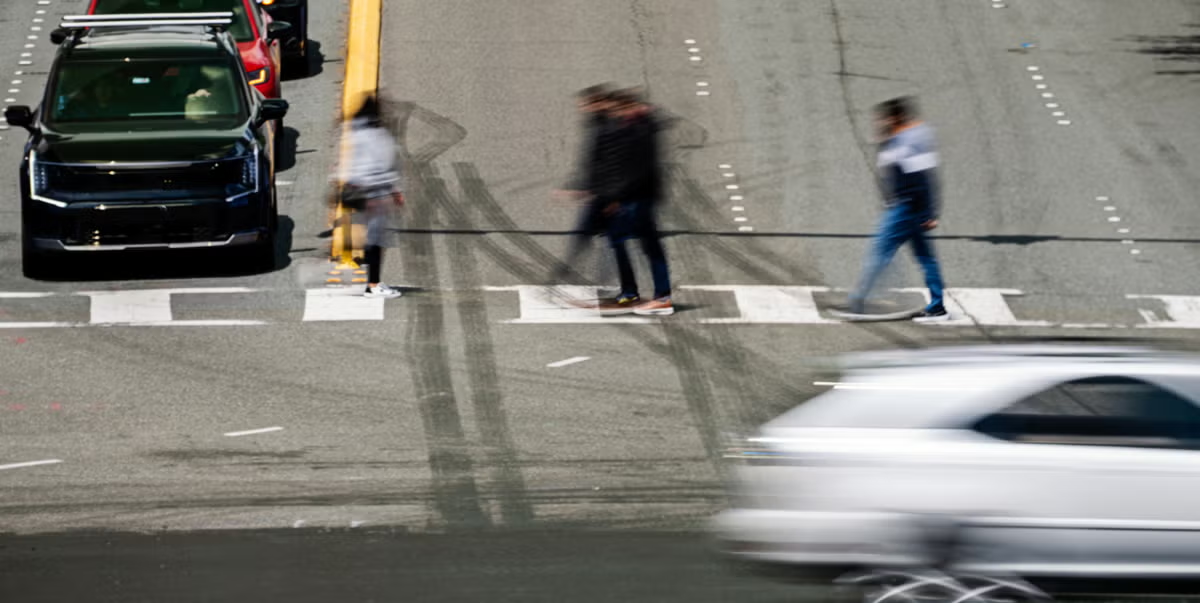
New research by the Times shows that thousands of fatal crashes involving pedestrians could have been avoided with lower hood heights and improved visibility.
 A
↗
A
↗
A world model predicts environment dynamics based on current observations and actions, serving as a core cognitive mechanism for reasoning and planning. In this work, we investigate how world modeling based on language models can further push the boundaries of general agents. (i) We first focus on building foundation models for agentic environment simulation. We introduce Qwen-AgentWorld-35B-A3B and Qwen-AgentWorld-397B-A17B, the first language world models capable of simulating agentic environments covering 7 domains via long chain-of-thought reasoning. Leveraging more than 10M environment interaction trajectories of 7 domains in real-world environments, we develop Qwen-AgentWorld through a three-stage training pipeline: CPT injects general-purpose world modeling capabilities from the state transition dynamics and augmented professional corpora, SFT activates next-state-prediction reasoning, and RL sharpens simulation fidelity through a tailored framework with hybrid rubric-and-rule rewards. To evaluate language world models, we present AgentWorldBench, a comprehensive benchmark constructed from real-world interactions of 5 frontier models on 9 established benchmarks. Empirical results demonstrate that Qwen-AgentWorld significantly outperforms existing frontier models. (ii) Beyond foundation models, we further investigate two complementary paradigms through which world modeling enhances general agents. First, as a decoupled environment simulator, Qwen-AgentWorld supports scalable and controllable simulation of thousands of real-world environments for agentic RL, yielding gains that surpass real-environment training alone. Second, as a unified agent foundation model, world-model training acts as a highly effective warm-up that improves downstream performance across 7 agentic benchmarks. Code: https://github.com/QwenLM/Qwen-AgentWorld
 X
↗
X
↗
Security, reliability, and maintainability reports for SaaS founders and AI-agent-built projects.
 X
↗
X
↗
@notch If you are asking “Why push back against anti-datacenter efforts?” I consider it a tragedy that anti-nuclear efforts largely strangled nuclear power in the US based on vibes, and I don’t want to see that happen to AI. Public opinion matters, and it shouldn’t be ceded
 D
↗
D
↗
Today, we're excited to announce Crosspay — a unified SDK that brings in-app purchases to every platform. Learn how we're simplifying monetization for developers worldwide.