I'm trying to understand where the biggest supply gaps still exist in real-world data for robotics and embodied AI. I'm not referring to synthetic or simulation data, only data collected from the physical world. Some examples I'm thinking about: Dexterous manipulation Tactile/contact sensing Bimanual tasks Warehouse/logistics Industrial assembly Mobile manipulation Long-horizon household tasks Human demonstrations vs. robot-generated data For those working in robotics or VLA/world model research: What types of real-world data do you wish existed in much larger quantities? Are there specific verticals (manufacturing, healthcare, retail, agriculture, etc.) where data is especially scarce? Are there modalities (RGB, depth, tactile, force, audio, IMU, eye gaze, etc.) that are consistently missing? If someone were starting a company focused on collecting real-world robotics data, where would you say the biggest unmet need is today? I'd love to hear perspectives from anyone training robot foundation models, collecting datasets, or deploying robots in production. submitted by /u/Tricky-Promotion6784 [link] [Kommentare]
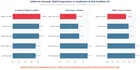
TL:DR: I’m a grad student in AI, I saw that Google released TabFM and TimesFM last week, I built an MCP wrapper to serve both transformer models in a single Docker container so you can connect their new ML transformer models to a local LLM via Open WebUI, Claude Code, or Codex and do ML tasks that would have previously required building, training, and tuning ML models to do. Tested with classic ML datasets (Iris, California Housing, etc), Pretty solid scores for accuracy for being zero-shot: (94.7% for Iris) and R2 of 0.91 for regression test) vs. traditionally tuned ML models. You need about 16GB of VRAM to run both models. I added dynamic model load and unload with a TTL set to 5 mins. CSV. support now, with XLS, XLSX, JSON, JSONL support soon. PyTorch-based so CUDA only. Works on DGX Spark, 3090, H100 and most anything Nvidia with 16GB+ VRAM. Install script auto detects architecture. Here is my repo if you want to try out the MCP: https://github.com/porespellar/Zer0Fit Here’s the non-TLDR version: I’m working on my Masters in AI and I saw someone’s post here the other day about Google’s new TabFM Tabular data foundational transformer models released last week and I thought that they were super groundbreaking in that they were basically bringing ML models into the GenAI space which is both weird and cool because ML models are very different animals than LLMs Here was the original Google blog post on it: https://research.google/blog/introducing-tabfm-a-zero-shot-foundation-model-for-tabular-data/ Anyways, I wanted to play around with these new models from a chat interface and try to “kick the tires” a bit, so I built an MCP implementation for both the TabFM and TimesFM models. Nothing super fancy, just a quick and dirty MCP wrapper of the PyTorch versions (this will only run on CUDA). I made the MCP with 2 build targets in mind: DGX Spark (arm-based with CUDA 13) and 3090 (AMD64 with CUDA 12.6). No Mac support because of Google using PyTorch, sorry. I also wanted this to work with my preferred chat client: Open WebUI, so that’s what it’s geared towards running best with and was tested against, I also added Claude Code and Codex CLI support as well, but haven’t really fully tested those out yet. Install is just a git clone and an ./install.sh. The whole thing runs out of a single Docker container and dynamically loads and unloads the models into VRAM with a TTL of 5 minutes to free up reserved VRAM when not in use. I also included an Open WebUI Skill.md that can be imported into Open WebUI, and skill.md and agents.md for the other harnesses. I tested it with some fairly classic ML datasets from Kaggle that most data science students have probably encountered while studying AI/ML. - Iris (classifiers) - California housing (regression) - Airline Passengers (time series forecast) I spent a semester trying to learn ML models and tuning them and not really knowing what the hell I was doing, usually overfitting my models, and changing all kinds of parameters that I didn’t know if they were really helping or hurting my models. It all seemed like a dark art that I never fully understood. TBH, I wasn’t really a fan of ML, I think it’s cool stuff, but I just don’t have the math skills or stats chops to be able to understand WTF I’m doing most of the time with hyperparameters tuning. A man has to know his limitations, LOL. Anyways, as I said earlier, I just wanted to get Google’s cool new ML models running where I could feed a dataset to an MCP and then have it do all the ML magic that Google trained these foundational models to do. I tried to make it easy for the average person like myself to run. I thought others might want to test out the models too so I made it a public repo. So here it is if you want to mess around with it: https://github.com/porespellar/Zer0Fit I’ll try and do some maintaining if I see that there is any continued interest, but I can’t promise that I’ll keep up with it, so please feel free to fork the repo and take it in any direction you want to. I think models like TabFM and TimesFM are going to low-key bring the branches of AI / ML tree closer together and we’re going to see some really cool and wild stuff as people take these concepts further in the future. Note: This repo was hastily built to just get the models running. I’ve done very limited testing only on DGX Spark. Again, feel free to fork it and make it as good as you want to. And please remember that this stuff is very experimental. Don’t use the forecasts or predictions made by these models for anything other than just research curiosity. Use at your own risk. Let me know what you think of the repo if you give it a try. Cheers. Note Regarding my test results in the images: I created the test scripts using DeepSeek V4 Flash and I had Claude Opus 4.6 review the test methods, code, and results. I don’t claim to be smart enough to know if the stats / math is correct. I would love it if some of the very smart ML research folks on here would give the repo a try and let us know if they are getting similar results or if my results are completely wrong. I included the sample datasets in the repo so “apples-to apples” comparison tests could be run by others to either prove or disprove my results. I really don’t mind if I’m wrong, I’m a student and just want to learn and improve. submitted by /u/Porespellar [link] [Kommentare]
This new paper develops an information-processing theory of consciousness and uses it to identify how consciousness can be instantiated in AI, paving the way for genuine AGI and beyond (the paper demonstrates that conscious functioning is the missing ingredient that enables a toddler to navigate an obstacle-strewn room or an 18-year-old to learn to drive with massively less training than is required by a robot or autonomous vehicle): Abstract: An acceptable information-processing theory of consciousness should be able to identify the adaptive advantages that drove the emergence of consciousness during the evolution of life. It should also predict the specific dynamical architecture of information processing that would need to be instantiated in AI to produce consciousness and the superior adaptation it enables. Whether such an instantiation produces AI that is actually conscious and also more adaptable would provide the ultimate test of the theory. A prime candidate for such a theory is the Subject-Object Emergence Theory of consciousness. It argues that consciousness first evolved because it enabled organisms to achieve adaptive body-environment coordination without extensive trial-and-error learning. It postulates that the subject in an appropriate Subject-Object subsystem would be able to use depictive (iconic) visual representations of the relative positions of its body and the environment to guide motor actions that will produce adaptive body-environment coordination. The depictive representations will 'light up' for such a subject, producing subjective experience that is used to deliver adaptive benefits. Hand-eye coordination is a familiar example in humans—novel and intricate coordination tasks can be undertaken without additional reinforcement learning, provided focused conscious attention is employed to provide us (the subject) with relevant depictive images. The paper identifies how such a conscious Subject-Object subsystem could be instantiated in AI systems, enabling hand-eye and other body-environment coordination without the extensive reinforcement learning or complex computational programming needed at present. Drawing further on the Subject-Object theory of consciousness, the paper also identifies how these simple conscious subsystems evolved further in organisms to establish the conscious modelling that enables conscious planning, imagining, abduction and other higher cognitive functions. It demonstrates that current approaches to incorporating world modelling in AI will fail to achieve key elements of the general intelligence found in humans that require consciousness. The full paper can be accessed freely at: https://ssrn.com/abstract=6911039 submitted by /u/BigPicturexyz [link] [Kommentare]
Hey ML community! I’ve been exploring world models and wrote a short article aimed at making the concept easier to understand. I also propose a framework for classifying different approaches and highlight a few trends that emerge from that classification. I’d appreciate feedback on the framework, especially where it may be incomplete, unclear, or technically inaccurate. Article: https://x.com/srini_sunil_/status/2075577335076598194?s=20 submitted by /u/ssrini125 [link] [Kommentare]
So, I am working on this startup project with pretty low budget and one of the features is sentiment analysis based on political news, x posts and Instagram hashtag trends in which will be in Indian languages. I've been suggested muRIL, an Indian language-based model fine-tuned on political data as the best long-term option. But our team does not have any ML engineer so we dont know how we should approach that. Also do tell me if you think there is a better alternative submitted by /u/OkRoyal9187 [link] [Kommentare]
I’m trying to build a model evaluation platform and wanted to see which ones I should evaluate first. Any resources on this would be helpful. submitted by /u/No-Bad-583 [link] [Kommentare]

Trying to separate demo-reel hype from actual capability. Every few weeks a new humanoid video goes viral, but polished demos and deployed systems are very different things. submitted by /u/futurewilltell [link] [Kommentare]
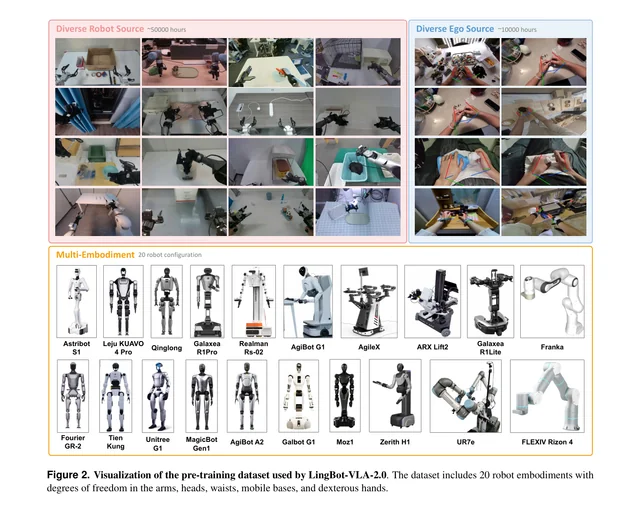
Robbyant released LingBot-VLA 2.0, a single model driving 20 embodiments from single-arm Franka and dual-arm UR7e up to full humanoids like Unitree G1 and Fourier GR-2. The action space also covers head, waist, mobile base, and dexterous hands, not only dual-arm manipulation. Training data is roughly 50,000 hours of real-robot trajectories across those 20 configs plus 10,000 hours of egocentric human video, filtered and reconstructed. The ablations on 4 GM-100 real-robot tasks show a clean result: relative joint actions over absolute lifted average success from 33.7% to 55.0%, with relative joint positions cutting the action standard deviation to roughly a third of absolute (about 0.28 vs 0.80). On its own GM-100 generalist eval, Robbyant self-reports higher progress and success than pi-0.5 and GR00T N1.7. Absolute success remains low: 34.4% on Agilex and 15.6% on Galaxea, with several tasks at 0%. The paper itself notes the model often makes partial progress then fails at the final precise placement or release. OOD performance degrades sharply. submitted by /u/deepmoss47 [link] [Kommentare]
I am preprocessing a CSV dataset for multiclass classification with XGBoost. My Feature variable contain numerical and categorical values, while the target variable contain many categorical value. For example, feature variables contain patient name, phone number, and exercise history, while Target variable contain different disease name such as heart attack, stroke, Alzheimer's etc. I know that feature variables can be encoded using one-hot encoding, but should the target variable also be encoded using the same method, or should I use a different encoding method for target variable (e.g., label encoding)? If anyone know the answer, please let me know. I have searched everywhere, but failed to get any clear idea about it. Thank you. submitted by /u/Rami02021 [link] [Kommentare]
Has anyone gotten a response from the eccv travel support program listed on their website? https://eccv.ecva.net/Conferences/2026/DEI Edit: also have anyone applied for this program as an accepted author? I have an independent research paper accepted and am currently looking for funds for paying for the registration fees submitted by /u/tedd235 [link] [Kommentare]
I have experience in deploying traditional robotics software, but I feel I am not up to date with what is happening in the modern robotics work like using vlm, vla, etc. People talk about it and show proof of concepts, but never seen a real deployment of these used cases especially in the case of the manufacturing industry. Has anyone deployed a robotic product with a modern robotics AI stack? Would love to gain the insights on this. submitted by /u/Live-Inspector-2641 [link] [Kommentare]
I unfortunately cannot get my hands on a rgbd/ stereo camera. So, I have to find a way with monocular camera. Is there any way? Currently, I have a fully functional ros2 nav2 robot with 2d lidar. How about using depth_anything or such? Can anyone provide me insights? submitted by /u/Candid-Scheme1835 [link] [Kommentare]