Channels
Call for Papers and Demos Real-Time Conversational Agents (RTCA): Toward Natural Multimodal Interaction 1st RTCA Workshop [@]() NeurIPS 2026, Sydney, Australia 11 or 12 December 2026 Website: https://rtcaneurips26.github.io/ We are pleased to share the Call for Papers and Demos for the inaugural RTCA Workshop at NeurIPS 2026, focused on real-time multimodal conversational agents: streaming speech, video, and language generation; naturalness in interaction; and evaluation of live systems. Conversational AI has moved from text chat into the real world, voice modes that talk back, embodied avatars, agents that share our screens and tools. To feel natural, these systems must operate in real time, streaming while continuously listening, watching, and re-planning. This is fundamentally harder than offline generation: latency, turn-taking, backchannels, interruptions, and cross-modal alignment become first-class problems that the offline paradigm sidesteps. Recent progress on full-duplex speech–language models, real-time talking-head generation, and streaming ASR shows the regime is feasible, but the field still lacks shared benchmarks, vocabulary, and methodology for interactional naturalness. RTCA brings together researchers across speech, vision, language, HCI, social-signal processing, and ML systems around three intertwined questions: real-time generation under hard latency budgets, naturalness in interaction, and evaluation of live systems. Topics of Interest We invite original contributions on topics including (but not limited to): Streaming/low-latency speech synthesis, ASR, and full-duplex audio–language models Real-time talking-head, avatar, and embodied video generation; lip-sync, gaze, expressivity under streaming Streaming language models; incremental and speculative decoding for dialogue Turn-taking, backchanneling, interruption handling, and floor management Multimodal alignment under latency and partial-observation constraints Prosody, emotion, and paralinguistic generation in interactive settings Memory, grounding, and tool use during live conversation Evaluation of naturalness: perceptual studies, turn-taking metrics, perceived latency, interactive Turing-style tests Datasets and benchmarks for interactive (not offline) evaluation Efficient inference, on-device deployment, and the systems–quality trade-off Safety, identity, and trust in real-time agents (deepfakes, persuasion, consent) Submission Types We welcome: Full papers (up to 8 pages) — may be presented as posters and/or contributed talks. Short papers (up to 4 pages) — work in progress or focused contributions. Demo papers (Extended Abstracts or up to 2 pages) All submissions must use the NeurIPS 2026 style file and be formatted for double-blind review. Page limits exclude references and appendices. Papers must be submitted in PDF format via OpenReview (portal link to be published on the workshop website). The workshop is non-archival; authors retain the right to publish elsewhere. Important Dates (End of day, Anywhere on Earth) Call for papers opens: 18 July 2026 Submission deadline (papers and demos): 29 August 2026 Author notification: 29 September 2026 Workshop date: 11 or 12 December 2026 Organisers Niki Foteinopoulou — Tavus, United Kingdom Alessandro Conti — Tavus, Italy Jack Saunders — Tavus, United Kingdom Oya Celiktutan — King's College London, United Kingdom Cigdem Beyan — University of Verona, Italy Ioannis Patras — Queen Mary University of London, United Kingdom For more information, visit our website https://rtcaneurips26.github.io/ or contact us at [rtca-workshop@googlegroups.com](mailto:rtca-workshop@googlegroups.com). We look forward to your contributions! submitted by /u/Few-Ferret9700 [link] [Kommentare]
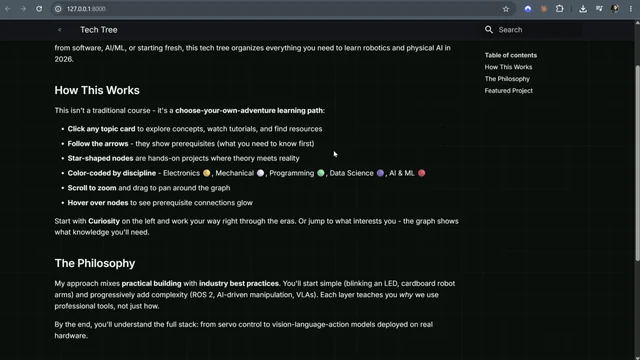
If you've tried to get into robotics, you've probably hit one of these walls: How do I get started? How do I get from blinking an LED to an autonomous robot? I come from a software (or mechanical, or data) background, what am I missing? I couldn't find a single good answer to these, so I started building one: an open source "tech tree" for robotics. It's a visual skill map. You start at the root and unlock the rest as you go (electronics, mechanics, programming, data science, AI), with hands-on builds as the milestones: blink an LED, a sensor project, a robot arm, a robot dog, and up into more serious AI. The main idea: it's not new content. There is already a ton of great tutorials, courses, and docs out there. The tech tree is just the map that sits on top of it and points you to the right resource for each skill, in an order that makes sense. It's early and nowhere near complete, which is kind of the point. It's fully open on GitHub, so if you have a favorite tutorial, a course that made something finally click, or a resource you wish you'd found sooner, you can add it. PRs and issues welcome, and "you forgot X" comments even more so. Links: Website: https://www.backtoengineering.com/ Repo: https://github.com/iuliaferoli/backtoengineering What would you add, or what's missing from the paths? submitted by /u/Growth-Sea [link] [Kommentare]
See the offer here. I assume its open to everyone and not targeted. Read through all the disclaimers and FAQ, still can't quite figure out what's going on here. Who am I lending to? How risky is it? Obviously Robinhood wouldn't do this unless they could profit from it, and it's pretty safe to assume I'd be facing risks as well (7% returns would never be risk free). But I just have no way to quantify it since I don't really understand what's being sold. Anyone know? Or can explain? submitted by /u/supes1 [link] [Kommentare]

Good Morning! .. Hope you are all enjoying the bear trap BTC is presenting... Dont get caught with your shorts down. ~JiJ submitted by /u/Jump_in_Jack [link] [Kommentare]
While writing an essay about AI memory and persistent context, I started wondering whether current AI memory systems are optimized for the right thing. Current AI systems already maintain forms of persistent context through saved memories, conversation summaries, user preferences, project notes, and similar mechanisms. These memories are primarily descriptive. They help the system remember facts about the user and previous interactions. But suppose future systems evolved in a different direction. Instead of primarily storing facts and preferences, imagine the persistent context being continuously refined and restructured to infer higher-level patterns such as recurring explanatory frameworks, preferred abstractions, and characteristic reasoning styles. For example, rather than remembering: "This user is interested in economics." "This user works in engineering." the system might gradually infer: "This user tends to explain economic outcomes through incentives and institutional constraints." "This user tends to understand complex systems through interactions and feedback loops rather than by analyzing individual components in isolation." In such a system, persistent context would become less like a collection of notes and more like an evolving model of how the user understands and interprets problems. Could representations like this emerge naturally from sufficiently capable AI systems, or would they require architectures fundamentally different from today's memory, retrieval, and summarization approaches? submitted by /u/Boris_Ljevar [link] [Kommentare]
Coins in my portfolio include: Chainlink (LINK) 15.43% Hedera (HBAR) 14.15% OriginTrail (TRAC) 9.97% Wayfinder (PROMPT) 9.75% Ondo (ONDO) 9.58% Render (RENDER) 8.12% Sui (SUI) 7.54% Solana (SOL) 7.09% SPX6900 (SPX) 5.52% XRP 5.18% Monad (MON) 4.42% Pepe (PEPE) 2.21% Hivemapper (HONEY) 1.04% I am new to crypto but in the last week or so i started learning, researching more, listening to people's opinions. I wanted coins from different areas like defi, layer 1, memecoins, AI, payments, DePin, enterprise, rwa that have a medium to high upside, that's why i didn't invest in btc and eth... I care and don't care if i lose the money i put in, meaning it's not from my savings, emergency funds. Am comfortable losing them but although it might hurt doing so i wont be affected economically. Am comfortable with long term holding them in case they go up later on so am not in it for gambling or a quick buck either. My first goal is to sell when i go over the money i put in which is around 975 euros. Except if i think it has potential to go even more up. So i might sell coins that might go up and i believe that's their top they can go to and hold others i believe they might do better later on. What do you think of the coins i invested in? Do you think they might do well and gain a substantial amount of money if a bull comes in? Do you think i'll lose most of my money? Do you think if another bottom comes in it's better to accumulate more of them and if yes which of them should i accumulate more? I know nobody knows for sure what will happen, i also know i have to watch the news, research adoptions, btc news, what the big sharks are investing in, what the governments do, interest rates, and general news that might affect the whole market in general and each of my coins individually but as a speculation i'd love to hear your opinion. submitted by /u/Traditional_Most105 [link] [Kommentare]
Would be nice if altcoins could hold a range for a while and just go sideways to give some confidence in the market. The last 2 years was like, can't go up, needs to dump. That's exhausting. Can altcoins give us a some store of value by going sideways, please? submitted by /u/Timely-Fig2030 [link] [Kommentare]

Here are the demos, a robot arm, a walker, and an RC car, more to come https://flomotion.app/motion/demos submitted by /u/dexx-32 [link] [Kommentare]

https://arxiv.org/pdf/2607.13511 the core idea is, we cannot have ternary PTQ with fixed matrix size, trying to do that is dead end. so i tried decomposing the matrix to 2 ternary matrices and inner diagonal scaling matrix. now that the inner rank can be arbitrarily large the accuracy can be arbiratily small. and its not that it has to be very large too i also showed that it does take only slightly more vram then current quantisation methods. the slight more vram is worth it if we abuse the ternary math. submitted by /u/LMTLS5 [link] [Kommentare]

Katana turned 1 on July 1st. Over the last year, they've outcompeted many chains from the 2024/25 era and are still going strong. I've made posts about Katana in the past. I work in web3 and this project is one of the most exciting I've seen because of the design of the chain and the way emissions are structed. If you've ever farmed an incentive program, you know the arc. Emissions turn on, TVL floods in, the APY looks unreal for six weeks, emissions taper, capital walks to whoever's paying more. Most chains are renting their liquidity and calling it growth. Katana does it differently. There where no VC-term deals to raise liquidity favorably. All revenue stayed on the chain from day 1 as Katana did a really great job of being opinated and owning the stack. On most chains, TVL is a cost. You pay for it. On Katana, TVL is the revenue. When you bridge an asset onto a normal chain it sits in a contract doing nothing. That's true almost everywhere. VaultBridge routes those bridged assets into yield strategies instead, so the deposits themselves earn. The chain takes revenue off that. That revenue funds chain-owned liquidity, meaning pools the chain owns outright and permanently, which cannot walk out because they were never rented. And it funds incentives, paid out of income rather than out of a printer. So the flywheel spins the right way. More TVL means more revenue, which means more owned liquidity and a bigger incentive budget, which means more TVL. On a normal chain that same loop runs in reverse: more TVL means a bigger incentive bill, which drains the treasury faster, which shortens the clock to the announcement. That's the difference between a chain that compounds and a chain that burns. Year one, by Katana's own published numbers: Day one: $250M+ bridged, 15 apps live including Morpho, Sushi, Spectra Aug 2025: $488k in revenue generated and distributed Oct 2025: Sushi passed $1B in spot volume on the chain Jan 2026: in-house quests platform, 6k+ users completing 5+ quests Mar 2026: KAT staking live, listed on Binance, Coinbase, OKX, Kraken, Upbit, Bithumb Mar 2026: acquired IDEX, the team that built the #1 DEX of 2018, relaunched as Katana Perps Apr 2026: Binance Earn and OKX Earn integrations, $600k+ in revenue from those alone Jun 2026: perps volume past $400M, three trading competitions, $155K+ USDC paid straight to traders Year one total: $4M+ in protocol revenue, 28M+ KAT compounded since TGE It also got stress tested twice, which is the part that gets skipped. It ran normally through 10/10 when plenty of things did not. It stayed liquid through the April crunch and serviced tens of millions in outflows without gating anybody. A chain that holds up while people are running for the door is a fundamentally different asset than one that only works when everything is green. And you can still farm right now. There are stablecoin vaults sitting in the 8-10% range, avKAT in the 50% range (pays to coordinate liquidity, expect to drop over time), and season quests, The thing I'm actually watching in year two: KAT as a liquidity coordinator. You lock KAT, you get voting power, you point emissions at whatever part of the chain you think deserves liquidity. That's a ve model and you've seen it on Curve and Aerodrome. The difference is those coordinate liquidity for one DEX. Katana's runs at the chain level. So the question stops being "which pool gets emissions" and becomes something closer to capital allocation. Lending markets, perps, yield venues, spot pools, all competing for the same liquidity, with token holders arbitrating between them. Right now it's mostly DEX pools, which is the boring version of this. The interesting version is a chain where holders are steering liquidity across every venue on the stack based on where it earns most. Nobody's really run that at chain scale. Watching it develop is genuinely the thing I'm most curious about this year. My honest read is the gap between what's been built and what it's priced at is the widest of anything I hold. That either means the market is early or the market looked and disagreed. I lean early. I've been wrong before. TL;DR: Katana recently turned 1. $4M+ protocol revenue, no VC, no presale, IDEX acquired and relaunched as perps, listed on every major CEX, survived 10/10 and the April crunch. It inverted TVL from a cost into a revenue source, which is why it has no expiry date while chains that bought their TVL are announcing pivots. Still farmable, stablecoin vaults in the 8-10% range from borrow interest plus incentives. We've all watched chains rent TVL with emissions and die when the money ran out. Katana is the only one I can name that built the revenue engine first and never took the VC money that starts the clock. submitted by /u/TimmyXBT [link] [Kommentare]