 R
↗
R
↗
This guy was just doing a live set on Kill Tony. He claims to have worked for Mt Gox in Japan, specifically doing their English press releases, before (and after) the hack. The show is still going on, will provide a time stamped link later. submitted by /u/TatarAmerican [link] [Kommentare]
R
↗
I think browser based mining is a fairly new thing and I’m wondering what people think of it? I don’t want to plug any particular coin but I’ll point out browsercoin as a general example. For years it seems like there have been too many barriers preventing mass adoption but what if a browser based token automatically generates a wallet and you can mine at home or on a mobile device. Would this make crypto adoption easier for most people to enter and possibly stimulate use as a currency, whatever token that might be? I’m looking for meaningful discussion from folks who understand the tech better than me. submitted by /u/SBTWP [link] [Kommentare]
R
↗
Welcome to the Daily Crypto Discussion thread. Please read the disclaimer and rules before participating. Disclaimer: Consider all information posted here with several liberal heaps of salt, and always cross check any information you may read on this thread with known sources. Any trade information posted in this open thread may be highly misleading, and could be an attempt to manipulate new readers by known "pump and dump (PnD) groups" for their own profit. BEWARE of such practices and exercise utmost caution before acting on any trade tip mentioned here. Please be careful about what information you share and the actions you take. Do not share the amounts of your portfolios (why not just share percentage?). Do not share your private keys or wallet seed. Use strong, non-SMS 2FA if possible. Beware of scammers and be smart. Do not invest more than you can afford to lose, and do not fall for pyramid schemes, promises of unrealistic returns (get-rich-quick schemes), and other common scams. Rules: All sub rules apply in this thread. The prior exemption for karma and age requirements is no longer in effect. Discussion topics must be related to cryptocurrency. Behave with civility and politeness. Do not use offensive, racist or homophobic language. Comments will be sorted by newest first. Useful Links: Beginner Resources Intro to r/Cryptocurrency MOONs 🌔 MOONs Wiki Page r/CryptoCurrency Discord r/CryptoCurrencyMemes Prior Daily Discussions - (Link fixed.) r/CryptoCurrencyMeta - Join in on all meta discussions regarding r/CryptoCurrency whether it be moon distributions or governance. Finding Other Discussion Threads Follow a mod account below to be notified in your home feed when the latest r/CC discussion thread of your interest is posted. u/CryptoDaily- — Posts the Daily Crypto Discussion threads. u/CryptoSkeptics — Posts the Monthly Skeptics Discussion threads. u/CryptoOptimists- — Posts the Monthly Optimists Discussion threads. u/CryptoNewsUpdates — Posts the Monthly News Summary threads. submitted by /u/AutoModerator [link] [Kommentare]
R
↗
Curious: how are you feeling about crypto compared to a few years ago? A. It’s the future, nothing changed B. I’m not so sure C. Yeah I’ve lost some enthusiasm D. It’s probably another symptom of late stage capitalism and they’re gonna screw us E. Other (explain) submitted by /u/nandofour-san [link] [Kommentare]
R
↗
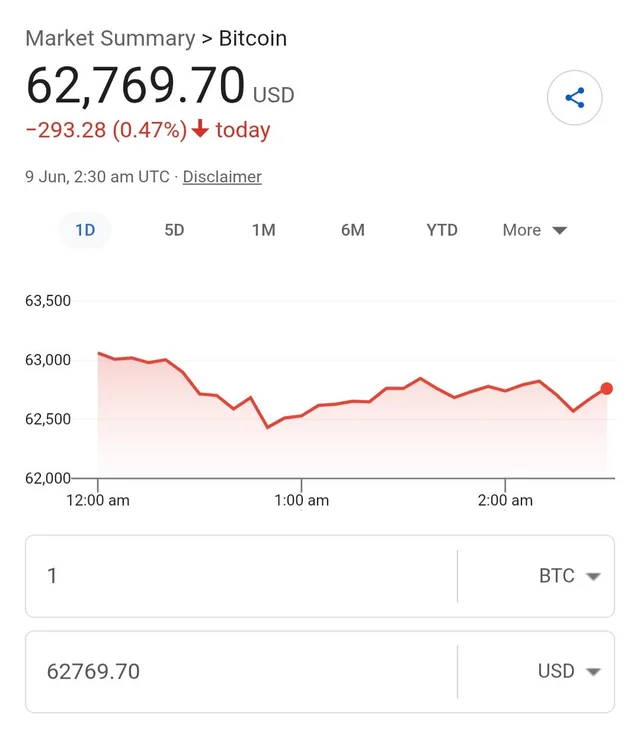
We’re down about 50% from the October highs, and my feed is packed with fear, doom, and “Bitcoin is dead” posts. So let’s zoom out for a second. Bitcoin is not going to zero. Why? Because as long as even one person somewhere in the world values it, they’ll trade something for it. Something that was worth pennies 16 years ago is sitting around $60,000 today… after being cut in half. Name another asset that can drop 50% and still be up that much over its lifetime. This is what Bitcoin does. It doesn’t move in a straight line. It climbs in violent, gut-wrenching waves with brutal pullbacks in between. Every major correction has felt like the end of the world while it was happening. Every single one. And yet here we are. The part critics never seem to address is this: Bitcoin’s supply gets tighter over time, while the supply of dollars keeps expanding. Every four years, Bitcoin’s issuance gets cut in half on a predetermined schedule, all the way toward its hard cap of 21 million coins. Fiat currencies work the opposite way. More gets created whenever policymakers decide it’s necessary. That’s not a conspiracy; it’s simply how the system is designed. Over time, assets with limited supply tend to rise relative to currencies that are continually being expanded. We’ve seen that play out in real estate, stocks, and many other scarce assets for decades. So no, the daily price action isn’t the story. Short-term markets are driven by emotions, headlines, liquidity, and uncertainty. Sometimes that sends prices higher. Sometimes it sends them lower. That’s the noise. The bigger picture is much simpler: a scarce asset, growing adoption over time, and a currency system that continues to expand. Zoom out. The long-term trend is what matters. submitted by /u/Vegetable-Acadia-766 [link] [Kommentare]
R
↗
Obviously related to price drop submitted by /u/No-Masterpiece2246 [link] [Kommentare]
R
↗
It's so upsetting. So depressing to see the posts that the xrp community is putting out. I mean maybe they should spend their money on some dignity. They really need to get some because it doesn't look like they have any. It's such b******* what they say about xrp. Oh my God, the math doesn't add up. None of it does. If they have stable coins, why do they need xrp and just look at the amount of YouTubers spilling out of their neck? The same goat s*** that Jake Claver puts out or in cash official or some of those other stupid non-stop xrp channels God I've personally unsubscribed from every one of them. It makes me sick! I can't stand the xrp community anymore it's jus sad 😢 submitted by /u/ZannyNanny23 [link] [Kommentare]
R
↗
I spent the last month building open benchmarks for crypto infrastructure. RPC latency, bridge fees, oracle deviation, stablecoin peg drift, L1 finality, Solana transaction landing rates. Everything is live, backed by Prometheus, the methodology is public, and the harness code is on GitHub. Before I add more providers I want methodology review from people who have thought about this longer than I have. Honestly the state of the field is rough. Every infrastructure benchmark I found falls into one of three buckets: marketing copy published by the provider being measured, a one off blog post with no live data and no methodology, or closed measurements you just have to trust. None of them are reproducible. None publish their sampling cadence, outlier handling, region split, or fetch mechanism. So I built one that does. This is not a launch post. I want technical critique on how I am measuring, not feedback on the UI. Link is at the bottom. The methodology questions are why I am here. Sampling cadence and aggregation Each metric has its own scrape interval. RPC eth_call latency runs at 30s per provider per region. L1 finality wall clock is 10s polling for HTTP only chains, with a persistent WebSocket subscription for BNB and Avalanche so I can record when a block is first seen as latest and when the same block is first seen as finalized, down to the millisecond. Stablecoin peg is 5s on CEX REST tickers and 12s on Curve get_dy onchain. Aggregator head lag is 15s WebSocket event sampling. Samples get bucketed per minute, then aggregated with quantile_over_time across the reporting window (24h or 7d). I publish p50, p90 and p99 separately. The leaderboard sorts on p50 by default because it is the most stable indicator of typical user experience, but the full distribution is queryable from the API and shown on each bench page. For a single 24h window on a daily active metric I currently get roughly 100k to 500k data points per provider depending on cadence. I think that is enough to publish a leaderboard. Am I wrong? Where is the floor for "this comparison actually means something" in your experience? Outlier handling, where I am least confident For latency metrics I currently drop the top 1% per minute bucket before computing the per minute median. The daily p99 is then computed from those per minute medians, not from raw samples. This trims one off spikes (a single GC pause, a single network reroute) without hiding consistent tail behavior. Three providers have already pushed back, in opposite directions. One says I am masking their real worst case (which they argue is still better than competitors with wider tails). Another says I should drop nothing and let the raw distribution speak. A third says I should drop more, top 5%, because they have a known rare failure mode they consider out of scope. I do not have a principled answer yet. The tension is between representing typical experience honestly and letting one network event dominate the number. What do you do? Is there a paper or prior art you would point me to? Multiregion Three of the benches run in three regions: US East, EU West and Singapore. For those the leaderboard reports the median across regions, which hides regional advantages a provider may have. A provider with a single US datacenter and no Singapore edge can look bad on the global number even if it is fast for its actual customer base. A provider that is strong only in EU looks mid tier when measured globally. Right now I expose per region rankings as a filter on the bench page, but the shareable headline is the median across regions. Should this be configurable per provider? Should the headline default to the user's nearest region by geolocation? I have not seen anyone solve this cleanly. Connection reuse For eth_call latency I rebuild the HTTPS connection on every call to measure cold call latency. A few providers argue this is not representative, since in production their clients hold persistent connections and reuse them. They want warm call latency. My reasoning is that cold call is the honest measurement when you do not know client behavior, and it captures TLS handshake overhead, which is a real cost. But warm call is closer to what a long lived application actually sees. Right now I publish cold call as the default and do not publish warm call at all. Right call? Should I publish both? Why Prometheus Two reasons. First, every number on the site is a literal quantile_over_time query. Anyone can hit the HTTP API, pull the raw sample series, and recompute the leaderboard with their own aggregation. Reproducibility is the whole point. Second, it makes adding providers cheap. The harness exposes /metrics with consistent labels, a new entrant opens a PR adding their RPC URL to the config, and the metric shows up automatically with no manual leaderboard edits. The cost is that quantile_over_time is an approximation, not an exact percentile, so it deviates by roughly 1 to 2% from the true percentile on raw samples. For most users that is noise. For a provider sitting 0.5% behind the leader it can be the difference between rank 1 and rank 2. I disclose it, but I know some people consider it disqualifying. Site: https://openchainbench.com/ Github : https://github.com/OpenChainBench/OpenChainBench submitted by /u/Minimum_Abies3578 [link] [Kommentare]
R
↗
I've been in crypto for a few years now and honestly most of my mistakes came from following influencers, Twitter narratives, and random YouTube predictions. The biggest change for me was when I stopped looking for the next 100x coin and started focusing more on risk management, portfolio allocation and understanding market cycles. I'm curious what resources have actually helped people become better investors over time. Not necessarily signal groups or trade calls, but communities, newsletters, research platforms, books, podcasts, etc. What made the biggest difference for you? submitted by /u/Hunter-_-Twitch [link] [Kommentare]