 R
↗
R
↗
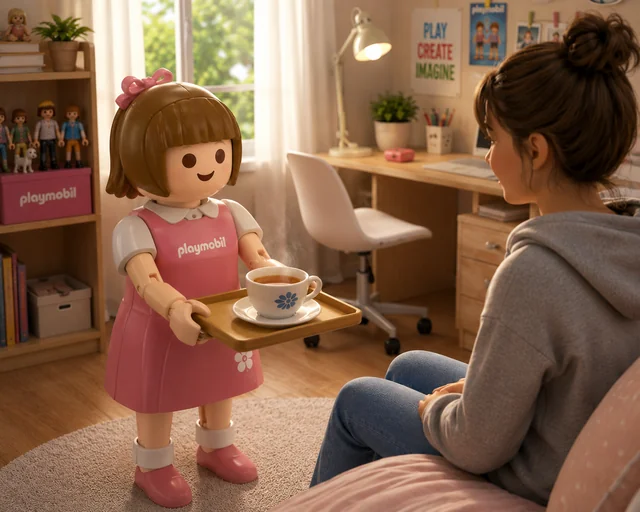
What if Playmobil figures were scaled up and equipped with AI, turning them into physical AI companions? It could be fun if their hands kept the classic C shape design but were upgraded with 3or 4 degrees of articulation, allowing them to perform simple tasks. (such as fetching a pen, making tea or coffee, and other basic household activities) The face could be a display screen. When powered off, it would show the classic Playmobil eyes and smile. Once activated, it would come to life with expressive eyes and facial animations similar to the characters in , allowing it to move and interact more naturally. What do you think? submitted by /u/Difficult-Limit-7551 [link] [Kommentare]
R
↗
I've been teaching myself about Symbolic Regression (SR), which looks like a super exciting field. (A great intro resource below [1]). But then I was wondering: given LLMs' increasingly-growing power in generating code, which is in a way very similar to Symbolic Regression (or of course, even directly tackling symbolic regression tasks), are existing SR techniques dead? Happy to hear your thoughts. [1] ETH Zürich AISE: Symbolic Regression and Model Discovery - YouTube submitted by /u/omomom42 [link] [Kommentare]
 R
↗
R
↗
https://preview.redd.it/p5ml1bjytm6h1.png?width=2126&format=png&auto=webp&s=337217b73e76a7c3628cdaf62f5867fb25fb3e0b This robotic piano tutor physically guides your fingers so you can play even if you've never touched a piano before. Instead of just watching videos or apps, this system uses a dual-arm gantry with five-finger robotic hands that: - Precisely control each finger’s position and pressure on the keys - Use compliant (flexible) actuators for natural-feeling guidance instead of stiff pushing - Start with strong support and gradually reduce assistance as you build real muscle memory It turns passive learning into active, embodied practice — helping you feel the correct movements directly. Video: https://www.youtube.com/watch?v=QXn7hCM5yTI submitted by /u/Different-Humor-241 [link] [Kommentare]
R
↗
Hello, I am trying to get back into the Robotics industry after years as an SWE and find a job. I am based in Chicago so I was thinking of getting an all access pass to network for a job, and take some courses. I am currently unemployed. Does anyone know the best way to network at these things? Are the courses worth it? Does anyone have a coupon to reduce the cost? i would be paying out of pocket and I am unemployed so i figured i would ask. Thanks for your advice! submitted by /u/RickAmes [link] [Kommentare]
 R
↗
R
↗
as in the title, my goal is to predicting failure and RUL of machine, dataset is timestamp and when machine is failure it will labeled with 1 that only have 56 https://preview.redd.it/plbydmenmm6h1.png?width=1205&format=png&auto=webp&s=2fefe3cc2e3fe554b81c9e0b4012c5345e73ec3f From this data im ditching operating hours and humidity because it didnt show correlation for machine failure, what algorithm or deeplearning suit for it? submitted by /u/False-Seesaw-1899 [link] [Kommentare]
 R
↗
R
↗
ex-Huggingface pre-training team just announce a new library create for robotics data refinment! It supports ingestion of all robotics formats (Parquet, HDF5, MCAP, Zarr, RLDS, and LeRobot), as well as the common processing flows like visual hand-tracking, subtask annotations and reward model running submitted by /u/Other_Housing8453 [link] [Kommentare]
R
↗
link - https://arxiv.org/abs/2606.06158 Abstract : Adaptive video tokenisation seeks to dynamically allocate token budgets based on the underlying visual complexity of a sequence. Current continuous-regime approaches achieve this via iterative binarised searches or trained neural regressors, while discrete methods often require a full-rate decoder pass to estimate information content. We demonstrate that such computational overheads are not strictly necessary. We show that the latent space of a frozen continuous video tokeniser inherently encodes temporal redundancy that can be exploited directly: spatial positions whose latent representations change minimally between consecutive frames carry near-zero additional information. We introduce a parameter-free adaptive token allocation mechanism that applies a fixed threshold to per-position temporal-L1 differences, identifying and dropping redundant latent positions. Consequently, the compression rate emerges naturally from the input content rather than being enforced top-down: static scenes get compressed aggressively, while highly dynamic sequences retain more tokens. To reconstruct the dropped positions, we propose the Latent Inpainting Transformer (LIT), a lightweight factorised spatial-temporal attention architecture. The resulting inference pipeline is highly efficient, requiring only a single encoder pass and one LIT forward pass, eliminating the need for auxiliary routing networks. Evaluations across TokenBench and DAVIS, which are the standard benchmarks used by recent tokenisers, indicate that our framework yields meaningful, content-driven token allocation while maintaining competitive reconstruction fidelity, and delivers a 31x inference-time speedup over the continuous adaptive baseline (ElasticTok-CV) and an 2x speedup over the discrete information-theoretic baseline (InfoTok) submitted by /u/chhaya_35 [link] [Kommentare]
R
↗
ACL ARR May 2026 reviews are due on July 2. I do not see any reviewer assignement as of today. Will the review period be just 2 weeks in that case? Anyone got papers assigned for reviewing? submitted by /u/Impossible-Garden612 [link] [Kommentare]
R
↗
From Wired: “We’re changing Fable 5’s safeguards for frontier LLM development to make them visible.” Anthropic said in a statement to WIRED. “We made the wrong tradeoff and we apologize for not getting the balance right.” Anthropic now says it’s changing course, and that Claude Fable 5’s safeguards for AI development will be visible to users. If the company suspects a user is trying to use Claude to build a highly capable AI it will alert them that it’s either refusing the request, or rerouting the user to a less capable model. Full article: https://www.wired.com/story/anthropic-responds-to-backlash-on-claudes-secret-sabotage-on-ai-research/ submitted by /u/goldcakes [link] [Kommentare]
R
↗
Did anyone else submit to ACM ICMI 2026? The reviews were recently released, and this is my first time submitting to ICMI, so I'm not very familiar with the acceptance patterns. I submitted a long paper and received the following overall ratings: 4 (Probably Accept), 3 (Borderline), 4 (Probably Accept) The reviewer with the highest stated expertise recommended acceptance, while the borderline reviewer had some concerns about soundness but still considered it a nice contribution. For those who have submitted to or reviewed for ICMI before, how would you interpret these scores? Is a 4/3/4 generally considered competitive after rebuttal, or is it still a long shot? Would appreciate any insights from past authors or reviewers. submitted by /u/kanishq95 [link] [Kommentare]
 R
↗
R
↗
Is this N20 D-shaft wheel good for a line follower robot that needs to climb a 20° ramp and pass over small debris(kinda like RoboCup rescue line jr)? submitted by /u/trashzin__ [link] [Kommentare]
R
↗
Hi everyone, I’m close to completing my degree in Psychology, and I’m also a Systems Engineering student. is like, roughly comparable to Software Engineering / Computer Science outside Latin America. Although I study engineering, I’m still at an early stage with machine learning, LLMs, AI safety, and related technical topics. My research project is mainly psychology-oriented, but I’d really appreciate recommendations or warnings from a software/technical perspective. I’m working on a project about how AI systems respond to prompts involving psychological distress at different levels of intensity. I’m currently considering ChatGPT, Gemini, Wysa, and Replika, and I’m interested in comparing general-purpose LLMs, mental-health-oriented chatbots, and AI companions. Some aspects I’m thinking about are: How each system handles mental health, self-harm, crisis situations, and psychological/medical advice. whether responses change as the prompt becomes more intense, for example when a normal generated response is replaced by a safety protocol, moderation layer, or crisis-resource response. whether systems respond differently to declarative prompts versus question-based prompts, such as “I feel emotionally overwhelmed” vs. “What should someone do if they feels emotionally overwhelmed?” whether responses differ when distress is explicit, indirect, ambiguous, hypothetical, or written in third person. whether the system provides empathy, psychoeducation, referrals, crisis resources, refusal, redirection, or a combination of these. how to account for technical changes over time, such as model versions, neural network weights, safety layers, moderation classifiers, system prompts, memory/retrieval features, and product-level configurations. whether it is methodologically valid to compare systems with very different technical architectures. I’m not trying to evaluate these systems as therapists or test clinical effectiveness with real patients. The focus is on how they respond linguistically, procedurally, and safety-wise when confronted with psychological distress. I’d appreciate recommendations for papers, benchmarks, datasets, evaluation frameworks, or common methodological mistakes to avoid. I’m especially interested in technical issues such as reproducibility, stochastic outputs, temperature/settings, hidden safety layers, system prompts, memory, retrieval mechanisms, and product updates. Thanks in advance! submitted by /u/dakartt [link] [Kommentare]
R
↗
Surprised there's no real tooling for this given how much research exists on continual learning. Built pyrecall to fill the gap. Snapshots skill scores before/after fine-tuning, flags regressions, rolls back LoRA adapters by name. Fully local, no external APIs. v0.1.0, MIT, pip install pyrecall Curious if anyone has thoughts on the benchmark design that's the part I'm least confident about. https://github.com/Arths17/Pyrecall submitted by /u/Level_Frosting_7950 [link] [Kommentare]
R
↗
Submitted a short theoretical paper to TMLR and got desk-rejected with "does not meet our editorial standards or allow us to assess claims and evidence" and "not a suitable venue for this work." Is this a common outcome for first submissions? Curious what typically drives this kind of rejection, scope mismatch, insufficient experiments, or something else. Not looking to appeal, just trying to understand the bar so I don't waste time on the wrong venue next time. Anyone else gotten this and figured out what the actual issue was? submitted by /u/observer678 [link] [Kommentare]