Channels
Welcome to the Daily Crypto Discussion thread. Please read the disclaimer and rules before participating. Disclaimer: Consider all information posted here with several liberal heaps of salt, and always cross check any information you may read on this thread with known sources. Any trade information posted in this open thread may be highly misleading, and could be an attempt to manipulate new readers by known "pump and dump (PnD) groups" for their own profit. BEWARE of such practices and exercise utmost caution before acting on any trade tip mentioned here. Please be careful about what information you share and the actions you take. Do not share the amounts of your portfolios (why not just share percentage?). Do not share your private keys or wallet seed. Use strong, non-SMS 2FA if possible. Beware of scammers and be smart. Do not invest more than you can afford to lose, and do not fall for pyramid schemes, promises of unrealistic returns (get-rich-quick schemes), and other common scams. Rules: All sub rules apply in this thread. The prior exemption for karma and age requirements is no longer in effect. Discussion topics must be related to cryptocurrency. Behave with civility and politeness. Do not use offensive, racist or homophobic language. Comments will be sorted by newest first. Useful Links: Beginner Resources Intro to r/Cryptocurrency MOONs 🌔 MOONs Wiki Page r/CryptoCurrency Discord r/CryptoCurrencyMemes Prior Daily Discussions - (Link fixed.) r/CryptoCurrencyMeta - Join in on all meta discussions regarding r/CryptoCurrency whether it be moon distributions or governance. Finding Other Discussion Threads Follow a mod account below to be notified in your home feed when the latest r/CC discussion thread of your interest is posted. u/CryptoDaily- — Posts the Daily Crypto Discussion threads. u/CryptoSkeptics — Posts the Monthly Skeptics Discussion threads. u/CryptoOptimists- — Posts the Monthly Optimists Discussion threads. u/CryptoNewsUpdates — Posts the Monthly News Summary threads. submitted by /u/AutoModerator [link] [Kommentare]



Surprised there's no real tooling for this given how much research exists on continual learning. Built pyrecall to fill the gap. Snapshots skill scores before/after fine-tuning, flags regressions, rolls back LoRA adapters by name. Fully local, no external APIs. v0.1.0, MIT, pip install pyrecall Curious if anyone has thoughts on the benchmark design that's the part I'm least confident about. https://github.com/Arths17/Pyrecall submitted by /u/Level_Frosting_7950 [link] [Kommentare]
Submitted a short theoretical paper to TMLR and got desk-rejected with "does not meet our editorial standards or allow us to assess claims and evidence" and "not a suitable venue for this work." Is this a common outcome for first submissions? Curious what typically drives this kind of rejection, scope mismatch, insufficient experiments, or something else. Not looking to appeal, just trying to understand the bar so I don't waste time on the wrong venue next time. Anyone else gotten this and figured out what the actual issue was? submitted by /u/observer678 [link] [Kommentare]
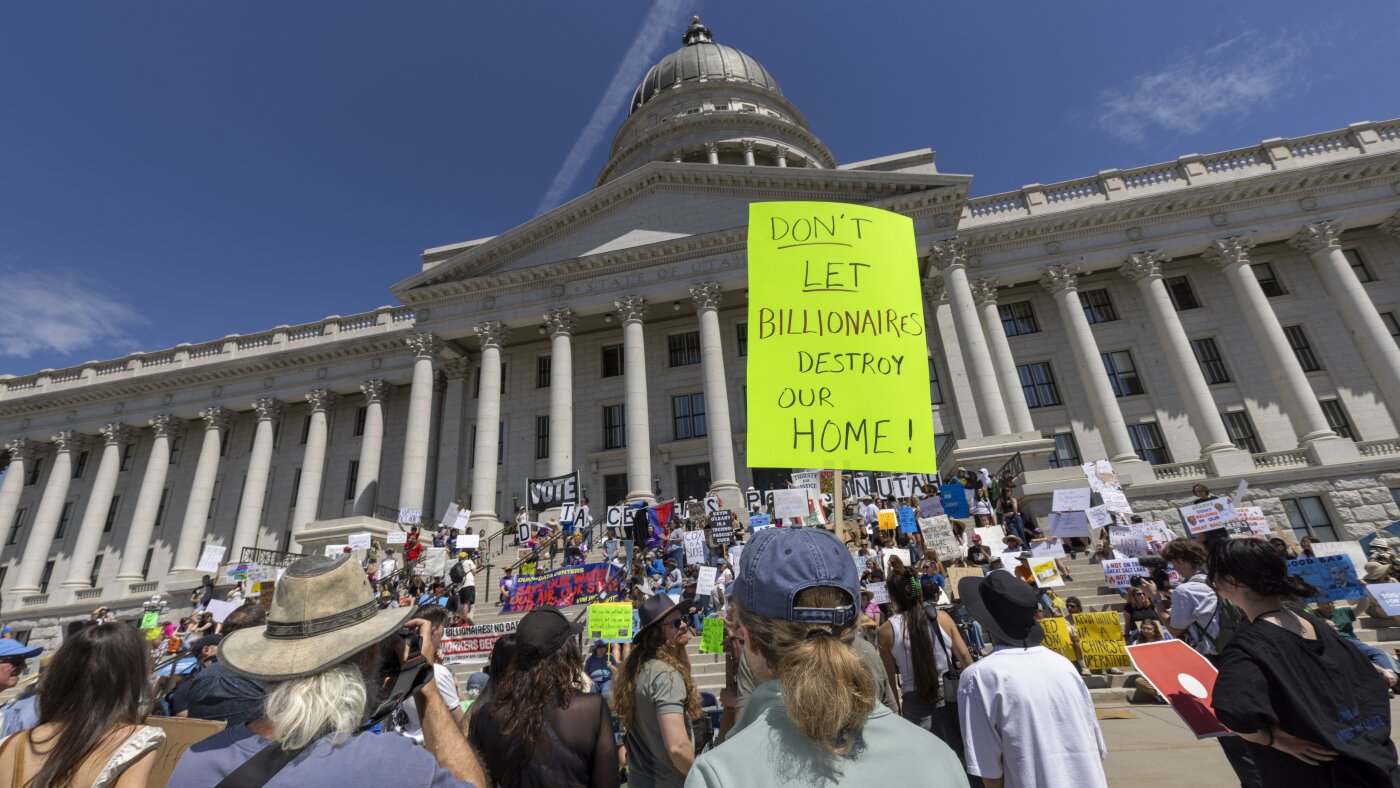
NPR > Technology The theory taking the rich by storm: China funds data center haters By Geoff Brumfiel Wednesday, June 10, 2026 • 4:01 PM EDT Speaking at an event titled "Harnessing American Power" last month, Interior Secretary Doug Burgum expressed dismay at what he saw as a new wave of local opposition to data centers in America.What's more, he claimed, not everything was as it seemed."It's not organic and local, some of this is foreign-sourced dark money," he told the crowd.He isn't alone in his suspicions. Over on the podcast All-In, which is hosted by a group of tech multimillionaires who call each other "besties," there was also talk of foreign influence, specifically from China."It is starting to feel or seem like there might be a CCP-funded campaign," fund manager Gavin Baker told the hosts.The theory that China is paying local activists in America to oppose data centers is catching on like wildfire among the Silicon Valley elite, despite a lack of evidence. Wealthy investors are naming names and pointing fingers, even if they can't directly link their projects' opponents to China.That's not to say that Chinese influence is completely absent from the U.S. conversation around AI infrastructure and data centers. On Wednesday OpenAI said it banned a cluster of likely Chinese accounts that used ChatGPT to generate anti-data center content this past winter. The accounts were probably run by a private Chinese technology firm working for "provincial-level government clients" in China, OpenAI said. The company said the operators posed as Americans on social media and posted AI-generated comments and images highlighting energy demand and rising electricity costs. Related Story: NPR But OpenAI also said the impact of the influence campaign appeared limited and its social media posts didn't get much traction. "This was not a case of an influence operation creating a debate. The debate existed already. This was an influence operation from China trying to interfere in it. We didn't see any signs that they succeeded," said Ben Nimmo, who leads threat investigations at OpenAI, on a call with reporters.The allegations that some activists are being directly financed by China come amid a rising wave of anti-data center sentiment: a recent Gallup poll found that 71% of Americans somewhat or strongly opposed construction of data centers in their communities. Related Story: NPR Despite that public opposition, the theory does appear to be gaining some traction in Washington. In a letter last week, Congressman Brett Guthrie, R-Ky., the chairman of the House Committee on Energy and Commerce called for a briefing on whether the U.S. government sees evidence for Chinese influence in the data center debate. The letter was addressed to FBI Director Kash Patel as well as David Sacks and Michael Kratsios, two wealthy tech investors who sit on President Trump's Council of Advisors on Science and Technology (Sacks, who was until recently Trump's special adviser on artificial intelligence and cryptocurrency, is also a regular host of All-In)."Cells" in UtahMany top earners promoting the foreign influence theory are either directly or indirectly invested in artificial intelligence. One prominent advocate is Canadian multimillionaire and Shark Tank star Kevin O'Leary, who is an investor in a giant data center in Utah called Stratos. It was going to be roughly twice the size of Manhattan and was being pushed through the permitting process, until local opposition began to build.After a local planning council approved the project in early May, O'Leary noticed an "immediate spike in misinformation," he said during a recent Fox News interview he posted on his own social media account."We dug in, I got my guys to do a deep dig into the IP addresses and here's what we found, this is fascinating," he said. "We found two cells inside of Utah."O'Leary claimed that a nonprofit called Alliance for a Better Utah and a consultancy known as Elevate Strategies were operating on behalf of the Chinese government against the project, which his company, O'Leary Digital, is leading. He went on to name several current and former employees with both organizations.Among them was Gabi Finlayson, a senior partner at Elevate Strategies, which is based in Salt Lake City and helps Democratic candidates run for office in Utah and elsewhere.She told NPR she had no idea how she or Elevate ended up on O'Leary's list. "I think we have been as confused as anybody," she said.Finlayson said that Elevate, like several progressive groups, had posted about the data center on its social media channels, but the firm is not playing a central role in efforts to stop construction. Moreover, its social media accounts don't generate revenue for the organization."We are certainly not a Chinese cell. Nobody pays us to make any content, let alone any foreign government," she said.Employees at Alliance for a Better Utah were equally perplexed."I grew up watching Shark Tank with my dad occasionally, and I was like why is this guy talking about us?" said Elizabeth Hutchings, the organization's communications director. O'Leary named people who didn't even work there anymore, and he claimed "there was evidence that millions of dollars were being funneled from the Chinese Communist Party," Hutchings said.O'Leary did not respond to several NPR requests for comment about the claims. NPR checked Alliance for a Better Utah's tax documents and found they posted revenue of around $200,000 dollars in 2024, which was on par with their annual revenue for the past decade."You know, it was such an outrageous claim we laughed," Hutchings said.The group even made a fundraising video mocking the idea they were funded by China on social media. The video displayed a hammer and sickle while asking for donations from local Utahns.Alliance for a Better Utah has also filed a lawsuit on behalf of five residents of Box Elder County, where Stratos is set to be built. The residents claim they weren't adequately consulted about the project."We haven't found much"Beyond the limited findings from OpenAI, evidence for a coordinated Chinese campaign to stop data centers in the U.S. remains thin.In mid-May the Bitcoin Policy Institute, a nonprofit primarily devoted to advocating for the crypto industry, published a report claiming "three vectors of influence" behind the anti-AI campaign. The report claimed that Chinese state media, foreign billionaires and alleged Chinese-backed U.S. leftists were working together to stop data center development, but offered little direct evidence that the campaign existed or was having much effect. In an article published by the Washington Post, several groups named in the report denied any Chinese funding or involvement. Related Story: NPR Independent researchers say they have so far turned up little evidence of a coordinated Chinese effort."We haven't found much," says Darren Linvill, the co-lead of the Media Forensics Hub at Clemson University, which tracks foreign influence campaigns online.China, like a lot of countries, controls armies of social media bots that can try to sway the online discourse, but Linvill says they're not talking much about this topic. And, he says, despite claims to the contrary, Chinese state media appears much more intent on promoting Chinese data centers."China tends to care a lot more about what you think about China and China's economy, than they tend to do about what you think about your neighbor and what's happening in your own backyard here in the United States."Linvill said he can't rule out that the Chinese are quietly paying influencers or others to oppose data centers, but he pointed out there's no need."I think in this case, the people talking about data centers are real people with real passions and real perspectives and real opinions."In Utah, those people appear to have forced Kevin O'Leary to scale back his plans. After the president of the Utah Senate raised concerns, he agreed to shrink his data center project to a quarter of its original size.NPR's Shannon Bond contributed reporting to this story.