 R
↗
R
↗
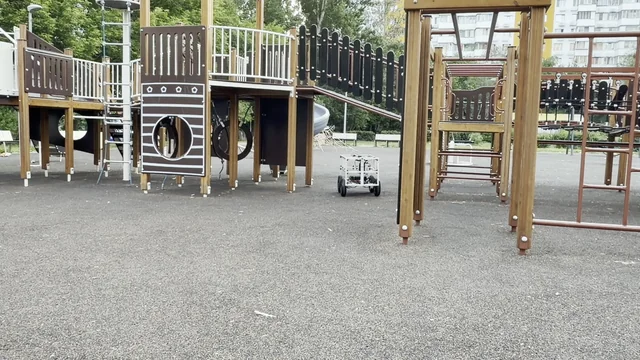
First real drive outside. Before this it only ran on the bench. Build: four 10.5" hoverboard hub motors, 2x ODrive (ODESC 3.6), Raspberry Pi 5, aluminium profile frame. Control is fully manual right now, from a laptop over 4G: live camera, per-motor telemetry, ARM / E-STOP. Main thing I learned: skid-steer turning depends heavily on surface grip, so that has to go into the control logic rather than being tuned by feel. Next step is autonomous A-to-B: 3D lidar, ODrive on CAN with closed-loop wheel control, ROS2/Nav2 for planning. Still early. Happy to answer anything about the build. submitted by /u/NiamorroMilky [link] [Kommentare]
 R
↗
R
↗
 R
↗
R
↗
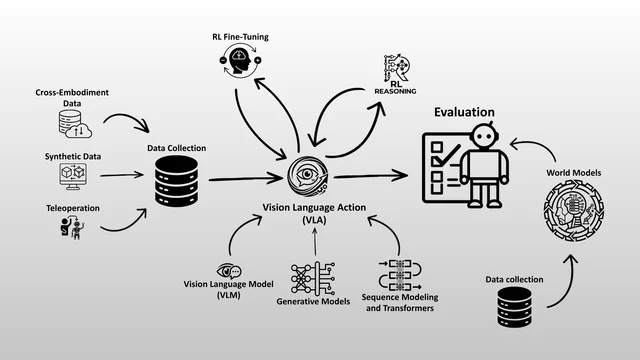
From data collection to sim-to-real deployment, I put together an 8-part breakdown covering the entire robot learning stack. It goes through teleoperation hardware, generative models for action generation, VLAs, world models, RL fine-tuning, and real-world evaluation, all grounded in the actual papers. Full series here submitted by /u/Tall_Ad_9781 [link] [Kommentare]
 R
↗
R
↗
 R
↗
R
↗
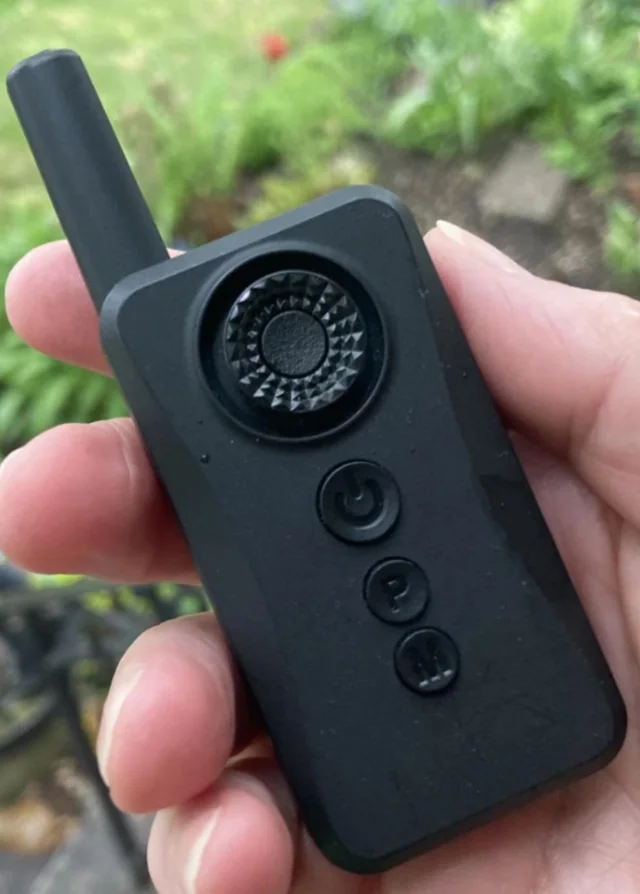
Hi, does anyone know how to pair the companion side remote for the Unitree Go2 pro. Have been looking everywhere and cant figure out how to pair my new companion remote to my robot. Any help much appreciated submitted by /u/GBC__ [link] [Kommentare]
R
↗
Bit of a long shot, but is there anyone here who actually worked on data collection for humanoid robots? I have a high level understanding of the process and required data, but don’t understand the details. I’m trying to figure out the real workflow, not just what’s described in papers. Looking for someone who’s done it in practice and wouldn’t mind answering a few questions. submitted by /u/Farseer_W [link] [Kommentare]
R
↗
 R
↗
R
↗
I posted about an earlier version of this project here a few years ago. I always wanted to continue it, but life happened: house, kids, work, and suddenly project time disappeared. The old version worked, but it was five-year-old code, so I did what most people think about doing when they look at old code - I started from scratch. The project is called Vanchor. It is a different kind of robot than what is usually posted here, but still a robot :) Vanchor is an open-source GPS anchor/autopilot system for smaller boats using cheap electric trolling motors. The target is small fishing boats, kayaks, and other small boats with trolling motors (focused on bow mounted currently). The idea is to turn a cheap trolling motor into a simple autonomous boat-control system. Main functions: Hold position, similar to spot-lock Hold heading Follow waypoints Follow a shoreline Follow a depth contour Move between fishing spots Work around an island or structure Drift or orbit around an area Follow APB data from a plotter Test behaviour in simulation before using real hardware It is not meant to replace OpenCPN, chartplotters, or proper marine navigation. It is more focused than that: small-boat control for fishing and DIY automation. The new version has among a lot other features: Python-based controller Local web UI for phone/tablet use Simulator based on Fossen’s 3-DOF marine craft model GPS/IMU hardware support Driver system for custom hardware Location and heading from phone sensors through the PWA app, where supported Depth contours Catch logging GPX waypoint import Several fishing-focused control modes Early PCB designs Early 3D-printable servo/control models One thing I wanted to fix from the old version was the wiring. The boat setup quickly turned into a crow’s nest of wires, and debugging loose connections in a boat is not fun. Especially when you just want to catch some perch. So this version also has early PCB designs for a cleaner setup, plus 3D-printable servo/control models. The simulator is one of the more useful parts right now. It makes it possible to test control behaviour without having the boat, water, GPS, IMU, and motor driver available at the same time. The project is still early, but it is now at the point where outside feedback would be useful. Any feedback is appreciated. Especially feedback on the PCB. It looks fine when I inspect it, but it has been years since I designed my own, much simpler, PCB. And yes, even the 3D models and PCB designs were created with Fable. Without it, I would never have found the time to pull this together. So far, I am quite impressed by it. https://preview.redd.it/5u1eld6qlwbh1.png?width=3708&format=png&auto=webp&s=daa0ec1e2f3685177b538af5c972931e268b6c0a Repos: Main project: https://github.com/AlexAsplund/vanchor PCB designs: https://github.com/AlexAsplund/vanchor-pcb CAD models: https://github.com/AlexAsplund/vanchor-cad submitted by /u/aasplunds [link] [Kommentare]
 R
↗
R
↗
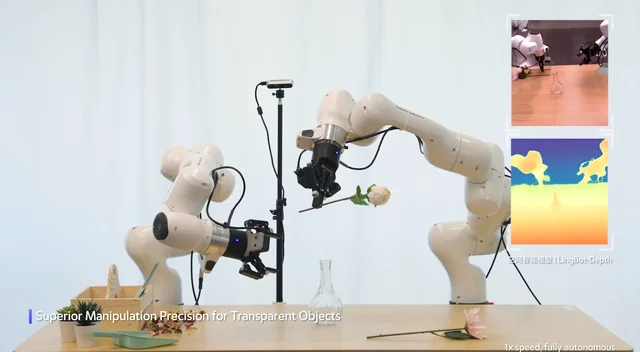
The clip shows a dual-arm rig autonomously arranging flowers into a glass vase at 1x speed, fully autonomous, with three simultaneous camera angles in the corners so the full workspace is visible. Robbyant has released LingBot-VLA 2.0, a VLA model trained on roughly 60,000 hours split as 50,000 hours of real-robot data across 20 embodiments plus 10,000 hours of egocentric human video. The action space covers whole-body control to include head, waist, mobile base, and dexterous hands up to Unitree G1 and Fourier GR-2. On the authors' own GM-100 eval, where pi-0.5 and GR00T figures are also self-reported, Agilex Cobot Magic reaches 34.4% success and Galaxea R1 Pro 15.6%, with several tasks at 0%. The paper notes the model often makes partial progress then fumbles final precise placement or release, and OOD performance degrades sharply. Relative joint actions increased average success from 33.7% to 55.0% in ablations. submitted by /u/Feeling_Till_7418 [link] [Kommentare]
 R
↗
R
↗
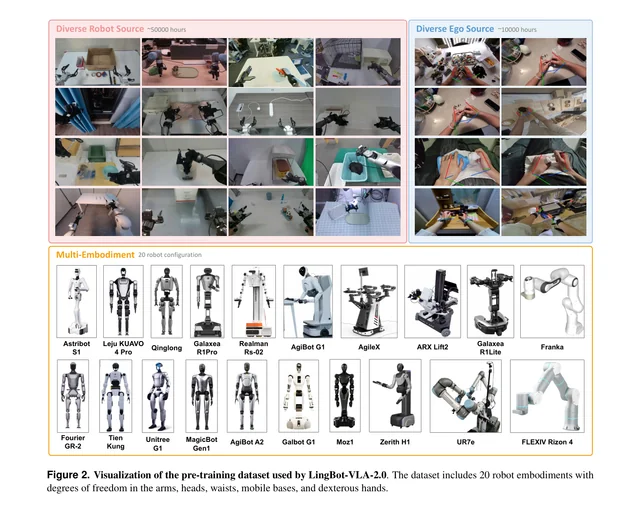
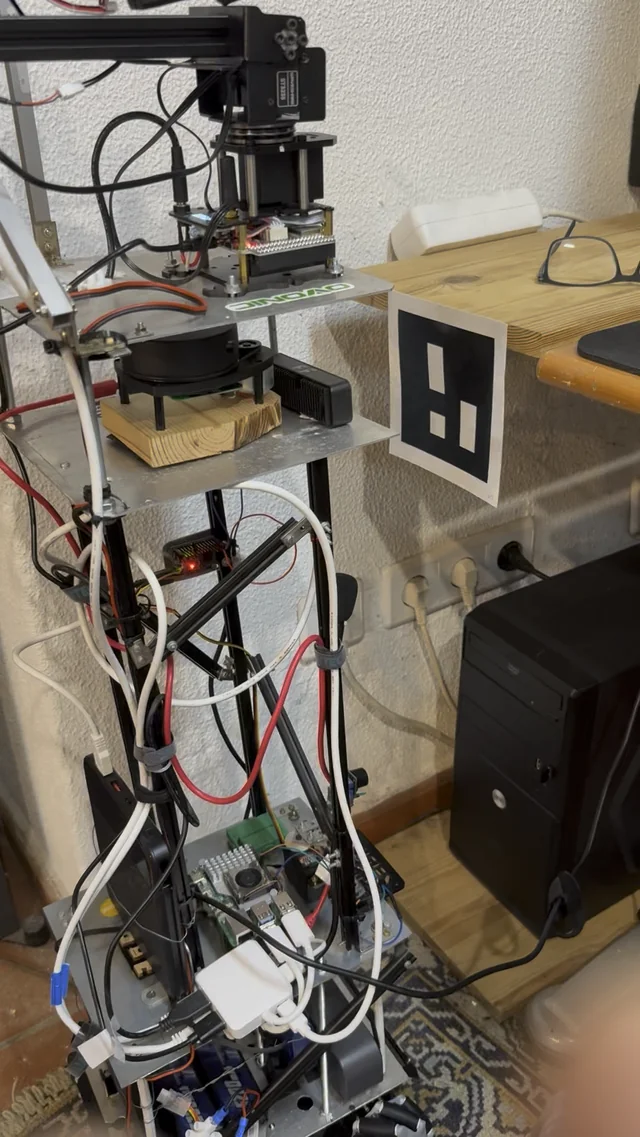
Robbyant released LingBot-VLA 2.0, a single model driving 20 embodiments from single-arm Franka and dual-arm UR7e up to full humanoids like Unitree G1 and Fourier GR-2. The action space also covers head, waist, mobile base, and dexterous hands, not only dual-arm manipulation. Training data is roughly 50,000 hours of real-robot trajectories across those 20 configs plus 10,000 hours of egocentric human video, filtered and reconstructed. The ablations on 4 GM-100 real-robot tasks show a clean result: relative joint actions over absolute lifted average success from 33.7% to 55.0%, with relative joint positions cutting the action standard deviation to roughly a third of absolute (about 0.28 vs 0.80). On its own GM-100 generalist eval, Robbyant self-reports higher progress and success than pi-0.5 and GR00T N1.7. Absolute success remains low: 34.4% on Agilex and 15.6% on Galaxea, with several tasks at 0%. The paper itself notes the model often makes partial progress then fails at the final precise placement or release. OOD performance degrades sharply. submitted by /u/deepmoss47 [link] [Kommentare]
 R
↗
R
↗
And it came to being. It now is a LLM with short and long time memory running on a llama server. Along with the existing autonomy on moving around the house and moving stuff. submitted by /u/Additional-Buy2589 [link] [Kommentare]
 R
↗
R
↗
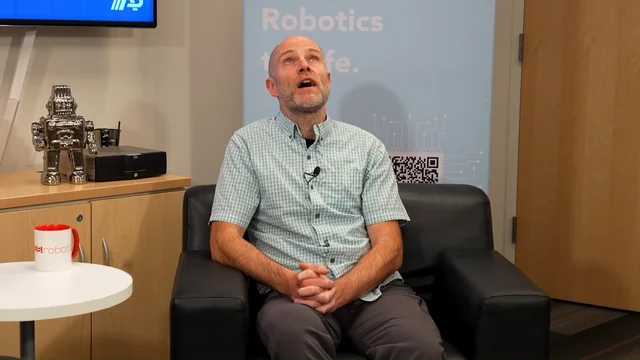
Russ Tedrake says the current robotics boom is not just about one technical breakthrough. The difference now is that several things are happening at the same time: AI progress, more talent entering the field, more investment, better supply chains and a growing need for automation in the real world. Robotics has had hype cycles before. Tedrake’s point is that this one has more than hype behind it. The question is still whether the field can execute, but the pieces are lining up in a way they have not before. submitted by /u/Responsible-Grass452 [link] [Kommentare]
 R
↗
R
↗
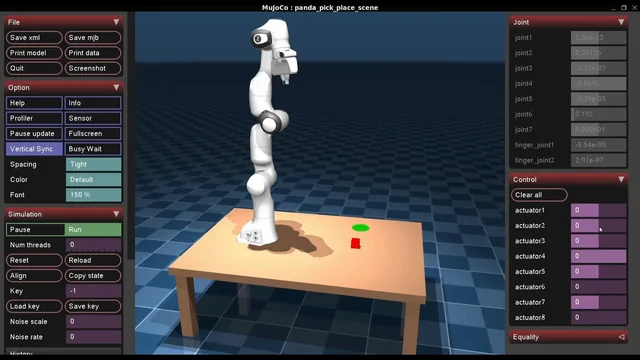
Tried creating same pick and place simulation with a few different models. The recurring pain point was resolving XML issues after the initial generation. Gave Drift a try for the same task. I spent more time iterating on the scene itself instead of chasing configuration errors. If anyone is looking for the exact prompt I used: Create a MuJoCo scene using a Franka Panda arm, place it on a table and a cube in front of it with a target pad. submitted by /u/AxBodiSpray [link] [Kommentare]
 R
↗
R
↗
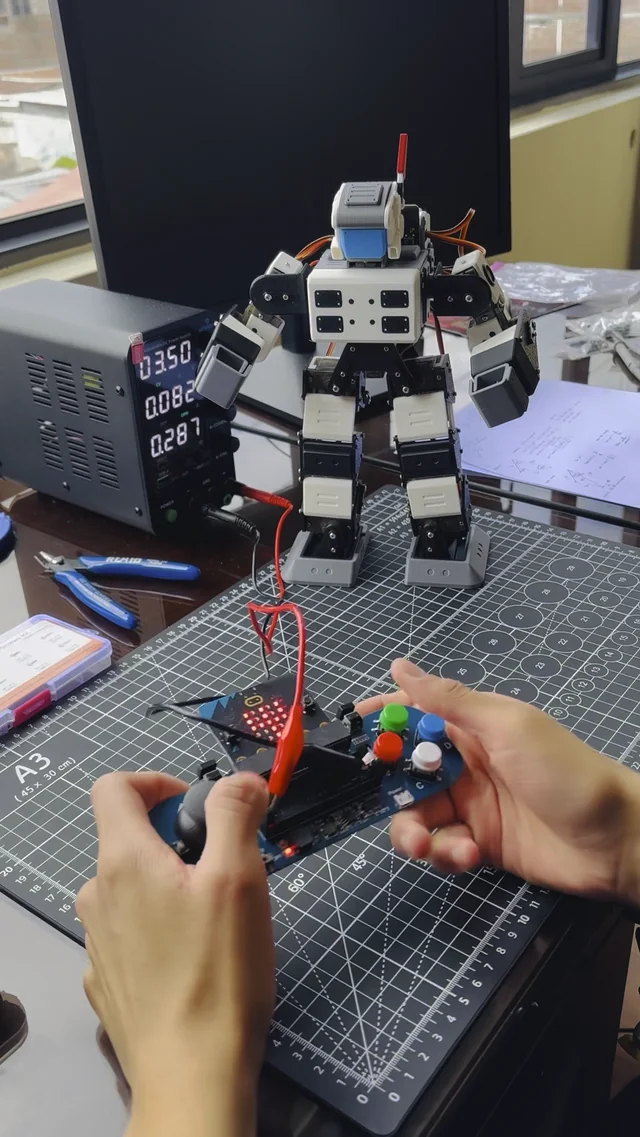
I recently designed and built this humanoid robot using low-cost servos. Over the past few days, I’ve been working on the inverse kinematics and programming its first walking motions. At the moment, I’m using a remote controller to send X, Y, and Z position commands, allowing the robot to shift its weight and move its legs forward and backward while walking in place. I’m still fine-tuning parts of the code, but I’m really happy with the progress so far, and it’s starting to come together nicely. submitted by /u/RoboDIYer [link] [Kommentare]
 R
↗
R
↗
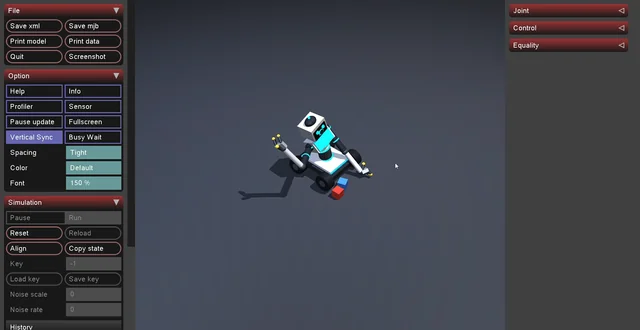
Hey everyone, I've been building CARL, an embodied virtual primate scout in MuJoCo. He has a 28-DOF body, 3-fingered hands, and is controlled by a multi-tiered biologically-inspired cognitive architecture. The codebase is fully open-source, but it is far from perfect. We are looking for help, critiques, and design upgrades on absolutely everything: 🛠️ 1. Physical Design & Body Upgrades (Morphology/Hardware) - Suggestions for better hand/gripper layouts (should we go to 5-fingers or use compliant pads?). - Better limb length proportions to maximize reach and avoid joint locking. - Optimal positioning of LiDAR, camera sensors, and tactile grids. - Bipedal chassis balancing and layout suggestions. 🎮 2. Control Loops & Trajectories (Robotics/Controls) - Smother arm trajectory models to fix our sudden joint-angle jumps and snapping. - Calibrating physics contact constraints in MuJoCo to stop fingertip clipping. - Alternatives to our current Damped Least Squares IK solver. 🧠 3. Cognitive Architecture & AI Models (Deep Learning/RL) - Optimizing our PPO actor-critic network and Liquid Time-Constant (LTC) arm policy. - Better reward shaping to speed up learning convergence (currently too slow!). - Improving how our high-level emotional drives (dopamine, cortisol) link down to motor execution. We are completely open to any feedback, design overhauls, or code contributions. Take a look at the repo and tell us what you would change! * GitHub Link: https://github.com/Manassadashiv/carl-simulation * Honest breakdown of our struggles: https://github.com/Manassadashiv/carl-simulation/blob/main/CONTRIBUTING.md submitted by /u/Manas_Sadashiv [link] [Kommentare]