 R
↗
R
↗
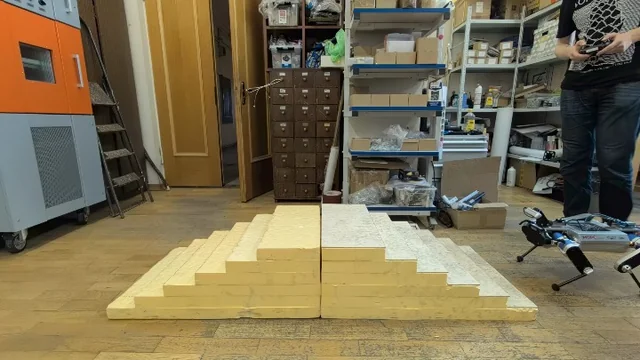
I’m continuing to improve the locomotion algorithm for my quadruped robot. The current control stack uses MPC and WBC for body posture and motion control. Footholds are selected based on a height map built from depth camera data In this experiment, the robot successfully climbs stairs with a step height of 5 cm and a tread depth of 12 cm. Here is the GitHub repository of the project. submitted by /u/yoggi56 [link] [Kommentare]
R
↗
Over the past few years, humanoid robots have attracted a lot of attention. However, I have been noticing another interesting trend: service robots are already creating practical value in real business environments. In restaurants, hotels, warehouses, and commercial spaces, robots with clear tasks seem to have a faster path to deployment. Examples include: - Delivery robots reducing repetitive labor - Cleaning robots improving operational efficiency - Warehouse robots optimizing internal logistics The challenge is no longer only about robot intelligence. Real adoption also depends on: - Reliability ; - Maintenance - Cost efficiency - Integration with existing workflows I am curious about the community's opinion: Do you think the next major growth wave will come from humanoid robots, or from specialized robots designed for specific business scenarios? submitted by /u/Jane-Tannai [link] [Kommentare]
 R
↗
R
↗
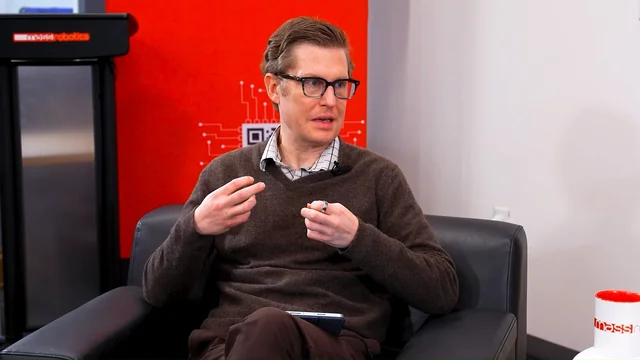
MIT professor Yoel Fink talks about why tech companies often end up building similar products. He points to glasses, headsets and watches as examples of companies moving in the same direction. His argument is that this kind of pattern can cause teams to miss other paths. For smart fabrics, Fink says the starting point should be the fact that humans already wear fibers every day. Clothing is already accepted on the body in a way that metal, glass and rigid devices are not. That makes fibers a practical place to explore sensors, computing and human-machine interfaces. submitted by /u/Responsible-Grass452 [link] [Kommentare]
R
↗
Leading with the number that matters most if you're deciding whether to bother: on refrigerator-sorting, success goes from 60.0% in-domain to 13.3% out of distribution (robot pose perturbed ±10cm, previously-unseen objects swapped in). The other soft spot is long horizon, where the policy makes real partial progress and then misses the final precise placement. I'm putting that first because the release reel is slick and I'd rather calibrate before the demos do it for me. With that framing, here's what Robbyant open-sourced: LingBot-VLA 2.0 (Robbyant is an embodied AI company under Ant Group). The design bet is a unified whole-body action space. Everything maps to one 55-dim canonical action vector (arm joints, end-effector, gripper, a 12-dim dexterous hand, waist, head, mobile base), and a single policy is jointly trained across 20 embodiments, from an 8-DoF single arm up to a 32-DoF humanoid, on about 60,000 hours (roughly 50,000 h robot trajectories and 10,000 h egocentric human video). The action head is a MoE expert (loss-free token-level routing, DeepSeek-V3 style) with dual-query distillation from a depth teacher (LingBot-Depth) and a causal video teacher (DINO-Video, released too, which edges out DINOv3 and V-JEPA 2 on 3 of 4 LARYBench metrics). The one practitioner takeaway from their ablations I'd actually act on: the biggest single lever was representation, not architecture. Absolute to relative joint actions moved average success from 33.7 to 55.0 (+21.3), a larger swing than any model change they tested. Videos, matter-of-factly: a multi-embodiment grid (multiple robots, different tasks, at once), an 8-minute continuous autonomous run, transparent glass-vase flower arranging with a live depth window, and a contact-rich zipper pouch. Dual-arm real hardware, watermarked 1x speed and autonomous. It's a release reel, so no claim of zero cherry-picking, weight the failure cases above accordingly. One catch worth surfacing so nobody has to dig for it: GM-100 ("The Great March 100") is their own bimanual benchmark, from Yong-Lu Li's RHOS lab at SJTU with Robbyant and co-authored by the project lead. Not independent. Generalist scores (progress / success): Agilex Cobot Magic 66.2 / 34.4, Galaxea R1 Pro 34.6 / 15.6, ahead of GR00T N1.7, pi-0.5, and their own 1.0. Note success sits far under progress (Galaxea overall 15.6%, some tasks 0%). If you run a bimanual setup, the weights and code are open under the Robbyant org on GitHub and HuggingFace, so pulling them and breaking them on your own robots is the real test here. Independent numbers would be worth more than the self-reported ones. submitted by /u/Good-Razzmatazz-6179 [link] [Kommentare]
 R
↗
R
↗
It's underappreciated how close to perfect the performance of a robot needs to be to be profitable, and getting there takes an enormous amount of experimentation across data, hardware, and machine learning. In CV or LLMs, the same test set can be used forever. However in robotics, each test needs to be manually reset and evaluated for success. This does not scale, especially when success is measured as the difference between 98% and 99% success. Here's what that scaling problem costs in practice. Measuring a policy at 90%+ level with any confidence takes 40-50 rollouts per checkpoint (
 R
↗
R
↗
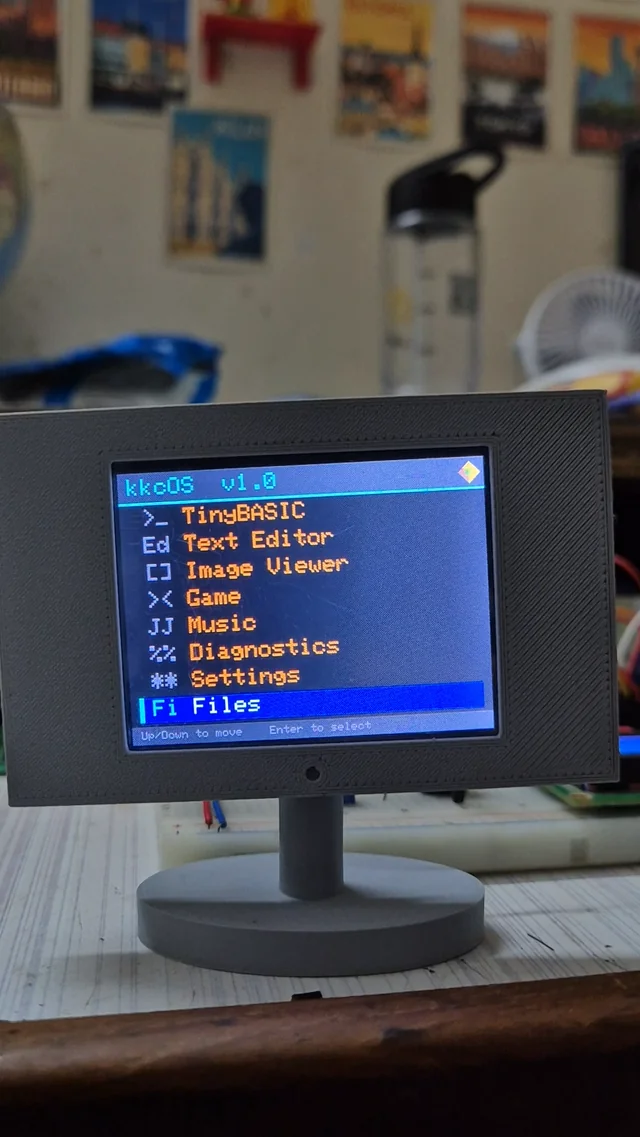
I made this homebrew computer with 1284p and VGA interface (currently on a TFT). Here I showcase the software part where I made a file storage system on its EEPROM. submitted by /u/Grand-Station-6886 [link] [Kommentare]
 R
↗
R
↗
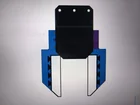
Hi everyone, I'm currently working on my bachelor's thesis, where I'm designing a modular hybrid robotic gripper. The idea is to combine: A rigid PLA backbone that transmits gripping force. A replaceable TPU insert attached using a dovetail. A compliant contact pad that deforms locally to conform to different object shapes. Unlike a Fin Ray finger, I don't want the whole finger to bend. I only want the contact pad itself to compress , almost like a soft mattress, while the rigid backbone continues transmitting the gripping force. My challenge is choosing the internal structure of the TPU pad. I've already tried: Vertical pillars (1 mm thick, initially 9, then reduced to 5). These turned out much stiffer than expected. In FEA, almost all the stress concentrated at the pillar joints and the contact surface barely moved. A completely hollow pad, which deformed very easily, but I'm concerned it may become too compliant and reduce force transmission. So I'm looking for an internal structure that provides controlled local compliance: The contact surface should deform under load Deformation should be distributed rather than localized. The rigid backbone should still transmit most of the gripping force. It should be printable with FDM using TPU. It should also be practical to model in FEA. My questions are: Is there a known lattice or compliant structure commonly used for this type of application? Should I be thinking in terms of lattice geometry, thickness, relative density, or something else entirely? Are there any compliant mechanism patterns (diamond, X-lattice, zig-zag, auxetic, etc.) that are known to behave like a compressible contact pad? If you've designed soft robotic fingers or compliant structures before, what worked well and what should I avoid? I'd really appreciate any advice, papers, or examples. I'm trying to make design decisions that I can justify academically rather than simply saying "this one seemed to work." submitted by /u/ghanoushi [link] [Kommentare]
 R
↗
R
↗
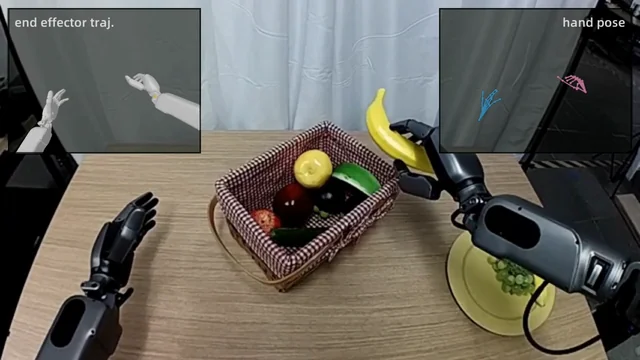
Fully generated by an open video model called LingBot-Video, from Robbyant, an embodied AI company under Ant Group. The only inputs are the hand-pose and end-effector-trajectory panels in the corners, everything else is predicted. Curious what this sub makes of it: are rollouts like this good enough to evaluate or plan real manipulation policies, or does the sim-to-real gap still kill it? submitted by /u/StillThese3747 [link] [Kommentare]
 R
↗
R
↗
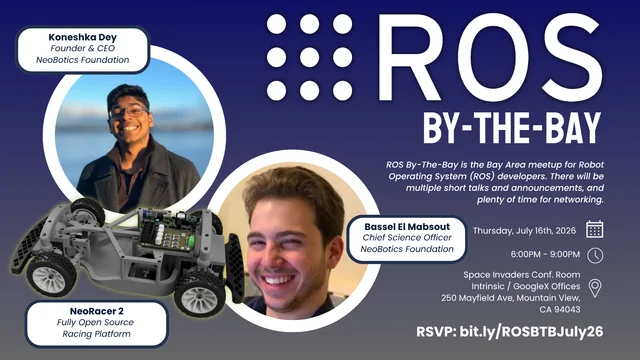
Date: Thursday, July 16th, 2026 Time: 6-9pm Location: 250 Mayfield Ave Mountain View. RSVP Here submitted by /u/OpenRobotics [link] [Kommentare]
 R
↗
R
↗
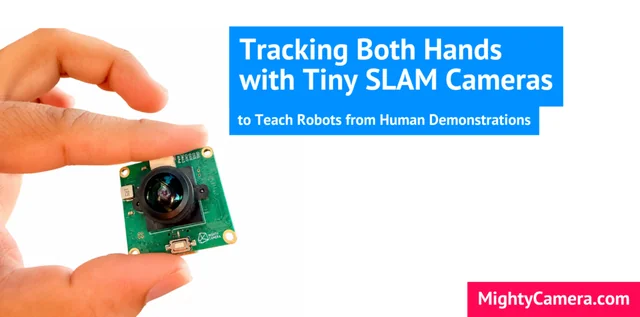
I am working on Mighty Camera. This is a VIO/SLAM module that also natively supports multi-camera setups. Here is a demo of tracking both hands and also putting them in same 3d space. (Yes it can detect and localize on AprilTags ON-DEVICE). Each arm running VIO on-device independently. This is useful for recording data for robotics that is enriched with arm/hand/head pose info. submitted by /u/twokiloballs [link] [Kommentare]
R
↗
Hello everyone whats the customs situation for getting a robotic arm into india( cost is around 12,000 dollars) 13-14 lakhs INR please let me know your experience with things like the additional duties, how the process is etc i checked the hs code calculator but wanted to know from people/companies who have bought these arms. submitted by /u/optimusprime1001 [link] [Kommentare]