
Channel
c/robotics
No description.
Owner @master · 601 posts · 1 joined · Status active · Posting permission: Every logged-in user can post
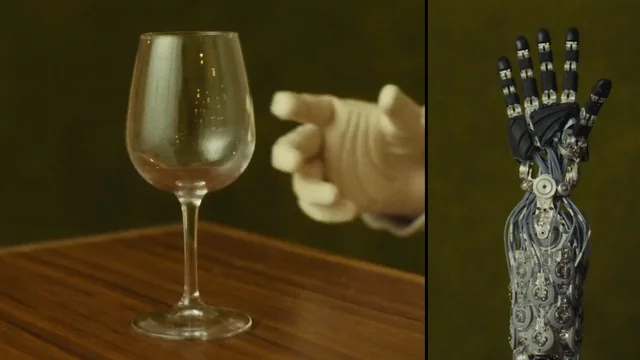
For aesthetic reasons, robots are typically equipped with outer casings around their core components. Could the degrees of freedom of a bare robot be compromised in terms of performance due to design constraints? Is that why the demonstration robot in the example uses rubber gloves as its outer casing? Is this a better choice? submitted by /u/D1n0saurMecha [link] [Kommentare]
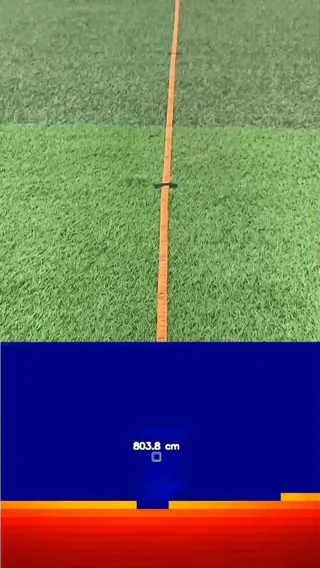
I've noticed that more robotics projects seem to be talking about first-person (egocentric) video instead of regular camera footage. At first I assumed video is just video, but now I'm wondering if the viewpoint actually makes a big difference. For example, a first-person view naturally captures things like: where the hands are moving how objects are being manipulated what the operator is paying attention to the exact sequence of actions Does that make it significantly better for training robots, or is it mainly useful for specific tasks like manipulation? Would love to hear from anyone working in robotics or embodied AI. Is first-person data becoming the new standard, or are third-person datasets still enough for most applications? submitted by /u/RoofProper328 [link] [Kommentare]
I’m trying to build a model evaluation platform and wanted to see which ones I should evaluate first. Any resources on this would be helpful. submitted by /u/No-Bad-583 [link] [Kommentare]
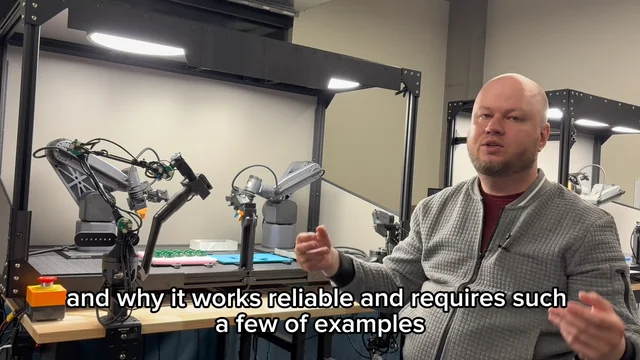
Hi! My team and I are trying to make it easier to program our assembly robot. We think current approaches with large AI models are going in the wrong direction, making robots unreliable and turning them into black boxes. From our point of view, AI should help program the robot, not control it directly. The problem is that there is no convenient language for programming complex movements. So instead, we fill a large lookup table (dataset) at 30 fps while the robot is controlled through teleoperation. AI acts just as the glue between these examples and fills in the gaps without adding new knowledge. This makes the model reliable, predictable, and debuggable, like code. And as I showed in the video, it took me 5 minutes to set up tray picking with randomness. What do you think about this approach? submitted by /u/Wing-Realistic [link] [Kommentare]
We've been building Sowbot (aka the Feldfreund devkit), an open-source ROS 2 Jazzy stack for small-scale agricultural robotics: RTK-GNSS localisation (dual F9P moving base), LCAS topological navigation on top of Nav2, and a NiceGUI web cockpit for mission planning — draw the field corners, it generates row coverage via Fields2Cover. Just got multi-row mission following working end-to-end in Gazebo: the robot sequences entry/exit points across a full field of rows on its own, no manual nudge between rows. Video: https://www.youtube.com/watch?v=A0CVNcp19vU Just simulation for now, not a field result. It moves navigation and the sim step forward on our roadmap — hardware field validation is next, and we're not claiming a finished product. Stack, if useful to anyone: Two-SBC split — Limbic (ESP32 firmware, sensor fusion, localisation) and Neo (perception) ESP32 running https://lizard.dev/ Containerised via Docker, full build/sim modes Fields2Cover for coverage planning Visual crop-row following (ExG + Otsu threshold) as a Nav2 action server for in-row traversal Stock Nav2 (Regulated Pure Pursuit) for headland turns between rows Built on Zauberzeug's Field Friend as a base, developed with Agroecology Lab (UK) and caatingarobotics (Brazil) Apsitech (India) navigation stack from LCAS's Agri-OpenCore ecosystem. Fully open source. Repo: https://github.com/Agroecology-Lab/feldfreund_devkit_ros WIP Reference hardware: https://sowbot.co.uk Happy to answer questions on the nav stack, sim setup, or anything else. PRs or collaboration welcome if this is your area. submitted by /u/Sabrees [link] [Kommentare]

Built this DIY RV reducer right in my room! 🔧🏠 Designed, 3D printed, assembled, and tested from scratch. Every print, adjustment, and iteration brought me one step closer to a smoother and more reliable gearbox. submitted by /u/Personal-Wear1442 [link] [Kommentare]

Trying to separate demo-reel hype from actual capability. Every few weeks a new humanoid video goes viral, but polished demos and deployed systems are very different things. submitted by /u/futurewilltell [link] [Kommentare]
Does anybody here have the files or can create an 3d printable 3dof stewart platform powered by 3 sg90 micro servo motors and run by an arduino? While I am currently studying to be a robotics engineer, I have only completed one year and do not have the knowledge to design, built, nor program a platform. I've looked online but all of the ones I found are too complex and/or require a lot of components. I did find one however, the design had the arms and the top platform be one large print, which made it difficult to print on my 3d printer. It also had extra designs on it just for decoration, which would be a waste of filament. I just want a small simple one that the arms, top platform, and bottom platform can all be printed separately. It just needs to be big enough to fit a lego speed champions car, while also just being powered by the micro servos and run by an arduino uno. submitted by /u/Ok_Bus_3393 [link] [Kommentare]
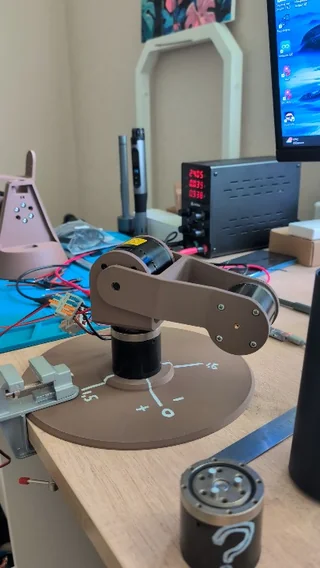
Hi everyone! I recently decided to dive into animatronics and started building an open-source robotic desk lamp inspired by expressive animated lamps from Pixar. This is still a very early mechanical prototype. Right now only the base and the first joint move, and I'm designing the rest of the arm. I'm looking for advice on one of the biggest design challenges: how would you route the cables through the moving joints while keeping them hidden and minimizing stress on them? If you've built articulated robots or mechanisms before, I'd really appreciate any examples, photos, or resources. I'd also love to hear your ideas for useful features. My current plan is to eventually add a depth camera so the lamp can understand its surroundings and interact with people. As a fun long-term challenge, I'd even like to see if I can teach it to jump or move around on its own. Any suggestions or criticism are very welcome! submitted by /u/Ok_Stress3654 [link] [Kommentare]
Like the title says. I know there’s an immense amount of lateral force that comes with milling through metal, so if you tried to do it with a robotic manipulator, it would probably have to be massive and heavy to handle the chatter. But I'm still curious if anyone knows a rigid arm like this. submitted by /u/spirit_vortex_ [link] [Kommentare]
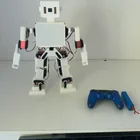
Hello, my name is Noah , I’m 14 years old and I’ve been building this humanoid robot from scratch. I designed the parts in CAD, 3D printed them, assembled the servos, and now I’m working on the software and walking algorithms/ gaits . It’s powered by a Raspberry Pi and uses multiple servo motors for its joints. There’s still plenty to improve, but seeing it come together has been really rewarding. I have posted it on TikTok and Instagram under the name of NoahisRobotix , but have not been that successful so far.. I’d love to hear what you think or answer any questions! submitted by /u/Equivalent_Ask_1156 [link] [Kommentare]